
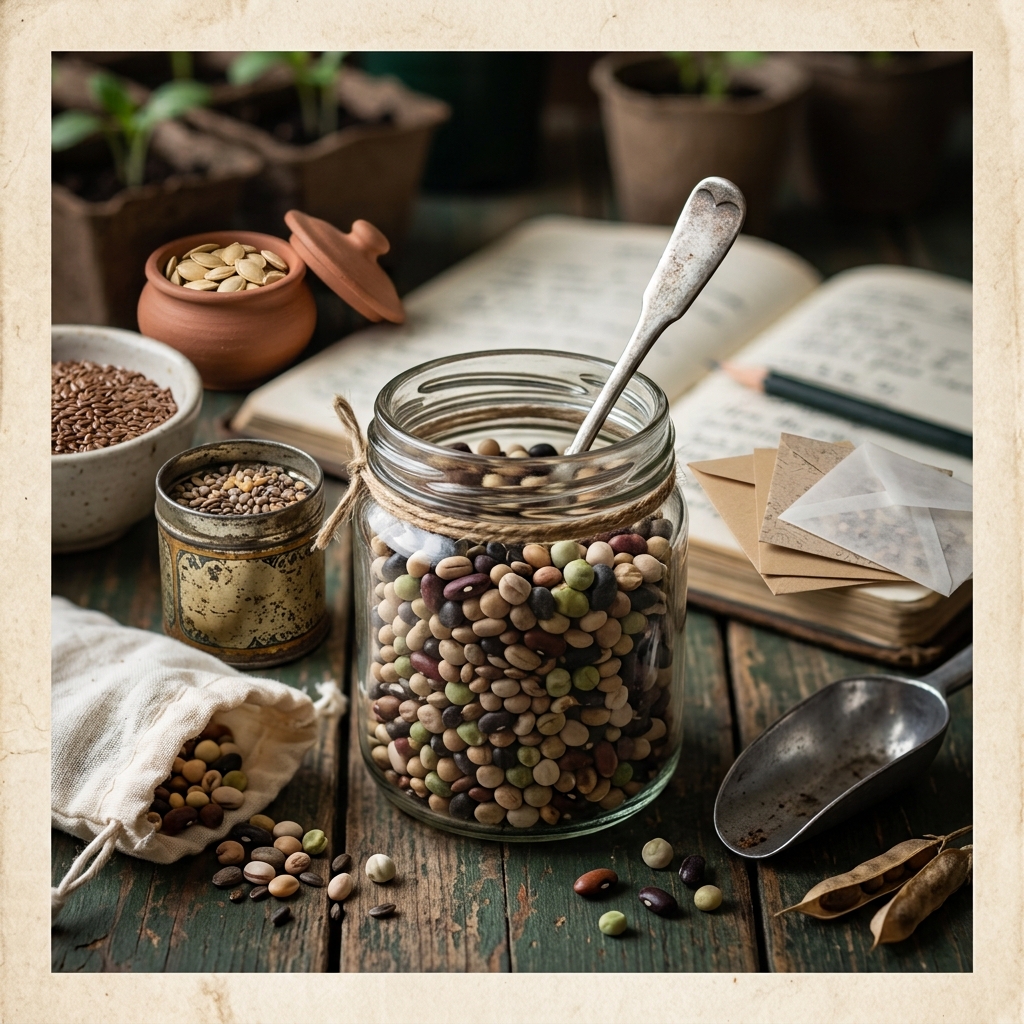
If you want to save seed this year, start with beans, peas, and tomatoes. Skip the squash. Skip the melons. Those three pollinate themselves, so the seed you collect in September grows into roughly the plant you grew this summer, and you can prove that to yourself in one season instead of guessing for three.
Check one thing first: did the plant come from hybrid seed? A packet marked F1 gives you a first generation that performs and a second that scatters. Save from an F1 tomato and you get tomatoes. Just not the tomato you grew. Open-pollinated and heirloom varieties come true, which is why the old varieties stayed in circulation long enough to get names. If the packet is gone and you can’t remember, save the seed anyway and treat next spring as the test.
Which plant to take it from
Take seed from the plant you would want ten more of, not from whatever is left standing at the end of the row. The tomato that ripened first and kept going. The bean that carried a heavy set without mildew climbing it. Seed carries what the parent had, so a plant chosen out of convenience pulls your whole garden toward the middle.
Mark it while it is still obvious. Tie flagging tape or an old shoelace on the plant in July, when you can see which one is performing. By the time the pods are brown, every plant in the row looks the same.
Beans and peas
Beans are the easiest seed on the place to save. They fertilize themselves before the flower even opens. West Virginia Extension puts the separation between bean varieties at roughly 15 feet, which most gardens handle by putting the two trellises at opposite ends.
The rest is waiting. Leave the pods on the plant well past the point where you would pick them to eat, up to a month past, according to UC Marin Master Gardeners. You want brown, dry, brittle pods, seeds rattling inside, hard as rocks when you press one. Strip the pods, spread them somewhere dry indoors, and give them at least two weeks before you shell anything.
You can also leave the seeds in the pods until planting time. Less handling, and less chance of a seed picking up moisture during a humid week in October.
Tomatoes
Tomato seed comes wrapped in a gel coat that keeps it from sprouting inside the fruit. Fermenting strips it off. Squeeze the seed and pulp of a fully ripe tomato into a jar, add a splash of water, and leave it on the counter for three to five days. Warm rooms work faster than cool ones, so August ferments quicker than late September does.
You will know it is finished by looking at it. Fruition Seeds describes three layers: dense mature seed on the bottom, light immature seed and pulp floating on top, mostly clear water between them. Pour off the top. Rinse what sank.
Dry the seed in a single layer on a screen or paper towel, somewhere between 70 and 90 degrees, with air moving on all sides. A week is the minimum. The dryness test is a pair of tweezers: squeeze a seed, and it is ready if it breaks. If it bends, it needs longer.
Tomato isolation runs wider than beans, at 25 to 50 feet between varieties. Bumblebees will cross them if the plants sit close enough together.
What to leave alone this year
Squash, pumpkins, and melons carry separate male and female flowers, and insects move pollen between them all summer. Save seed from a zucchini growing twenty feet from a butternut and you get a squash nobody ordered. WVU’s advice is blunt: pick one variety of watermelon, cantaloupe, or winter squash if you plan to save from it, and grow nothing else in that family.
Carrots, beets, onions, and most of the brassicas are biennials. They set no seed until their second year, which means overwintering the root or the whole plant before there is anything to collect. Doable. It is also a second winter of storage space and a second spring of bed space spent on a crop you will not eat, which is a fair trade once you have one seed crop already working and a poor one before that.
Storing what you collect
Cold, dry, and sealed. A screw-top jar or a zip bag in the refrigerator keeps humidity from swinging, and Illinois Extension calls the fridge or freezer the practical answer for home storage. Label as you go, variety and year. Seed you cannot identify in March is seed you will not plant.
How long it lasts depends on the chart you read. The charts disagree. Illinois Extension gives beans one year and tomatoes two under average storage. UC Marin Master Gardeners puts pea and bean seed at up to three years when stored properly. Most of that gap is what “average” and “properly” mean. A paper envelope on a garage shelf swings through eighty-degree afternoons and whatever humidity walks in the door. A sealed jar at the back of the fridge does not.
Run your own germination test rather than trusting either number. Ten seeds on a damp paper towel, rolled up in a bag, checked after a week. Seven sprouts means you sow a little thicker next spring. Two means you buy a fresh packet, and you found that out in January instead of in May.