
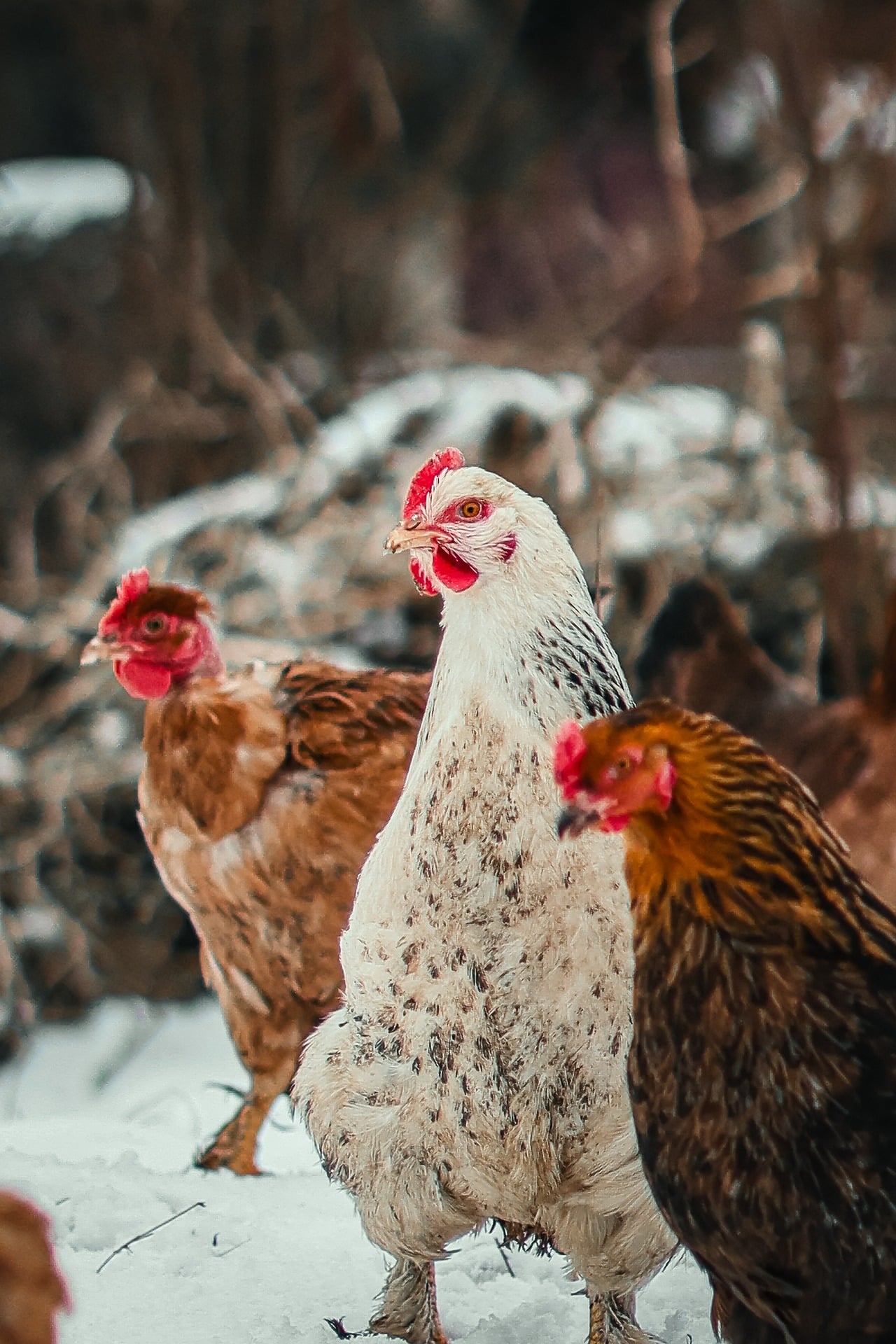
What hurts chickens in January is moisture, not cold. A bird in a sealed, warm, damp coop gets frostbitten. The same bird in a cold, dry, well-ventilated coop does not. That one fact rearranges most of the winter advice you will read.
eXtension states it directly: chickens “cannot tolerate being wet and cold.” The diagnostic is condensation. If there is water on the windows or on uninsulated walls in the morning, the coop is not moving enough air. University of Minnesota Extension comes at it from the other side and calls moisture control through airflow and manure management the critical lever on frostbite.
Ventilation is not a draft
Two different things, and the difference is mostly height. Oregon State Extension puts it as a design goal: adequate air exchange without creating drafts across the birds. Openings go high, at the roof or the eave. Pair them with a window you can crack partway. Illinois Extension describes that exact combination. Penn State adds two details worth having: site the openings on the side away from prevailing winds, and angle any inlets upward.
I went looking for a square-inches-of-vent-per-bird figure and there is not one. Not from Penn State, Oregon State, eXtension, Minnesota, Illinois, Maine, or Ohio State. The tidy ratios circulating online trace back to blogs and product pages, not to anybody who measured. Use the condensation test instead. It is free and it answers the question you actually have.
The heat argument, stated honestly
Extension services disagree here, and not in a small way. Minnesota Extension instructs owners to provide supplemental heat when the coop drops below 35°F, using radiant panels set at nest-box height or lower. New Hampshire Extension advises against heat outright: “The risk of a heat source causing a fire is too high with combustible bedding materials present.” eXtension says small-flock housing need not be heated. Ohio State names three hazards together, excess heat, carbon dioxide buildup, and fire.
Skip the heat. A coop full of dry straw with a lamp hanging in it is a structure fire waiting for one loose zip tie, and the birds do not need it if the ventilation is right.
One caution on how that argument usually gets made. The popular version says heated birds never acclimate and then die when the power fails. I could not find that claim in a single extension source. It might be true. It is not evidence, and it is weaker than the argument that actually is sourced, which is that heat lamps burn coops down.
Bedding
Go deep and leave it. Minnesota and New Hampshire both say 4 to 6 inches of straw or pine shavings. Illinois says 6 to 12. Anywhere in that band works. Stir it so droppings work down and add fresh material on top rather than shoveling out. eXtension says to postpone the full clean-out until spring, since the built-up layer insulates the floor.
What the extension literature does not say is that deep litter composts in place and warms the coop. That claim is everywhere online. It is not in Minnesota, Illinois, New Hampshire, Ohio State, or eXtension’s own litter-materials article, none of which give a carbon-nitrogen ratio, a moisture target, or a mechanism. Deep bedding insulates. Treat the rest as unproven.
On material, softwood shavings with pine preferred. Chop straw to an inch or less so it does not mat. Skip glossy paper, which will not absorb anything.
Light, if you want winter eggs
Fourteen hours total is the number most sources land on, though Penn State goes to 16 and Maine warns that past 17 or 18 hours production can actually drop. Add it in the morning, before sunrise, and let the natural sunset put the birds on the roost. Do it the other way, killing the lights at dusk, and you get hens standing in the dark on the floor because they never found the perch.
Maine gives the rule that matters more than the hour count: laying birds must never see day length decrease. A power outage over two days can trigger a molt that costs six weeks of eggs. Penn State says move the photoperiod by no more than an hour a week in either direction.
Bulbs stay small. Penn State caps them at 30 to 40 watts and notes hens need only half a foot-candle to respond. Maine sizes it at one 60-watt equivalent per 200 square feet, hung around 7 feet. Check the fixture for dust and make sure the birds cannot reach it, because a light is a fire source the same as a heater is.
Water and feed
Wisconsin Extension gives the ratio: about a quart of water per pound of feed. Illinois says birds need access at least every 10 hours, day and night, which in a hard freeze means either a heated base or two trips out. Ohio State recommends changing water twice a day and more often when it is cold, and warns that heated devices can malfunction and start a fire. Feed intake climbs too, up to 25% more in cold weather according to New Hampshire.
Frostbite and space
Single digits is where eXtension says frostbite becomes a real risk, on combs, wattles, and toes. Roosters get it most because their combs are largest, and among hens a big single comb like a leghorn’s is the vulnerable one. Pea and strawberry combs get it much less. Healing runs four to six weeks, and eXtension says not to rub the area, apply direct heat, or trim blackened tissue unless it is infected.
Petroleum jelly comes up constantly. It is not folklore, New Hampshire and Illinois both mention it, but eXtension subordinates it clearly: for mild freezing it helps, and coop management is the real key. Put your effort in the vents.
Space figures vary more than you would expect, from Penn State’s 1.5 square feet per laying hen to eXtension’s 3 to 4. Oregon State frames it in the way that matters for winter, when birds are shut in more: 3 square feet per bird with run access, 8 to 10 without. Roost space runs 6 to 12 inches per bird depending on who you ask.
Walk out some cold morning before the birds are up and put your hand on the wall. Dry wall, cold coop, healthy flock. Wet wall means you have work to do this weekend, and it is not the work you were planning.
Sources
- eXtension, Frostbite in Chickens
- University of Minnesota Extension, Caring for Chickens in Cold Weather
- UNH Extension, Backyard Chickens in Winter
- Ohio State University Extension, ANR-66
- Illinois Extension, Backyard Chickens in Winter
- Penn State Extension, Artificial Lighting for Winter Egg Production
- University of Maine Cooperative Extension, Bulletin #2227
- Oregon State University Extension, EC 1644
- University of Wisconsin Extension, Preparing for Winter