
Garlic goes in the ground after the first killing frost, not on a calendar date. University of Minnesota Extension puts the window at one to two weeks after that frost and adds that a warm autumn is not a reason to wait. That works out to late September in northern Minnesota and roughly mid-October in the southern half of the state. Penn State Extension gives mid- to late-October for Pennsylvania. Oregon State Extension stretches the window across September through November for the Pacific Northwest.
The frost anchor exists because of what the clove is doing underground. It needs enough warm soil left to push roots, and not enough to push a shoot above the surface before winter. Penn State states the goal in exactly those terms: early enough for a root system to develop, late enough to prevent shoot emergence. Too early, and the top growth that appears gets damaged. Too late, and South Dakota State Extension says the roots never establish, which is a failed crop rather than a weak one.
How deep is genuinely unsettled
The extension services do not agree, and the gap is not small. Penn State says 1 to 1.5 inches for most cultivars. South Dakota State says 4 to 6 inches, and says the extra depth is what prevents winter damage. Most of the rest land in between, with Minnesota, Cornell, and Utah State all giving 2 to 3 inches.
Depth does not track climate the way the common advice implies. Pennsylvania is milder than South Dakota, which is milder than northern Minnesota, and those three recommendations run 1 inch, 5 inches, and 2.5 inches in that order. What every source does agree on is mulch. That is the cold-climate answer, not depth.
Mulch, and whether it comes back off
Penn State calls for 2 to 4 inches of straw at planting. Minnesota says 3 to 4 inches of leaf or straw. South Dakota State says 6 to 8 inches, applied after the soil freezes rather than at planting. All three give the same reason, which is stopping frost heave, and the range is wide enough that anything from three to six inches has an extension service behind it.
Spring is where they split. Minnesota says pull the mulch once hard freezes are past so the soil can warm. Rutgers says take it off but leave enough to hold weeds down. Ohio State says rake it clear of the emerging plants and leave it sitting between the rows. Penn State prescribes mulch at planting and never mentions removing it.
Where the cloves came from matters more than the variety
The standard warning is that supermarket garlic will not grow. That is not the objection the extension services actually make. Ohio State and Cornell both point to sprout inhibitors. Minnesota notes that most of it is softneck of unknown regional adaptation. University of Maryland Extension gives the reason that carries real consequences: grocery garlic may be a symptomless disease carrier.
Two soil diseases are worth knowing about before a bulb of unknown origin goes into a bed. White rot sclerotia stay viable in soil for 15 years or more according to UMass Extension, and the University of Maine puts the outside figure at 40. Maine also supplies the number that makes it alarming. One sclerotium per 20 pounds of soil is enough to cause measurable crop loss. UMass states flatly that there is no way to clear white rot from ground where it has established, and Maine calls crop rotation of limited use against it.
Bloat nematode is the other one. Cornell’s Long Island Horticultural Research and Extension Center says it survives at least four years in soil, and that any bed where it turns up should stay out of alliums for five. Both arrive on planted cloves. Neither is visible on a grocery shelf.
Break the bulbs apart late
Illinois Extension says early separation of cloves has been shown to reduce mature bulb size at harvest. Minnesota narrows the window to one or two days before planting. Do not peel them. South Dakota State points out that a peeled clove sitting in wet soil is an open door for rot. Larger cloves produce larger bulbs, so the big ones go in the ground and the small ones go to the kitchen.
Nitrogen has a deadline
Minnesota Extension is blunt about this one. Avoid applying nitrogen after the first week in May. Penn State’s commercial schedule puts its last application around May 1 as well, and Penn State further recommends stopping irrigation after mid-June because late water encourages bulb disease. Feeding past that point pushes leaf growth at the moment the plant should be filling a bulb instead.
Scapes do less than the number you have heard
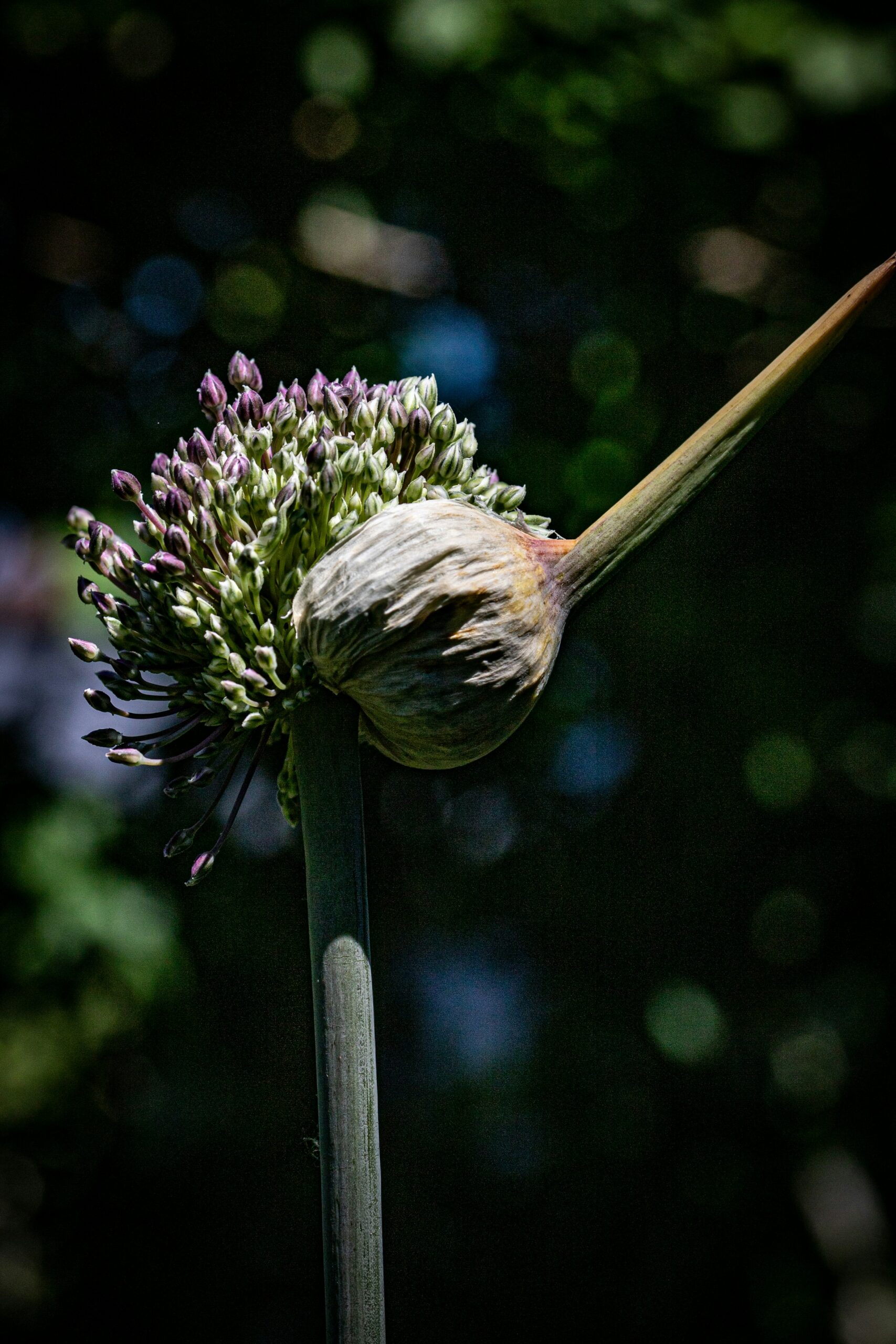
Hardneck garlic throws a flower stalk in late spring, and cutting it off is supposed to buy a bigger bulb. It does. The disagreement is over how much. The Government of Ontario, reporting trials by John Zandstra at the University of Guelph Ridgetown Campus, puts the gain from hand removal at 20 to 30 percent or more. University of Delaware Extension, summarizing a 2001 study by Rosen and Tong, reports about 15 percent on sandy soils and 5 percent on finer-textured ones.
Those are not the same claim, and the 30 percent version is the one that gets repeated. A gardener on heavy ground should plan for the low end of that range. Penn State says to cut the scape as soon as it is visible, while Minnesota times it to just after the scape starts curling, which is the point where the scape itself is still worth eating. Those two goals pull against each other. No source found reconciles them.
What it will actually keep
Hardneck garlic does not store for a year. Rutgers gives hardneck 2 to 4 months against 6 to 8 months for softneck. Cornell’s Small Farms Program drops the hardneck and softneck split altogether and goes by type, putting Rocambole at 3 to 4 months and Silverskin at over 12. Wisconsin Extension says hardneck types generally do not store well.
Storage temperature is its own argument. Penn State says 32 to 35°F at 65 to 75 percent humidity. Cornell Small Farms says 56 to 58°F and warns that below 50°F the bulbs risk sprouting. Both can be true, since the sprouting band sits between the two, but neither source says so. Anyone putting Music or German Extra Hardy in the ground this October should plan the kitchen around four months of garlic rather than twelve.
Sources
- University of Minnesota Extension, Growing garlic — https://extension.umn.edu/vegetables/growing-garlic
- University of Minnesota Extension, Last chance to plant garlic — https://extension.umn.edu/yard-and-garden-news/last-chance-plant-garlic
- Penn State Extension, Garlic Production — https://extension.psu.edu/garlic-production
- Oregon State University Extension, Fall is the best time to plant garlic — https://extension.oregonstate.edu/news/fall-best-time-plant-garlic-oregon
- South Dakota State University Extension, Planting Garlic — https://extension.sdstate.edu/planting-garlic
- Cornell CALS, Plan for Garlic in the Fall — https://cals.cornell.edu/school-integrative-plant-science/school-sections/horticulture-section/outreach-and-extension/pandemic-vegetable-gardening/pandemic-vegetable-gardening-2020-archive/plan-garlic-fall
- Utah State University Extension, Garlic in the Garden — https://extension.usu.edu/yardandgarden/research/garlic-in-the-garden
- Rutgers NJAES, Growing Garlic in the Home Garden (FS1233) — https://njaes.rutgers.edu/fs1233/
- Ohio State University Extension, Growing Garlic (HYG-1627) — https://ohioline.osu.edu/factsheet/hyg-1627
- University of Maryland Extension, Growing Garlic in a Home Garden — https://extension.umd.edu/resource/growing-garlic-home-garden
- UMass Extension Vegetable Program, Alliums, White Rot — https://www.umass.edu/agriculture-food-environment/vegetable/fact-sheets/alliums-white-rot
- University of Maine Cooperative Extension Bulletin #2062, White Rot of Allium — https://extension.umaine.edu/publications/2062e/
- Cornell University Long Island Horticultural Research and Extension Center, Bloat Nematode of Garlic — https://blogs.cornell.edu/livegpath/gallery/garlic/bloat-nematode-of-garlic/
- University of Illinois Extension, Fall Garlic Planting — https://extension.illinois.edu/blogs/garden-scoop/2021-10-09-fall-garlic-planting
- Government of Ontario, Benefits of removing the garlic scape — https://www.ontario.ca/page/benefits-removing-garlic-scape
- University of Delaware Cooperative Extension, Weekly Crop Update on garlic scape removal — https://sites.udel.edu/weeklycropupdate/?p=26378
- Cornell Small Farms Program, Secrets of Storing Garlic — https://smallfarms.cornell.edu/2020/07/secrets-of-storing-garlic
- University of Wisconsin Extension Master Gardener Program, Garlic — https://mastergardener.extension.wisc.edu/files/2016/01/Garlic.pdf