
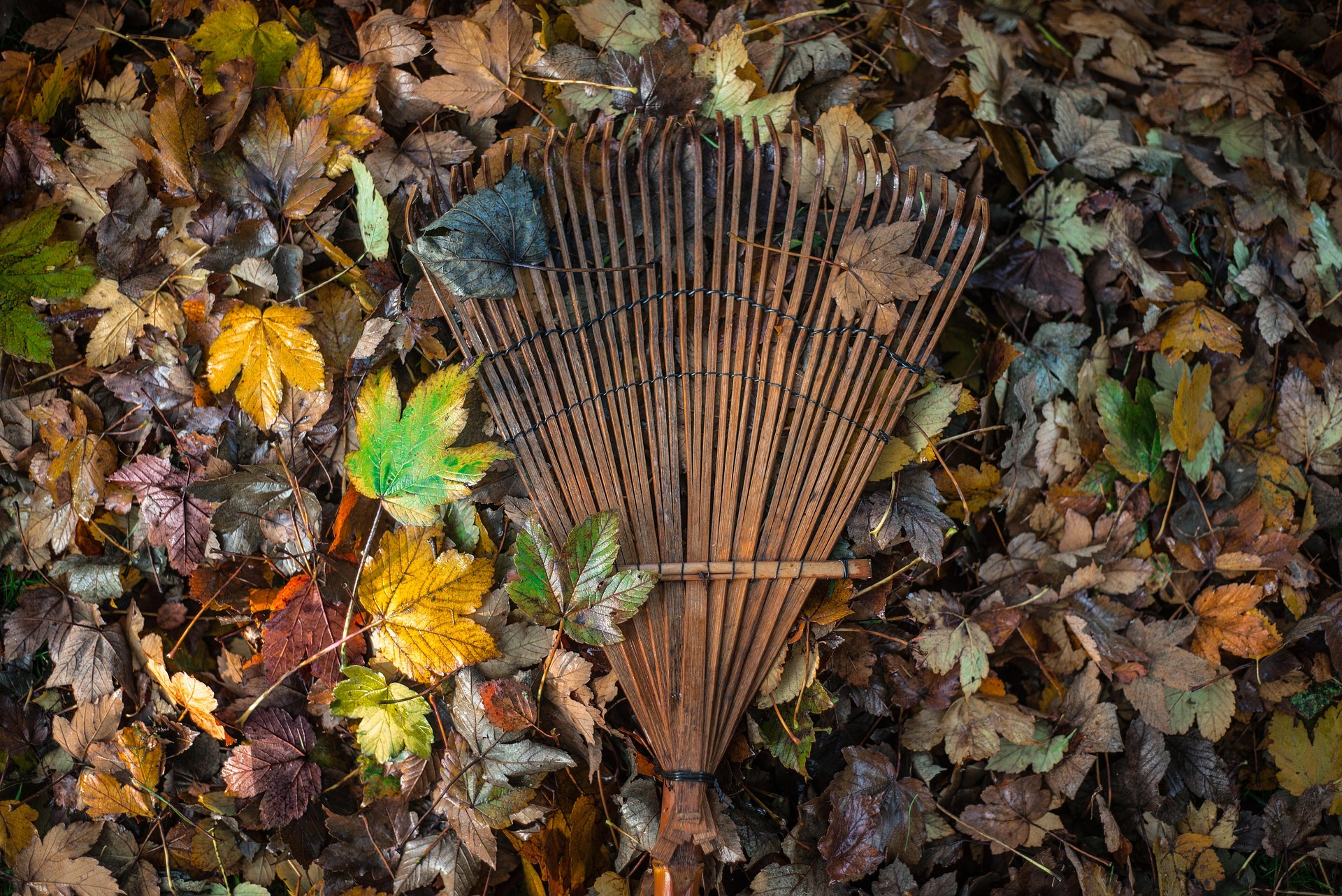
Four inches of leaves spread in October will be about three inches by spring. NC State Extension measured that settling, and it is the number that makes leaf mulch worth the afternoon it costs. You are not adding a permanent layer. You are adding one that disappears into the soil and has to be replaced next year.
Depth is where the extension services split, and the split is not sloppiness. University of Missouri Extension puts leaves at 2 to 4 inches around trees and shrubs, and says deeper than that starts blocking air and water movement. University of Maryland Extension draws a harder line: organic mulch should not exceed three inches, and only one inch over shallow-rooted plants like boxwood. Texas A&M AgriLife goes the other way and calls 3 to 6 inches of shredded leaves right for trees and shrubs, with 2 to 3 inches in flower beds.
The material is doing the arguing. Maryland is writing against piled bark and wood chips, which pack down and stay packed. Texas A&M is describing shredded leaves, which are fluffy and half gone by April. Both agree on the part nobody follows. Keep the mulch off the trunk, three inches of clearance by Maryland, four by UC Agriculture and Natural Resources.
Shred them or they mat
Iowa State University Extension is blunt about whole leaves. Shred or compost them before spreading, to stop matting, and do not use them as winter mulch on strawberries or herbaceous perennials, where they mat down and smother the plants. A matted leaf layer sheds water instead of letting it through. That is the failure mode, and it shows up in the first hard rain.
A lawn mower does the job. UC ANR adds the detail that decides whether mowing leaves in place works at all. The pieces have to be small enough to fall between the grass blades. Too coarse and they sit on top.
Mowing leaves into the lawn
This is the best-tested piece of the whole subject. Michigan State work reported by University of Illinois Extension found that a six-inch layer of maple and oak leaves could be mulched into established turf with no apparent adverse effects, and that the mulched leaves fed the grass and sped up spring green-up. A four-year Purdue University trial on perennial ryegrass, reported by University of Missouri Extension, found no effect on weeds, none on red thread or dollar spot or pink patch, and no thatch buildup.
Illinois Extension recommends a second pass at ninety degrees to the first when the layer is deep. That is the whole technique.
The oak leaf pH claim is wrong
Oak leaves will not acidify your soil. Iowa State Extension says oak leaf mulch should have little effect on soil pH. Illinois Extension goes further, and says even acidic oak leaves break down to neutral or slightly alkaline. The Michigan State turf work measured soil pH directly after leaf mulching and found it unchanged.
The pine needle version of this myth has been chased down properly. NC State Extension measured fresh pine needles at pH 3.2 to 3.8 on the day they drop, then explains why that does not reach the soil. Soil has buffering capacity, and microbes neutralize the acidity as the needles break down. NC State also offers a likely origin for the myth. Pines in North Carolina grow in soils that were already acidic, and the needles took the blame for a condition that was there first.
So if you are trying to drop pH for blueberries, leaves will not do it. Use something that will.
Nitrogen tie-up is real, but only if you till
Tree leaves run about 60 parts carbon to 1 part nitrogen, per UGA Extension and UC ANR. Bacterial composting wants closer to 24 to 1. That gap is why a pile of leaves sits there instead of heating up, and it is also where the nitrogen robbery warning comes from.
The warning applies to incorporation, not to mulch. University of Missouri Extension states it plainly. Carbon-rich material will not compete with plants for nitrogen if it is placed on the soil surface. Rutgers documents the other half: incorporate leaf compost and little or no nitrogen will be released for plant use during the season immediately following. Rutgers suggests 1 to 1.5 pounds of a 10 percent nitrogen fertilizer per 100 pounds of leaf compost to cover that.
Mulch on top. Till in spring only if you are willing to feed it.
Leaf mold takes longer than you have been told
Leaf mold is a fungal process, cold, not the bacterial hot composting most gardeners picture. UGA Extension names that mechanism and the reason behind it. A pure leaf pile never heats.
How long it takes is the widest disagreement in this whole subject. Illinois Extension says roughly six months for shredded leaves and nine to twelve for whole ones. UGA says one to two years, or April if you shred and turn monthly starting in December. Penn State Extension says a couple of years, shortened to six to twelve months with shredding, turning, watering or tarping. UC ANR says a leaf mulch layer becomes leaf mold by spring.
They are not describing the same thing. UC ANR has in mind a thin layer sitting on soil through a mild California winter. Penn State has a heap in a Pennsylvania one. A pile is drier and colder than a mulch layer, and it touches far less soil. It decays on its own clock.
It is not fertilizer
Iowa State Extension measured composted leaves at 0.5 to 1.0 percent nitrogen, about 0.1 percent phosphorus, and 0.5 to 1.0 percent potassium on a dry basis, and calls the nutrient content very small. Rutgers says leaf compost is too low in nutrients to work as a fertilizer. Penn State says leaf mold is not high in nutrients either.
What the afternoon buys you is organic matter and soil structure. That is worth having. It is not plant food.
The leaves to leave out
UC ANR draws one line worth respecting. Do not reuse leaves from trees that had anthracnose or fireblight, or an insect infestation such as scale or whiteflies, because winter decomposition never gets hot enough to kill the spores or the eggs.
Apple scab is the sharpest case. University of Wisconsin-Madison Extension says the fungus overwinters in leaf litter from infected trees, and that those fallen leaves are a major source of the spores that infect the next season. Collect them and get them out.
Black walnut is less absolute than the internet has it. Oregon State University Extension approves compost made with black walnut leaves for the vegetable garden, and notes that walnut leaves carry their highest juglone in spring and less of it in fall. WSU Extension says juglone breaks down completely within two months in a compost pile. Purdue Extension is more cautious. It warns that composted walnut refuse may still release small amounts, and it lists the plants that care: tomato, potato, asparagus, apple, rhododendron, azalea, lilac, some peony. WSU offers a test for anyone who wants one. Plant a tomato seedling in the finished compost and watch what it does.
Sources
- NC State Extension, Union County, Leaf Mulch: Free Soil Amendment for Your Lawn & Garden: https://union.ces.ncsu.edu/news/leaf-mulch-free-soil-amendment-for-your-lawn-garden/
- University of Missouri Extension G6958, Making and Using Compost: https://extension.missouri.edu/publications/g6958
- University of Maryland Extension, Excess Mulch Problems: https://extension.umd.edu/resource/excess-mulch-problems
- Texas A&M AgriLife, Don’t Bag It Leaf Management Plan: https://aggie-horticulture.tamu.edu/earthkind/landscape/leaf-management-plan/
- UC Agriculture and Natural Resources, Leaves Dropped From Trees Can Be Effective Garden Mulch: https://ucanr.edu/blog/fresno-gardening-green/article/leaves-dropped-trees-can-be-effective-garden-mulch
- Iowa State University Extension, Using Mulch in the Garden: https://yardandgarden.extension.iastate.edu/how-to/using-mulch-garden
- Iowa State University Extension, Can Oak Leaves Be Used as Garden Mulch: https://yardandgarden.extension.iastate.edu/faq/can-oak-leaves-be-used-garden-mulch
- Iowa State University Extension, What Is the Nutrient Content of Composted Leaves: https://yardandgarden.extension.iastate.edu/faq/what-nutrient-content-composted-leaves
- University of Illinois Extension IPM, Mulching Leaves Into Turf: https://hyg.ipm.illinois.edu/article.php?id=1326
- University of Illinois Extension, Don’t Bag Your Fall Leaves: https://extension.illinois.edu/blogs/know-how-know-more/2025-10-27-dont-bag-your-fall-leaves-use-them
- University of Missouri IPM, Try Mowing Leaves Rather Than Removal: https://ipm.missouri.edu/MEG/2013/10/Want-to-reduce-waste-and-time-Try-mowing-leaves-rather-than-removal/
- NC State Extension, Lee County, Pine Needle Mulch: The Myths and Legends: https://lee.ces.ncsu.edu/news/pine-needle-mulch-the-myths-and-legends/
- UGA Extension, Paulding County, Stop! Don’t Burn Those Leaves: https://site.extension.uga.edu/paulding/2022/01/stop-dont-burn-those-leaves/
- UC ANR Garden Notes, Mulching Oak Leaves: https://ucanr.edu/blog/garden-notes/article/mulching-oak-leaves-turf-garden-and-landscape-and-composting
- Rutgers NJAES FS117, Leaf Compost: https://njaes.rutgers.edu/fs117/
- Penn State Extension, Leaves Are Treasure, Not Trash: https://extension.psu.edu/leaves-are-treasure-not-trash
- University of Wisconsin-Madison Extension, Apple Scab: https://hort.extension.wisc.edu/articles/applescab/
- Oregon State University Extension, Walnut Leaves Safe for Composting: https://extension.oregonstate.edu/ask-extension/featured/walnut-leaves-safe-composting
- WSU Extension C032, Black Walnut Toxicity: https://s3.wp.wsu.edu/uploads/sites/2076/2024/07/C032-Black-Walnut-Toxicity.pdf
- Purdue Extension HO-193, Black Walnut Toxicity: https://www.extension.purdue.edu/extmedia/ho/ho-193.pdf
Leave a Reply