
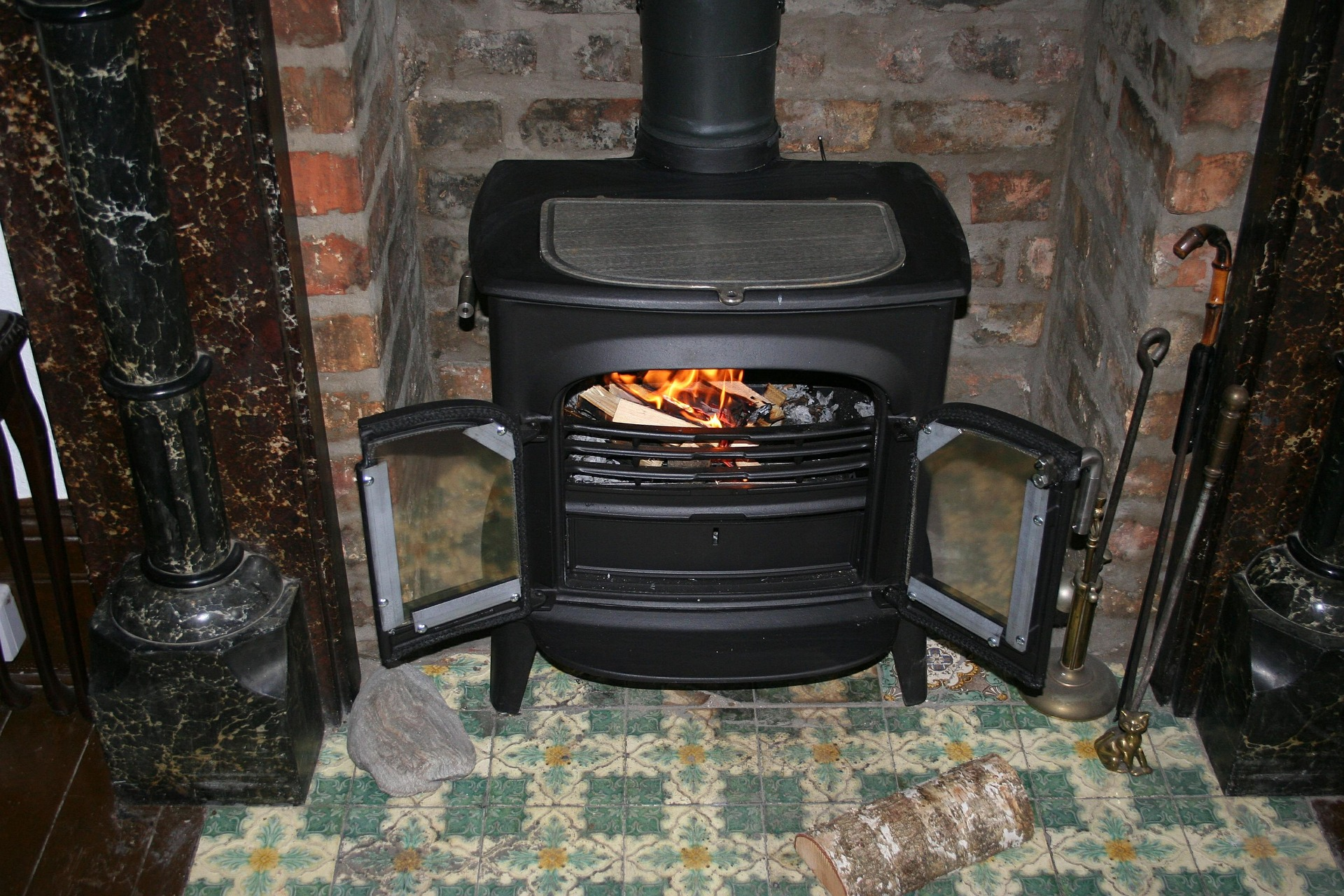
Closing the air down to hold a fire overnight throws away roughly half the fuel. It is also the most common thing people do with a wood stove. Montana State University Extension Forestry, republishing a Natural Resources Canada guide, puts it in capitals: never let the fire smoulder. That is their most important rule.
The reason is arithmetic. University of Missouri Extension states that the volatile gases driven out of burning wood carry 50 to 60 percent of its heat value, and that those gases need roughly 1,100°F plus adequate air to combust. Starve the fire of air and the gases never ignite. They leave as smoke and condense in the flue as creosote. The wood you cut and stacked heats the neighbourhood and coats your pipe.
The one time you close the damper
Penn State Extension names closing the dampers as the mechanism of incomplete combustion and gives exactly one exception: when the fire has burned down to glowing embers and you do not plan to add more fuel. That is the whole list.
A long burn still comes from somewhere, and it is load geometry rather than air starvation. Nova Scotia’s forestry department says to run high fire for 10 to 15 minutes after each refuelling, then hold heat with larger pieces placed compactly so flame cannot penetrate the whole load at once. Montana State adds that burn cycles of eight hours or less reach peak efficiency. A twelve-hour burn is not a technique. It is a stove being run wrong for four extra hours.
The reload sequence itself is specific. Rake the live coals forward to just inside the loading door, then place at least three and preferably more than five pieces on and behind the charcoal. Leave the air open until the firebox is full of flames, the wood surface is charred black and the edges of the pieces glow red. Then turn the air down in two or three stages, which Montana State frames as avoiding shocking the fire into a smoulder.
How long that open-air phase runs is the one place the sources scatter. Montana State says five to 20 minutes depending on piece size and moisture. Nova Scotia says 10 to 15. British Columbia says 15 to 30 depending on load size. All three anchor to the same visual, which is wood charred black and flames filling the box, so the clock is a guide and the firebox is the instrument.
Build it from the top
Montana State describes the top-down method and endorses it: split firewood on the floor of the firebox, kindling on the logs, fine kindling on that. The stated advantages: minimal start-up smoke, and no chance of the stack collapsing and smothering itself. You also never open the door to add bigger pieces once the kindling catches.
No agency publishes a measured emission reduction for top-down against bottom-lit. The method is endorsed; the figure people quote for it is not.
While on the subject of starting a fire: University of Missouri fact sheet G5453 tells readers to lay two-inch strips of cardboard on the newspaper. EPA, Montana State Extension, the University of Maryland Extension and Oklahoma State Extension all list cardboard among the things never to burn. The MU sheet predates the emissions-era guidance. If you own a copy, ignore that line.
The thermometer question nobody has answered
Missouri Extension says to keep flue temperature above 250°F to stop creosote condensing. Oklahoma State says creosote forms mainly from green wood or fires below 250°F. Two land-grants, one number, and neither states whether 250°F means the surface of the pipe or the gas inside it.
That gap matters more than it sounds. A single-wall pipe’s surface runs roughly half the internal gas temperature. If 250 is a gas figure, a magnetic thermometer reading 250 means the gas is near 500 and you have margin. If it is a surface figure, a probe reading 250 means the pipe is far too cool. Nobody resolves it, and no acceptable source gives an upper bound either, so the commonly quoted operating bands have no agency behind them.
Missouri does describe the instruments clearly. Magnetic thermometers read pipe surface. Probe thermometers measure gas in the centre of the pipe and are the ones that work on double-wall pipe, where a magnet reads almost nothing useful. Missouri confirms stove-top thermometers show a safe working range without ever stating what that range is.
What not to put in it
EPA’s list: household trash including cardboard, plastics, foam and coloured ink; coated, painted and pressure-treated wood; ocean driftwood, plywood, particle board and anything with glue in it; wet, rotted, diseased or mouldy wood; rubber, manure and animal remains.
British Columbia explains the driftwood entry: it releases sodium and chlorine ions. The province is blunt about the rest. Burning garbage, plastic and treated or painted wood is illegal there. So is burning coal in a wood stove. On a catalytic stove there is a further cost, since EPA warns that burning other fuels may poison the catalyst.
EPA also says to keep the door closed except when loading or stoking, because carbon monoxide can otherwise come into the house. Cracking it open during startup is a different thing.
A stove that is too big gets run too low
Montana State states the trap directly. A stove too large for the space overheats the room, gets turned down for most of its running hours, and produces smoky polluting fires as a result. Firebox size, not the overall size of the appliance, is the better guide to heating capacity.
Nobody in the agency literature gives a square-footage rule. Missouri Extension declines to give a number at all, noting that stove ratings are of little value unless you know the test conditions behind them.
The numbers that are firm are the emission limits. An uncertified or pre-1988 stove runs 15 to 30 grams of smoke an hour. The 2015 standard capped certified stoves at 4.5 grams an hour, and the 2020 step took it to 2.0 with crib wood or 2.5 with cord wood. EPA says a certified stove uses up to a third less firewood; Penn State says saving 30 percent is not unusual.
Efficiency figures are messier. EPA’s inventory documents put a certified stove at 68 percent, EPA’s consumer pages say 71 to 78, and Penn State says 80 or more. Different measurement bases, different decades. Read your own stove’s certification label instead.
If it has a catalyst
Run in bypass until the stove is hot, then engage. EPA puts catalyst light-off between 350 and 600°F and warns that engaging early cuts draft without cutting pollution. Normal operation sits near 1,000°F and prolonged heat near or above 1,600°F damages or destroys the element.
Service life is where the sources part company. EPA says up to 10 years; Montana State says two to six; EPA’s own 1998 technical review found catalytic stove emissions in some cases reaching conventional stove levels within five years as activity was lost. Performance can be gone long before the honeycomb crumbles.
Ash, and where it goes
Leave about an inch of ash in the firebox to insulate the coals, which is EPA’s figure. Montana State sets the ceiling at two inches, above which ash starts blocking under-fire air and stealing firebox volume. For round-the-clock burning Oklahoma State puts removal at once every seven to 10 days.
Ashes go in a covered metal container, outdoors, on a non-combustible surface, away from anything that will burn. That one is unanimous: EPA, CPSC, Illinois Extension, Missouri Extension and South Dakota State all say it. Oklahoma State supplies the reason with a specific. Field fires have been started by ashes several days old, and a cardboard box or a plastic bin is how that happens.
Read the chimney, not the fire
EPA’s rule of thumb is that visible smoke usually means the fire wants more air. British Columbia describes a good burn as bright lively flames with almost invisible smoke, and a bad one as dull steady flames or heavy smoke. Nova Scotia adds a detail for the fuel: wood should never sizzle.
So the instrument that tells you whether the stove is being run properly is outside the house, above the roof. Go out and look at it on a cold morning.
Sources
- US EPA Burn Wise, Best Wood-Burning Practices — epa.gov
- US EPA Burn Wise, Tips for a Better Burn — epa.gov
- US EPA Burn Wise, EPA Certified Wood Stoves — epa.gov
- US EPA Burn Wise, Choosing the Right Wood-Burning Stove — epa.gov
- US EPA Burn Wise, Frequent Questions About Wood-Burning Appliances — epa.gov
- US EPA, Catalytic Woodstoves (EPA-22A-4001) — epa.gov
- US EPA, Residential Wood Combustion Technology Review (EPA-600/R-98-174a) — epa.gov
- US EPA, AP-42 Section 1.10, Residential Wood Stoves — epa.gov
- Montana State University Extension Forestry, Guide to Residential Wood Heating (Natural Resources Canada) — montana.edu
- Montana State University Extension Forestry, Efficient, Convenient Wood Heating — montana.edu
- Penn State Extension, Using Your Wood Stove Efficiently and Effectively — extension.psu.edu
- Penn State Extension, Heating with Wood: An Introduction — extension.psu.edu
- University of Missouri Extension, G1731 and G1735 and G5453 and G1730 — G1731, G1735, G5453, G1730
- Oklahoma State University Extension, Wood Burning Stoves Offer Heating Alternative — extension.okstate.edu
- University of Maryland Extension, FS-926 Heating with Wood — extension.umd.edu
- University of Illinois Extension, Firewood: Burning Safety — extension.illinois.edu
- South Dakota State University Extension, Reducing Risk of Wood Stove and Fireplace Fires — extension.sdstate.edu
- Nova Scotia Department of Natural Resources, Your Wood Stove — novascotia.ca
- Province of British Columbia, Wood Burning Practices — gov.bc.ca
- US Consumer Product Safety Commission, winter home heating hazards — cpsc.gov
Leave a Reply