
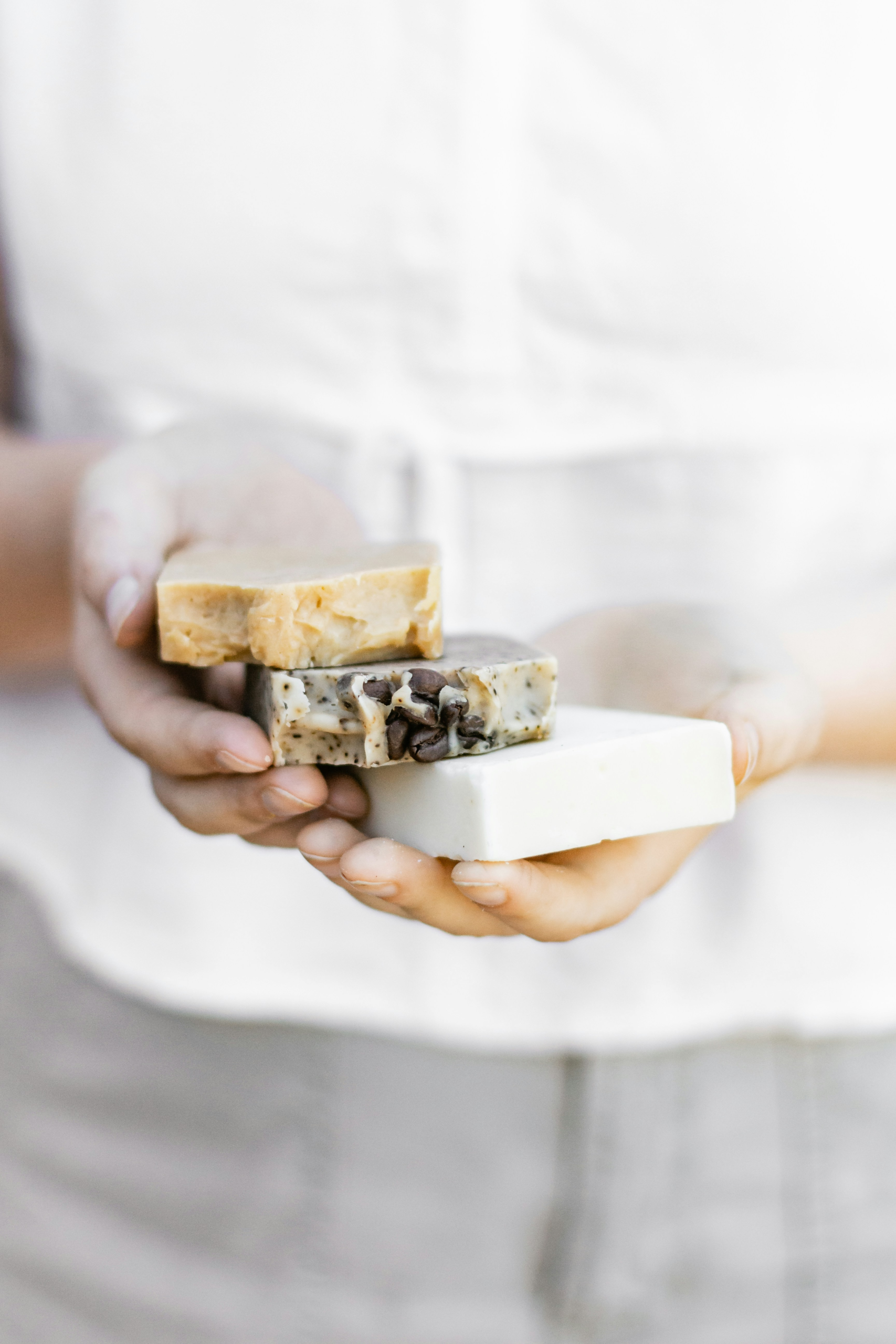
Five state extension services published soap bulletins between 1935 and 1970, they agree almost exactly on how much lye goes with how much fat, and not one of them tells you to wear gloves. South Dakota State’s 1935 circular gets closest with an instruction to “avoid fumes.” Utah State’s 1970 leaflet spends its safety paragraph on protecting the linoleum. That gap is the first thing to sort out, because the recipe arithmetic in those bulletins is still sound and the hazard guidance has to come from somewhere else entirely.
What the lye actually does to you
Start with the one fact that catches people. According to the Agency for Toxic Substances and Disease Registry, contact with 25 to 50 percent sodium hydroxide solutions “produces immediate irritation,” but after contact with solutions of 4 percent or less, “irritation may not develop for several hours.” A weak splash does not announce itself. NIOSH lists inhalation, ingestion, skin and eye contact as the exposure routes, sets a ceiling limit of 2 mg per cubic meter, and gives first aid as immediate irrigation for eyes and immediate water flush for skin. ATSDR puts numbers on that: flush skin at least 15 minutes and eyes at least 30 minutes.
Add lye to water, never water to lye, and know why. ATSDR states that sodium hydroxide dissolved in water “liberates substantial heat, which may be sufficient to ignite combustible materials.” NC State’s soapmaking lab protocol is the only source in this set with modern handling instructions: add the lye slowly to cool water while stirring, do not breathe the vapors, do not touch sodium hydroxide in any form with bare hands, and use gloves, goggles and an apron. OSHA requires eye and face protection meeting ANSI Z87.1 for anyone exposed to caustic liquids at work. The Consumer Product Safety Commission requires child-resistant packaging on any dry household product containing 10 percent or more free sodium or potassium hydroxide, which tells you how the agency reads a can of lye sitting on a shelf.
The recipe the bulletins agree on
Arkansas, Michigan State, Nebraska and South Dakota State all give the same proportions: 6 pounds of clean fat to one 13-ounce can of lye, yielding about 9 pounds of soap. Utah State is the outlier at 5½ pounds of fat per can. Half lard and half tallow makes a good laundry soap, per Arkansas. Beef fat is the hard fat, and adding roughly 10 percent of it firms up a soft pork batch.
Water is where they split. Arkansas, South Dakota State and Utah State call for 2½ pints per can. Michigan State calls for 1 quart, which is 2 pints, for the identical 13-ounce can and the identical 6 pounds of fat. Run the arithmetic and that is a 23.8 percent lye solution against a 28.0 percent one. NC State’s lab works at closer to 31 percent. None of the bulletins explains its choice.
The fat ratio matters more than the water does, and here the arithmetic is worth doing yourself. USDA’s Food Safety and Inspection Service hosts a Chinese national standard for edible lard that puts its saponification value at 190 to 202 mg KOH per gram. Converted to sodium hydroxide, that is roughly 135 to 144 mg per gram of lard, or 13.5 to 14.4 percent of the fat’s weight. Thirteen ounces of lye per 6 pounds of fat works out to 13.5 percent. So the 6-pound recipes sit right at the bottom edge of what the fat can consume, and Utah State’s 5½ pounds sits above it. No extension bulletin in this set mentions superfat at all. NC State defines the term, calls it “reducing the amount of NaOH required for complete saponification so that an excess of unreacted triglycerides remain,” and gives no target percentage.
Temperatures, and the honey test
Tallow is the one everybody agrees on: fat at 130°F, lye solution at 90 to 95°F. Michigan State is the only source that opens the fat side down to 120°F. Lard is contested. Arkansas, Nebraska and South Dakota State all say fat at 100°F with the lye at 70°F. Utah State says 85°F and 75°F. Michigan State says 80 to 85°F and 70 to 75°F, which is a 15-degree spread on the fat across three land-grant institutions using the same method.
Pour the lye solution into the fat in a thin steady stream with slow even stirring. Nebraska’s endpoint is the best-described one in the literature: “If the mass becomes like strained honey, and if the dip threads off in hairs, we say that soap has come.” Arkansas puts that at 10 to 20 minutes, Utah State at 5 to 15. Then leave the mold alone for 24 hours. Utah State says to throw a blanket over it.
Skip aluminum. Arkansas says “don’t use aluminum utensils,” Utah State repeats it, and the two of them plus Michigan State and South Dakota State all point to stone, glass, crockery, enamel or granite ware instead. Then note the contradiction: Utah State lists galvanized and heavy tin as acceptable, while Nebraska states that “strong lye solutions will attack copper, zinc, and tin.” Galvanizing is zinc. Nebraska is the one to follow there.
Cure time, and how to test a bar
Nobody agrees on cure. Arkansas and South Dakota State say at least two weeks, with Arkansas stretching toilet soap to a month. Michigan State says several weeks. Nebraska says four weeks and then goes further: “It would even be better to have it six months old before using. The older soap is the better.” Utah State gives no cure time whatsoever. Every source that mentions freezing says not to let new soap freeze.
The testing advice has aged badly. Michigan State in 1942 and Nebraska in 1940 both tell you to touch your tongue to the bar and feel for a bite. Michigan State’s own scan carries a banner reading “Archive copy of publication, do not use for current recommendations,” and NIOSH lists ingestion as a sodium hydroxide exposure route. There are two alternatives already on the record. South Dakota State in 1935 used red litmus paper on the wet soap, with a color change to blue meaning too much lye. NC State uses pH strips and gives an acceptance window of 7 to 10, with anything above 10 indicating free sodium hydroxide in the bar.
That window is also the honest answer to the claim that lye soap is inherently harsh. NC State’s position is that harshness tracks excess alkali, not the use of lye: soaps made with sodium hydroxide “are not harmful to the skin if the soap is made correctly,” and the failure mode is unreacted hydroxide left over from too much lye for the fat present. Arkansas and Nebraska describe the same failure from the other end, by texture. “Excess lye makes a coarse, flinty soap; it crumbles when shaved.”
Wood ash is not a shortcut
No acceptable source describes leaching lye from wood ashes, let alone validates the floating-egg test for its strength. What the extension literature does give you is the reason. The University of Georgia measured 37 wood ash samples and found pH ranging from 9 to 13.5 and potassium from 0.1 to 13 percent, concluding that composition varies with location and process and “makes testing the ash extremely important.” New Hampshire puts ash liming strength at 25 to 59 percent of pure lime and notes in passing that “our Yankee ancestors used wood ash to make lye for soaps.” Ancestors is the operative word. Every bulletin above specifies purchased lye weighed to the ounce, and a recipe balanced to 13.5 percent of fat weight cannot be run on an alkali that varies by two orders of magnitude between buckets.
One last piece worth knowing if any of this leaves the house. The FDA’s own guidance says true soap is regulated by the Consumer Product Safety Commission, not the FDA, provided it consists mainly of alkali salts of fatty acids, those salts are the only source of detergent action, and it is “labeled, sold, and represented solely as soap.” Market the same bar as moisturizing or deodorizing and it becomes a cosmetic, which pulls it under FDA labeling rules, including a street address on the label. The FDA says plainly that “a post office box or website address is not adequate.”
Sources
- NIOSH (CDC), NIOSH Pocket Guide to Chemical Hazards — Sodium hydroxide
- ATSDR (CDC), Medical Management Guidelines for Sodium Hydroxide
- Occupational Safety and Health Administration, 29 CFR 1910.133, Eye and face protection
- Consumer Product Safety Commission, 16 CFR 1700.14, Poison Prevention Packaging, and Soap Business Guidance
- NC State University, College of Natural Resources, The Soapmaking Factory Lab
- University of Arkansas Extension Service, Ida A. Fenton, Home-Made Soap, Extension Circular No. 305, reprinted 1936
- Michigan State University Cooperative Extension Service, Making Soap at Home, Extension Folder F-14, 1942
- University of Nebraska–Lincoln Cooperative Extension Work, Soap Making, EC1117, revised 1940
- South Dakota State University Extension, Mary A. Covert, Homemade Cleaning Agents, Circular 353, 1935
- Utah State University Cooperative Extension, Rhea H. Gardner, Soap Making, No Boil Method, FL 27, 1970
- USDA Food Safety and Inspection Service, hosted copy of GB/T 8937-2006, Edible Lard (a Chinese national standard hosted on a USDA domain, not a USDA-authored value)
- University of Georgia Cooperative Extension, Gaskin and Risse, Best Management Practices for Wood Ash as Agricultural Soil Amendment, Bulletin 1142
- University of New Hampshire Cooperative Extension, Olivia Saunders, Guide to Using Wood Ash as an Agricultural Soil Amendment
- US Food and Drug Administration, Frequently Asked Questions on Soap, Is It a Cosmetic, a Drug, or Both? (Or Is It Soap?), and Small Businesses & Homemade Cosmetics: Fact Sheet
- Prior post on the fat side of this: Rendering Lard and Tallow at Home
Leave a Reply