
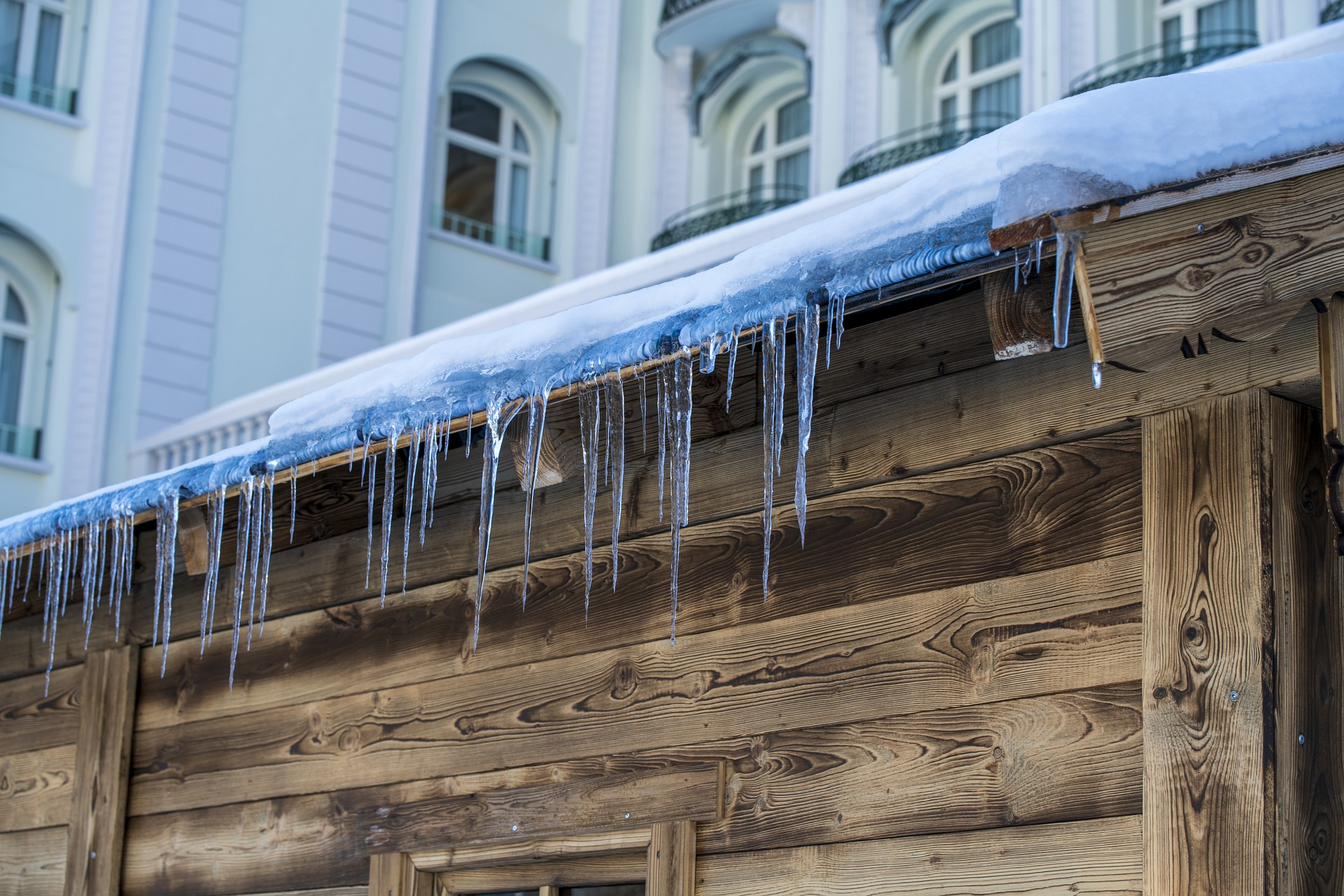
An ice dam needs three things and only one of them is weather. Snow on the roof, outdoor air in the teens or low twenties, and a roof deck that is above freezing up high and below freezing at the eave. University of Minnesota Extension states the condition directly: nonuniform roof surface temperatures lead to ice dams, with the upper roof above 32°F while lower surfaces sit below 32°F and outside temperatures are below freezing too. The overhang is cold because nothing underneath it is heated.
The temperature window is a range rather than a number, and the best evidence for it sits in one review hosted by the USDA Forest Products Laboratory, which quotes two studies a few lines apart. One found that ice dams seldom occurred when outdoor temperatures were above 22°F. The other found that on insulated buildings, ice dams form at outdoor temperatures above 15°F. One treats 22°F as a ceiling above which dams stop. The other treats 15°F as a floor above which they start. The paper never reconciles them, so call it the teens to the low twenties and stop hunting for a threshold.
The design target is published, and simpler than the rule you have read elsewhere. Keep the attic below freezing. The familiar version, that an attic should sit within five or ten degrees of outdoor temperature, appears in no extension, USDA or EPA publication. The closest measured figure is that attics in houses which got ice dams ran about 7°F warmer than attics in houses which did not.
Air sealing first, and it is not close
Minnesota Extension gives the order plainly: seal air leaks between the living space and the attic first, then consider increasing the ceiling or roof insulation, because heat reaches the attic mainly through air leakage. EPA runs the same logic backwards and treats the symptom as a diagnosis, listing a history of ice dams in the winter as an indication of serious air leaks.
EPA’s leak list is where to look: behind kneewalls, the attic hatch, wiring holes, plumbing vents, open soffits, recessed lights, and furnace flue or duct chaseways. Clearances matter while you are up there. Building codes usually require 1 inch of clearance from metal flues and 2 inches from masonry chimneys to any combustible material, insulation included, and insulation stays 3 inches back from can lights unless they are rated for insulation contact.
One warning counts for more on a homestead than in a subdivision. Minnesota says to make sure combustion and exhaust appliances still have enough air once the house is tightened. If you heat with wood, oil or unvented propane, that is not a footnote.
Insulation second, and the federal guidance disagrees with itself
ENERGY STAR’s current table calls for R-60 in an uninsulated attic across Climate Zones 4 through 8, and R-49 where three or four inches are already down. ENERGY STAR’s own do-it-yourself guide, still live and dated 2007, says the recommended level for most attics is R-38, or about 10 to 14 inches depending on the material. Same program, a 22-point spread.
The gap is code vintage rather than real disagreement. R-38 tracks older guidance, R-49 is the 2012 energy code and R-60 is the 2021 one. Extension figures sit inside that spread. NDSU says R-50, or roughly 15 inches of blow-in. Missouri says R-38 to R-49, and Wisconsin material says R-49.
Ventilation third, if at all
The Forest Products Laboratory review states that current technical information does not support a universal requirement for ventilation of attics. Two pages later the same paper concludes that ventilation is necessary in climates with a lot of snow to prevent icing at eaves, regardless of insulation level. Both halves are in one document, and the second is the one that applies here.
That review also publishes the tradeoff by city. The insulation level above which ventilation stops being needed to control eave icing is R-20 in Philadelphia, Washington and Chicago, R-30 in Madison, Boston and Sioux Falls, and R-40 in Minneapolis and Portland, Maine. Marquette, Michigan and Bangor, Maine need ventilation at any insulation level.
The same paper carries the sentence that explains why bolting on more vents so often changes nothing: heat loss into attics from air leaks, ducts or flues can lead to ice dams even when the attic is vented. A powered fan is no answer either. Minnesota states that mechanical attic ventilation is not a recommended solution to ice dams in Minnesota.
Three fixes to rule out before spending money
Heat cable is the first. NDSU Extension says homeowners often use it to treat symptoms instead of preventing ice dams, and a 1979 Minnesota extension fact sheet measured its reach at a few inches from the cable. The figure of 3,300 residential fires a year that gets attached to heat cable is real, but it belongs to pipe heat tape, and the CPSC releases behind it never mention roof de-icing at all.
The stocking full of calcium chloride is the second. No extension service, USDA, EPA or FEMA publication recommends it, and across thirteen publications checked for this, not one mentions it in either direction.
Chipping is the third. Minnesota’s instruction is to avoid excessive scraping or trying to chip off the ice, because those practices can damage the roof and lead to a leaky roof. Michigan State’s list of what not to take onto a roof is a snow blower, a chainsaw and an ice pick.
On that last one there is a case rather than a statistic. Michigan State University’s fatality investigation program recorded a 48-year-old man standing on the ground in January 2001, knocking icicles off an eave about twelve feet up with a snow shovel, working from the tips upward toward the roof edge. He loosened an ice dam the investigators put at about half a ton. It crushed his foot and broke his collarbone, his lower leg was amputated below the knee, and he died weeks later of bilateral pulmonary thromboemboli. Minnesota’s position: avoid working on a winter roof, and hire professionals for this work.
If water is already coming through the ceiling, Minnesota’s stopgap is to cut channels through the dam so trapped water can drain. Hosing with tap water on a warm day does it, and the same page says the channel becomes ineffective within days. A roof rake worked from the ground is the other option, carrying its own caution that a rake and push broom may damage the roofing.
Barns are a different problem than they look
The Building and Construction Technology program at UMass Amherst makes the mechanism argument: ice dams do not form on an unheated shed or garage, because there is no uneven melting and freezing. Nothing in this literature publishes solar gain, animal body heat or barn lighting as an ice dam mechanism in an outbuilding. Minnesota’s farm safety page does name one way in, which is that clearing snow off an agricultural roof partway can create ice dams along the eaves.
The outbuilding risk Minnesota actually quantifies is a different one. Many agricultural buildings are built to a 20 psf snow load against 35 to 42 psf for Minnesota houses, and they get into trouble at four to six feet of snow. That is snow load territory, not ice dam territory, and the two call for opposite responses on the same roof.
Two things people read wrong
An icicle is not proof of a dam. The strongest wording any source uses is that icicles are often a sign of water building up behind one, and that 1979 Minnesota fact sheet draws the distinction explicitly between a real ice dam and only a gutterful or eave-line of ice and icicles. Gutters do not cause ice dams either, though they do concentrate ice and water at the most vulnerable part of the roof.
If water has already reached the structure, moisture and time are the numbers that matter. The Forest Products Laboratory puts decay above roughly 25 to 30 percent wood moisture content, and says air-dried wood at or below 20 percent will not decay. EPA gives 24 to 48 hours to dry a water-damaged area before mold takes hold. Both figures argue for doing this work in October, while it is still only a heat problem.
Sources
- University of Minnesota Extension, Dealing with and preventing ice dams: extension.umn.edu/protecting-home-rain-and-ice/dealing-and-preventing-ice-dams
- University of Minnesota Extension, Prevent roof collapse (farm safety): extension.umn.edu/farm-safety/prevent-roof-collapse
- University of Minnesota Agricultural Extension Service, Forestry Fact Sheet 12-1979, Preventing Ice-Dams on Minnesota Homes: conservancy.umn.edu/server/api/core/bitstreams/9f82be1c-9cba-42f0-93b6-0c02113fb9fe/content
- Rose & TenWolde, Venting of Attics and Cathedral Ceilings, hosted by the USDA Forest Service Forest Products Laboratory: fpl.fs.usda.gov/documnts/pdf2002/rose02a.pdf
- Ibach & Lebow, Strength loss in decayed wood, USDA Forest Service Forest Products Laboratory: fpl.fs.usda.gov/documnts/pdf2014/fpl_2014_ibach001.pdf
- U.S. EPA, A Do-It-Yourself Guide to Sealing and Insulating with ENERGY STAR, EPA 430-F-04-024: energystar.gov/sites/default/files/asset/document/DIY_Guide_May_2008.pdf
- U.S. EPA, ENERGY STAR recommended insulation levels: energystar.gov/node/6646
- U.S. EPA, A Brief Guide to Mold, Moisture and Your Home: epa.gov/mold/brief-guide-mold-moisture-and-your-home
- North Dakota State University Extension, Reduce ice dam and icicle damage: ag.ndsu.edu/news/newsreleases/2023/january/reduce-ice-dam-and-icicle-damage
- University of Missouri Extension, Ice dams on the roof can damage your home: extension.missouri.edu/news/ice-dams-on-the-roof-can-damage-your-home
- University of Wisconsin–Madison Extension, Wisconsin Homeownership Preservation Education, Maintaining Your Home: fyi.extension.wisc.edu/whpe/files/2010/01/Maintaining-Your-Home-2.0.pdf
- Michigan State University, Michigan Fatality Assessment and Control Evaluation, Investigation 01MI006: oem.msu.edu/images/MiFACE/01MI006v1.pdf
- University of Massachusetts Amherst, Building & Construction Technology, Preventing Ice Dams: umass.edu/bct/publications/articles/preventing-ice-dams/
- U.S. Consumer Product Safety Commission, Check Heat Tapes, Cables For Possible Fire Hazards (pipe heat tape, not roof cable): cpsc.gov/Newsroom/News-Releases/1990/Check-Heat-Tapes-Cables-For-Possible-Fire-Hazards
Leave a Reply