
Hatcheries take January and February orders now. The checkout page asks one question extension services cannot agree on: medicated starter or not. Penn State answers it twice, in opposite directions, on two of its own live pages. The variable that settles it is not on the order form either.
Penn State against Penn State on medicated feed
Its brooding fact sheet says land fowl should have a coccidiostat in the diet for the first four weeks. The feed table on the same page prescribes medicated starter at 18 to 24 percent protein for the first eight weeks. Its coccidiosis page says the opposite. Do not use medicated feed during the first 14 days of life.
Neither page cross-references the other. Both are live. The gap shows once you read them together, because each page describes a different bird. The coccidiosis page argues from immunity. Chickens develop long-lasting protection after a few intestinal cycles of Eimeria, and amprolium suppresses exactly those cycles. The brooding page argues straight prophylaxis, keeping the parasite load down through the vulnerable window.
Ohio State supplies the missing variable. If the chicks had a coccidia vaccine at the hatchery, do not feed medicated starter, because it could inactivate the vaccine. So ask the hatchery about the vaccine, and let the answer pick the bag. One wrinkle at the feed store: some feeds labelled medicated carry probiotics rather than amprolium, so read the tag.
90 to 95 degrees is a starting estimate, not a specification
Oklahoma State, UNH, UMN, Iowa State and Ohio State all give 90 to 95 degrees for week one. Penn State and Mississippi State give 92 to 95. Every one of those is a range, not a number. The 5-degree-per-week step-down is close to universal, but the setpoint is not. And the measurement point matters more than the figure. UMN puts the thermometer two inches off the floor under the hover edge. UNH says 2.5 inches above the litter.
Two sources say plainly that the thermometer is the weaker instrument. National Extension notes that with infrared lamps, air temperature is not a good indication of bird comfort. UGA’s Brian Fairchild writes that temperature profiles vary by breed and by company, and that chicks will find their comfort zone. Read the birds. Comfortable chicks spread evenly and chirp softly, cold chicks crowd under the heat and peep loudly, and hot chicks press against the walls.
One fact sheet, two opposite readings of the same sign
Ohio State’s meat chicken fact sheet says in its care section that panting, spread out and stretched means too hot. About a thousand words later, in the housing section, it says cold chicks huddle under the heater and breathe with an open mouth.
Panting and open-mouth breathing are the same thing in a chick. Every other source assigns it to heat alone. Oklahoma State: chicks panting with their mouths open need cooler temperatures. Purdue: panting means the temperature is too high. This looks like a drafting error rather than a dispute. But nobody has corrected it, and it sits in the section a beginner reads while building the brooder. Follow it and you add heat to a brooder already too hot.
A lamp height is useless without the wattage
The published heights look incoherent. National Extension says at least 18 inches above the bedding, down to 15 for more heat and up to 24 for less. UMN says at least 15 inches. Iowa State says about 18. NC State says about eight.
Then read the bulbs. UMN gives its 15-inch minimum for a 250-watt infrared lamp. NC State gives eight inches for a 100-watt bulb inside a reflective shield. Radiant flux falls off with the square of distance and scales with lamp power. At floor level those two are closer than they look. The hazard is the reader who takes a height from one document and a lamp from another. A 250-watt infrared lamp eight inches off the bedding is a scorching brooder.
Penn State’s 20 inches measures something else. It is a clearance from flammable materials rather than a thermal setpoint, which is why it is the largest figure in the set. Hang the lamp from a chain or wire, never the cord. Five sources repeat that one. A second lamp means one burnout is not a crisis.
No acceptable source publishes a heat-lamp fire statistic. The US Fire Administration puts open flame first among agricultural fire causes, with heating systems at 2 percent of equipment involved in ignition. Penn State, citing NFPA, says heating equipment led barn fires from 2006 to 2010 and peaked in January, a category covering furnaces and space heaters rather than brooder lamps. The mechanism has institutional backing. The statistic does not.
Feeder inches, and the trough counted twice
Penn State, UMN, NC State, Ohio State and Utah State all give one linear inch of feeder per chick for the first week or two. National Extension gives two inches, then four after two weeks.
Its own parenthesis gives the game away. Remember to count both sides of a long, straight feeder. Two inches of trough perimeter is one inch of trough length, so the same physical feeder gets described twice under two conventions. A reader comparing two tables otherwise concludes one is wrong. Water space runs half an inch per chick through week five.
Bedding, and the cedar rule extension never wrote
Bedding converges hard on pine shavings, two to four inches deep, with paper towel or burlap over the top for the first week. Newspaper is the fight. National Extension bans it outright as a slick surface that causes leg problems. Penn State permits six to ten pages as a base under paper towel, and gives the principle: never brood on slippery surfaces, since chicks can suffer permanent leg damage. Iowa State recommends newspaper over the shavings on day one so chicks do not eat shavings instead of feed. That is the configuration everyone else warns about, because the chick walks on the paper.
Cedar is the interesting one. Eight extension publications in this set discuss bedding at length. None mentions cedar in either direction. The only two documents that take a position disagree, and the one written by an extension poultry veterinarian recommends pine or cedar shavings. Pine is the well-supported choice. But extension never wrote the cedar rule.
The box in the mail
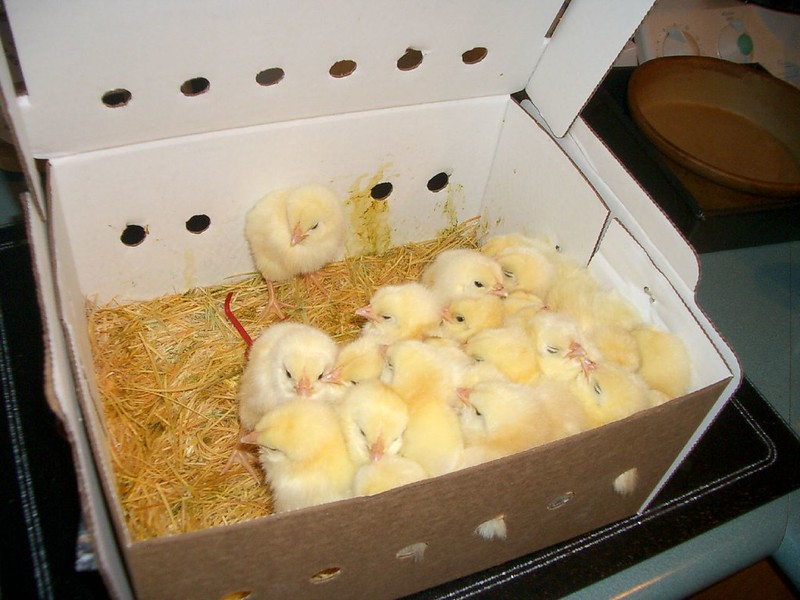
Day-old chicks can go by mail if they are not more than 24 hours old. That box is plain ventilated cardboard with no heater, warmed only by the chicks themselves. Ship early in the week. No box should sit through a weekend.
Three sources give three answers on how long chicks can go without feed. National Extension says 48 hours. Mississippi State says up to three days, and uses that figure to justify mail shipping. Penn State is the only source that separates the two questions. It gives about 72 hours as the yolk reserve and 24 hours as the target for getting chicks onto feed and water. For a box arriving in a January cold snap, the operative number is the target. The sources printing only the ceiling invite complacency about a delayed shipment.
Before the box arrives
Have the brooder clean, assembled and running first. Penn State says at least 48 hours ahead, warmed to 92 degrees a day before arrival. Use a circular guard for the first week, 15 to 24 inches high depending on the source. Purdue gives the reason nobody else does. Circular boundaries reduce huddling and loss from suffocation, so the corner-piling story holds up.
These birds hatch into the cold half of the year. National Extension keeps supplemental heat on for six weeks after arrival in winter even when the birds are fully feathered, partly to stop waterers freezing. Penn State’s step-down ends at 62 to 65 degrees. Oklahoma State, Iowa State and Ohio State pull heat at 70. Those are different ages presented as one milestone. Take 62, move birds to an unheated outbuilding in week six, and you chill them, which is the arithmetic behind getting the coop through winter.
Keep the brooder outside the house. CDC says poultry can look healthy and clean and still spread germs that make people sick. Its April 2026 outbreak notice counted 34 people across 13 states, 13 hospitalised. Children under five should not handle chicks.
Sources
- Penn State Extension, Brooding of Domestic Fowl
- Penn State Extension, Managing Chicken Coccidiosis in Small Flocks During Summer
- Penn State Extension, Space Should Increase as Birds Grow
- Penn State Extension, Fire Prevention in Barns
- Ohio State University CFAES Extension, Raising Meat Chickens, ANR-0161
- Oklahoma State University Extension, Backyard Flock Production
- University of New Hampshire Extension, Brooding and Caring for Chicks
- University of Minnesota Extension, Raising Layer Chicks and Pullets
- Iowa State University Extension, Establishing a Backyard Poultry Flock
- Cooperative Extension, Brooding Poultry Hatchlings
- Cooperative Extension, Raising Meat Chickens in Small or Backyard Flocks
- Cooperative Extension, Obtaining Birds for Small and Backyard Poultry Flocks
- Mississippi State University Extension, Poultry Beginnings: Raise Your Own Backyard Chickens, P3624 (2025)
- NC State Extension, Keeping Garden Chickens in North Carolina
- Purdue University Extension, A Guide for Housing, Brooding, and Handling Chicks Safely, AS-527
- University of Kentucky Cooperative Extension, Urban Poultry, ASC-241
- University of Georgia Extension, Five Common Issues During Brooding (2017)
- Utah State University Extension, Basics for Raising Backyard Chickens (2010)
- US Fire Administration, Topical Fire Research Series, Agricultural Fires (2001)
- CDC, Backyard Poultry
- CDC, Salmonella Outbreak in 13 States Linked to Backyard Poultry (2026)
Leave a Reply