
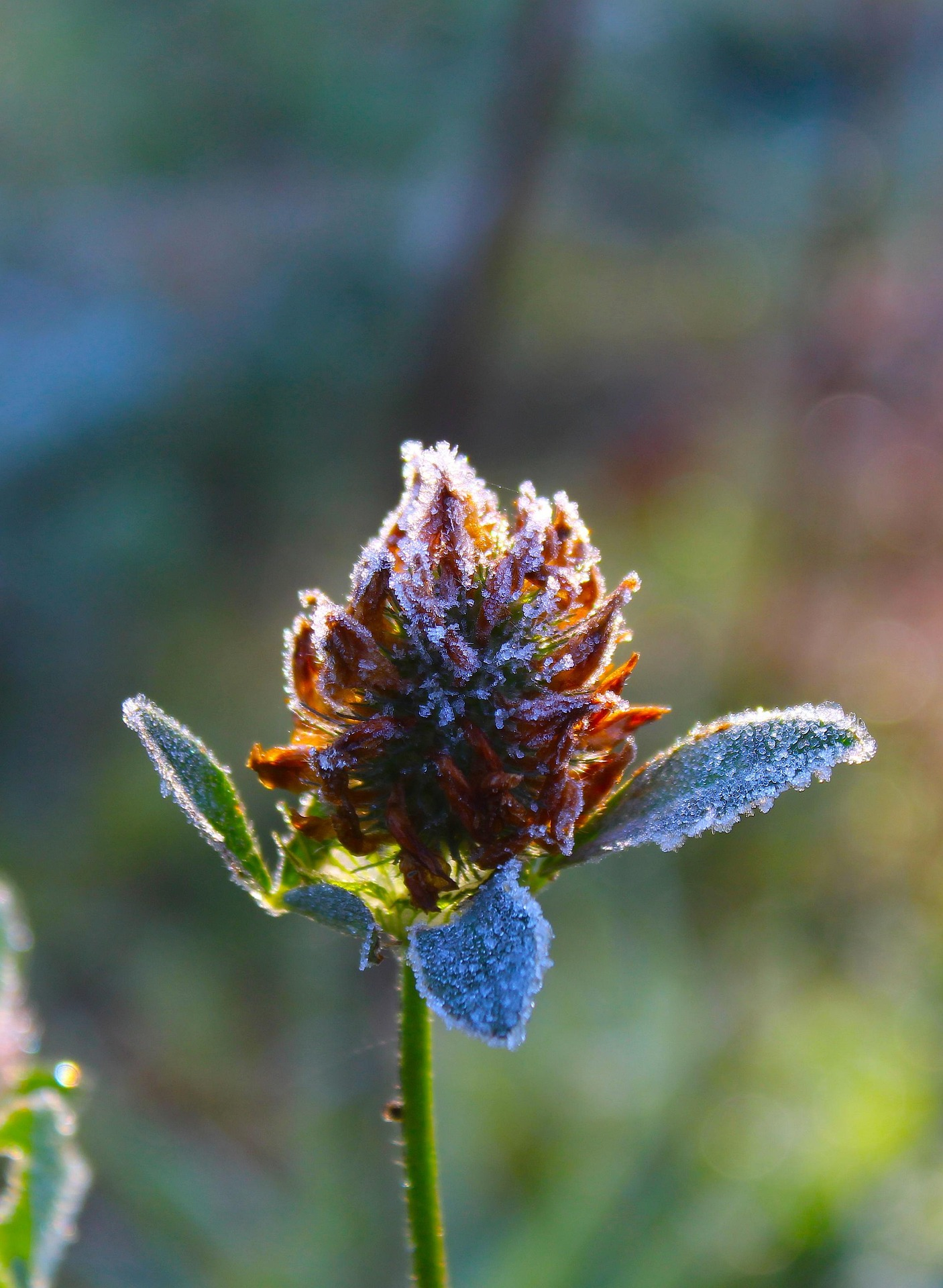
Frost seeding happens in February or March. The seed order happens now, and that is the problem, because the published rate for red clover runs from 1 pound an acre to 10. Penn State prints both 1 to 4 and 4 to 8 on two of its own pages. Missouri prints 4 to 6 in a news release and 10 in its numbered publication. Nobody is wrong. They are answering different questions, and you need to know which one before you buy.
The rate depends on a question the tables do not ask
Two things get collapsed into one number. The first is whether you plan to do this again. Penn State says outright that its pasture rate sits below its small-grain rate because a pasture seeding can be repeated next year and a small-grain seeding cannot. Treat the practice as annual maintenance and 2 to 3 pounds an acre makes sense. Treat it as a one-shot renovation and you want 8 to 10.
The second is how hard you prepared the ground. Missouri’s 10 pounds an acre sits in a publication that also tells you to disturb 40 to 50 percent of the sod and overgraze hard through fall. Illinois takes the other route. It says rates are not reduced for seeding into existing sod, because the most successful rates match those used for a prepared seedbed. Rate and site preparation substitute for each other, and the tables rarely say which they assume.
Most sources cluster anyway. Seven of them land at 4 to 8 pounds an acre of red clover, with 1 to 3 of white or ladino, into a pasture grazed down hard. Order inside that band.
Learn the condition, not the date
The calendar runs from late January in Missouri and Virginia to late March in New Hampshire. Kentucky’s own two documents disagree by nine days on the closing date. None of that matters much, because every source states the same trigger: soil freezing at night, thawing by day, before green-up.
The mechanism is honeycombing. Water in the soil expands as it freezes and heaves the surface. On thaw the ice leaves small openings, and loose soil falls into the cracks. Seed broadcast just before a cycle gets worked down. Iowa State says visible honeycombing is itself the signal, so read the ground rather than the date.
Leave enough cycles behind the seed. OMAFRA wants two or three after broadcasting, and Kentucky puts it at four to six weeks of potential nighttime frost remaining. Wisconsin gives the field test: go when the ground is firm enough that the spreader leaves no tire imprints, early in the morning with a thaw expected that afternoon. Soil type decides whether any of it works. Loam and clay crack and heave, while sandy or shaley ground dries fast and moves less.
Snow is contested. Missouri recommends broadcasting in mid-February with snow or heavy frost on the ground, partly because the seed is easier to see. Iowa State says flatly not to seed onto snow cover, since seed needs to reach bare soil. Penn State supplies the objection that decides it. Honeycombing is often absent under snow, so the mechanism is not running. A light skiff to see your spread pattern is fine. A snowpack is not.
What “works” means, and the four denominators behind it
The success figures look irreconcilable. Wisconsin measured 9 to 35 percent germination. Minnesota reports pasture survival from 0 to 60 percent and designed its research assuming 20. UNH says the practice succeeds only 60 to 70 percent of the time. Illinois says about 60 percent.
Those are two measurements wearing one word. Wisconsin’s and Minnesota’s figures are per seed, the fraction of broadcast seeds that became plants. UNH’s and Illinois’s are per attempt, the chance a field-year produces an acceptable stand. OMAFRA publishes both and they agree. Legumes establish at 50 to 60 percent and grasses at 20 to 30.
So 20 percent per-seed establishment at 6 pounds an acre is a success. The rate assumes most seed dies. Expect one attempt in three to disappoint.
Clover works, and most grasses do not
Illinois Extension’s beef-cattle page says perennial ryegrass and orchardgrass had the highest success rates with this method. Its own Good Growing blog says legumes establish more reliably than grasses. The NRCS Illinois fact sheet says most cool-season grasses establish poorly. Wisconsin contradicts itself the same way.
Separate two things and the fight mostly dissolves. Every source saying grasses fail is thinking of timothy, smooth brome and reed canarygrass, which no table recommends. Every source saying grasses work is naming ryegrass and orchardgrass only. Kentucky’s Master Grazer page makes that distinction out loud. The ryegrasses are the only grasses that established well enough in trials to be reasonable options.
The other half is what counts as the outcome. Ryegrass and orchardgrass win on seeding-year cover and weed suppression because they are fast and dense. They lose on persistent stand. No other source supports the Illinois claim, so do not plan on it.
Alfalfa gets a harder no, with a documented failure mode: a low-dormancy variety germinates during a thaw and a hard freeze kills it. Penn State has three live pages giving three verdicts on alfalfa and birdsfoot trefoil, two of them by the same author.
Lime is the prerequisite you may already be late for
Red clover will establish down to about 5.5 or 6.0 but wants 6.2 to 6.5, and Iowa State asks for 6.5 outright. The timing is what bites in November. UNH says a lime response may take up to a year, UVM says apply it a year ahead, and Virginia Tech and Kentucky both say at least six months. Lime spread this month will not have fully acted by February. If you have not tested the soil yet, test and lime now, then plan to seed the February after this one.
Leave nitrogen out either way. Missouri’s four-year study found nitrogen raises grass competition and blocks light to red clover. Phosphorus and potassium go on in late summer instead.
The nitrogen you actually get back
Kentucky publishes 100 to 200 pounds of nitrogen an acre a year for red clover. Wisconsin’s 2025 trial measured 18 pounds in the establishment season. That is an elevenfold spread. Missouri wobbles inside it too, printing 25 pounds an acre in one release and 25 to 75 a year later from the same quoted specialist.
Four quantities are wearing one label. Kentucky’s is total nitrogen fixed by the plant, most of which walks off in the animal or the hay bale. Minnesota’s 75 pounds is a credit to a following crop after incorporation. Missouri’s 25 is fertilizer displaced this year in a grazed sward. Wisconsin’s 18 is a first-season figure the authors expect to rise as plants mature.
For a grazed homestead pasture the useful number is the displacement one. Call it 25 to 75 pounds an acre a year once clover is 25 to 40 percent of the stand, and near zero in the establishment year. The 100 to 300 pound figures are fixation totals, not fertilizer you get to skip.
Prep is most of the job
Graze or clip to about two inches the previous fall. That exposes soil and weakens the grass. Four sources give two inches. Kentucky asks for three to four, which reads as a southern winter-cover floor rather than a seeding-day figure.
Thatch is what kills a seeding. Iowa State says visible bare spots mark a stand where frost seeding is likely to work, and OMAFRA puts a size on it: patches about the diameter of a quarter. Avoid thick sod-formers like bluegrass and reed canarygrass unless livestock can stomp the seed in.
Inoculate the seed too. Missouri warns that dry-mixing inoculant onto dry seed often causes poor nodulation and stand failure, so moisten it first. Check whether your clover already carries a lime-based coating with the inoculant in it.
Then control the competition, which Ohio State names as one of the most common causes of stand failure. Keep the grass short until the clover is up. Then pull the stock and let it reach six to eight inches before the paddock rejoins the rotation. The one dollar figure anywhere is a 2008 Ohio State case study: $59.93 an acre broadcast against $158 tilled. That is cheap against buying the hay the pasture did not grow.
Sources
- Penn State Extension, Frost Seeding: A Technique for Interseeding Cover Crops and Improving Forage Stands
- Penn State Extension, Frost Seeding for Cover Crop or Forage Establishment
- Penn State Extension, Pasture Improvements Can Take Place in the Winter
- University of Missouri Extension, Renovating Grass Sods With Legumes, G4651
- University of Missouri Extension, Frost Seeding Improves Yield, Quality
- University of Missouri Extension, Get Nearly Free Fertilizer by Frost Seeding Legumes
- Iowa State University Extension, Frost Seeding Legumes
- Iowa State University Extension, Should I Frost Seed? (2025)
- Iowa State University Extension, Boosting Pasture Productivity, IBC07-11
- University of Illinois Extension, Frost Seeding Pastures and Hay Fields
- University of Illinois Extension, Pasture Renovation
- UW-Madison Division of Extension, What Species Work Best for Frost Seeding?
- UW-Madison Division of Extension, Renovating Pastures (2023)
- UW-Madison Division of Extension, Interseeding Legumes Into Pasture (2025)
- UW-Madison Division of Extension, Field Notes: Frost Seeding
- University of Minnesota Extension, Frost Seeding Forages
- University of Minnesota Extension, It’s Time for Frost Seeding (2022)
- University of Kentucky Cooperative Extension, Establishing and Managing Legumes in Grass Pastures, AGR-26
- University of Kentucky Master Grazer, Frost Seeding
- Virginia Cooperative Extension, Renovating Pastures and Hayfields, SPES-92P
- Ohio State University Extension, Frost Seeding Clover: A Recipe for Success (2023)
- Ohio State University Extension, Is Frost Seeding a Pasture Renovation Option? (2023)
- Ohio State University Extension, Pasture Establishment and Renovation Economics (2008)
- UNH Cooperative Extension, Pasture and Hayland Renovation
- UVM Extension, Frost Seeding: Simple but Not Foolproof
- USDA NRCS, Frost Seeding, Illinois Grazing Manual Fact Sheet
- Ontario Ministry of Agriculture, Food and Agribusiness, Frost Seeding
Leave a Reply