
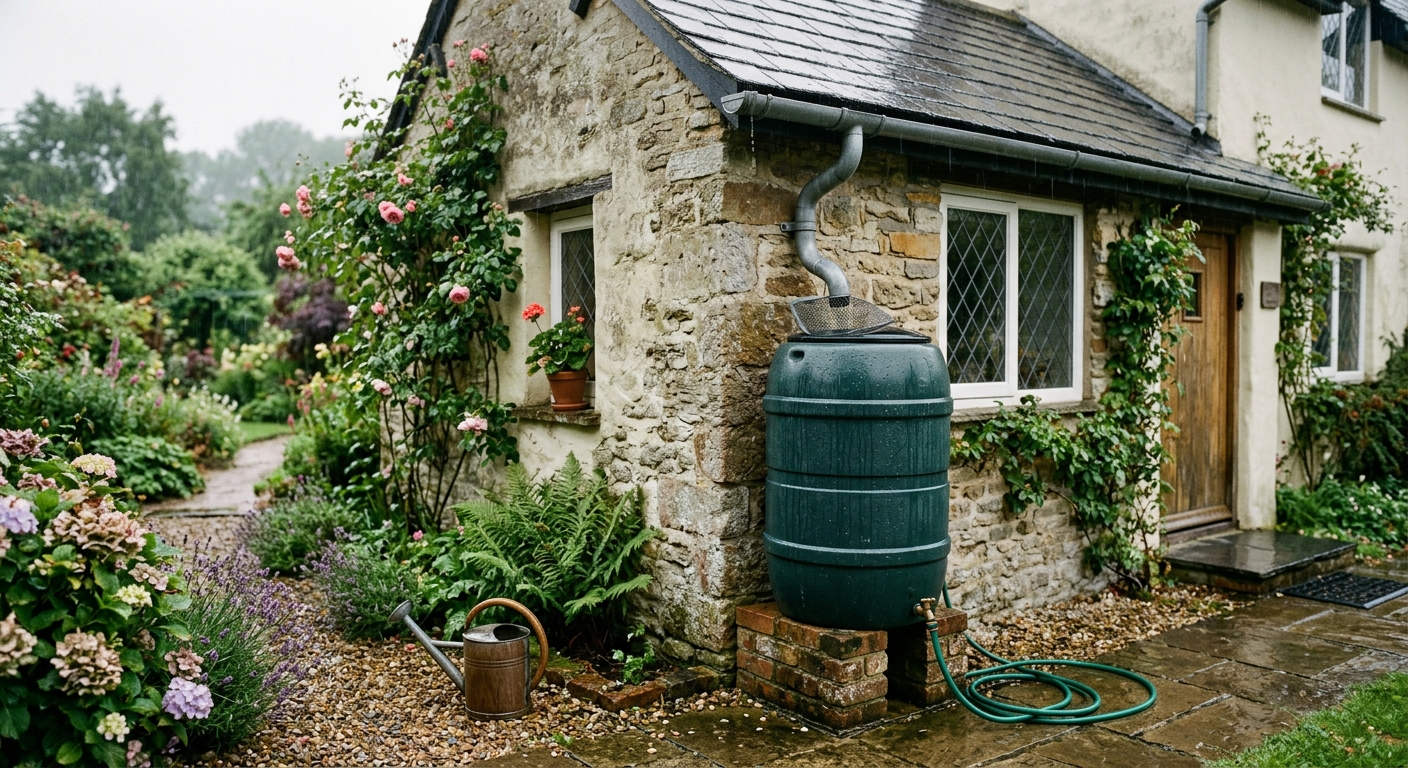
Every inch of rain on a square foot of roof is about 0.62 gallons. Nebraska Extension writes the formula as collection area in square feet times rainfall in inches times 0.623, and a 1,200 square foot roof works out to roughly 750 gallons from a single inch of rain.
You will not get 750. The Texas Water Development Board says installers assume 75 to 90 percent efficiency, losing the rest to splash, texture, and evaporation. Oklahoma State builds 90 percent into its design equation and Oregon State uses 75. Some extension publications print the bare formula with no loss factor at all, which overstates what your gutters will actually deliver by 10 to 25 percent.
Run the number at 0.5 gallons per square foot per inch and you will not be disappointed.
The legality question, corrected
It is not illegal to collect rainwater anywhere in the United States. Pacific Northwest National Laboratory says plainly that no state bans it, there is no federal regulation, and many states have no rules at all.
Colorado is the one everybody cites, and the claim is nine years out of date. HB16-1005 was signed in May 2016 and took effect August 10, 2016. The Colorado Division of Water Resources now allows two rain barrels totaling no more than 110 gallons at residences of four units or fewer, used outdoors on the same property, with sealable lids and no permit. A 2025 bill to remove the gallon cap was postponed indefinitely in committee, so 110 gallons still stands.
Utah requires registration above two covered containers of 100 gallons each, capped at 2,500 gallons, registration free. Nevada exempted rooftop collection at single-family homes in 2017. Oregon requires no water right as long as the water never touches soil between roof and tank. Virginia leaves barrels under 100 gallons unregulated and asks for registration within 30 days on larger non-potable systems.
Check your own state and your own county rather than a listicle. The most recent government-published survey I could find is from 2019, and several of these rules have moved since.
What your roof is made of
Nebraska Extension lists the materials to avoid: asphalt roofing, redwood or cedar shakes, treated wood shingles, anything with asbestos, lead solder or lead paint, and zinc from galvanized flashing.
The sources split on asphalt shingle, and the split is about end use. Texas Water Development Board says composite shingles are not appropriate for potable systems because of leaching. Texas A&M says the common asphalt shingle works fine for watering the yard. Oregon State goes further and considers asphalt runoff acceptable on vegetables because the residues degrade in soil, while ruling out wood shingle, tar, gravel, and concrete for food crops.
Metal is usually recommended, though not for the reason people assume. Texas A&M recommends it because it sheds contaminants easily, not because nothing leaches. A rooftop runoff compilation measured galvanized metal at 14.7 mg/L zinc and galvanized iron at 11.8, against asphalt shingle at 2.33 and a 0.05 mg/L reference standard. Texas A&M’s summary is the useful one: the material matters less than what has settled on it.
Lead is the hard stop. TWDB says lead cannot be used as gutter solder because slightly acidic rain dissolves it.
First flush
The first water off a roof carries the dust, pollen, and bird droppings that accumulated since the last rain. University of Hawai’i reports a large drop in fecal bacteria once the roof has flushed. A first-flush diverter fills a standpipe with that initial water and sends the rest to the tank.
Sizing recommendations span a five-fold range. Hawai’i says 5 to 10 gallons per 1,000 square feet. Oklahoma State, TWDB, and Oregon State say at least 10 per 1,000, with Oregon applying that per inch of rainfall. Texas A&M and TWDB also give 1 to 2 gallons per 100 square feet, and Clemson says 1 per 100.
Ten gallons per 1,000 square feet is the floor everybody agrees on. Twenty is better if you want a cleaner tank and can spare the water.
Do not drink it
CDC states that rainwater is not necessarily safe to drink without removing germs and chemicals first. Colorado State says untreated roof-collected rainwater is not safe to drink and is not recommended as a drinking source. Nebraska recommends it for non-potable uses.
Potable is possible and it is an engineered system, not a filter you screw on. Texas requires filtration to an ANSI/NSF Standard 53 filter followed by chlorine disinfection or a Standard 55 Class A ultraviolet unit, with first-flush or roof-wash pre-treatment ahead of it. Targets are zero total coliforms, zero fecal coliforms, turbidity below 1 NTU.
Mosquitoes
Screen every opening, including the inlet, the overflow, the vent, and any gap around the lid. NC State specifies mesh finer than 1/16 inch. Oklahoma State says 1 millimeter or smaller, which is the more conservative number and the one to buy.
The window is shorter than most people think. Rutgers says some species go from egg to adult in 5 to 7 days in the warmest weather, and recommends checking any barrel where water has stood past 72 hours. If you do treat, NC State says pick a larvicide that sinks, because floating products wash out with the overflow.
Tanks
Opaque, always. TWDB says storage tanks must be opaque on purchase or painted afterward to stop algae. Oklahoma State adds that sunlight degrades the tank itself.
Water weighs 8.34 pounds per gallon and 62.4 pounds per cubic foot, per USGS. That adds up faster than it sounds. A full 55-gallon barrel is over 450 pounds, a 1,500-gallon tank is 12,400, and a 3,000-gallon tank is over 24,000. North Carolina’s cistern manual calls for a 6 to 8 inch gravel base under cisterns up to 1,500 gallons and a 4 to 6 inch concrete pad above that.
Before the first hard freeze, drain and disconnect. Penn State notes water gains about 9 percent volume when it freezes, which is enough force to split a full barrel, and defines a hard freeze as below 28°F for an extended period.
The garden question, which has no consensus
This is where readers most want a clean answer and where the sources refuse to give one.
Against: Nebraska Extension says rain barrel water is not recommended for fruit and vegetable gardens. Arkansas says the best water for a produce garden is municipal. CDC says use tap or bottled water for anything you plan to eat, and keep the barrel for ornamentals.
For, with conditions: Clemson published a best-practices sheet specifically for edibles. Apply at the soil around the base by drip or watering can rather than on the foliage. Water in the morning. Do not apply the day of harvest. Wash everything thoroughly with potable water afterward. Use only food-grade barrels. Rutgers found E. coli in 66 percent of rain barrel samples but exceeding the irrigation standard in only 9 percent, and recommends annual testing plus monthly barrel cleaning.
A Maryland study using first-flush diversion and subsurface irrigation found E. coli within food safety limits and no Salmonella or Listeria. A Cincinnati study of 174 residential barrels found coliform and Enterococcus over EPA standards. Lead was flagged as the largest crop risk, accumulating over time in beans and beetroots.
Ornamentals, lawn, orchard, and livestock water are the uses nobody argues about. For a vegetable bed, the honest position is that it depends on your roof, your barrel, and whether you will actually do the soil-only application and the washing. If the answer to that last part is no, run a hose.
Sources
- University of Nebraska–Lincoln Extension, G2220
- Texas Water Development Board, Texas Manual on Rainwater Harvesting
- Oklahoma State University Extension, BAE-1757
- Oregon State University Extension, EM 9101
- Colorado Division of Water Resources
- Pacific Northwest National Laboratory, PNNL-24347 Rev.1
- Clemson HGIC, Harvested Rainwater on Edibles
- Rutgers NJAES, FS1218
- NC State Extension, Mosquito Control for Rainwater Harvesting Systems
- CDC, Collecting Rainwater and Your Health