
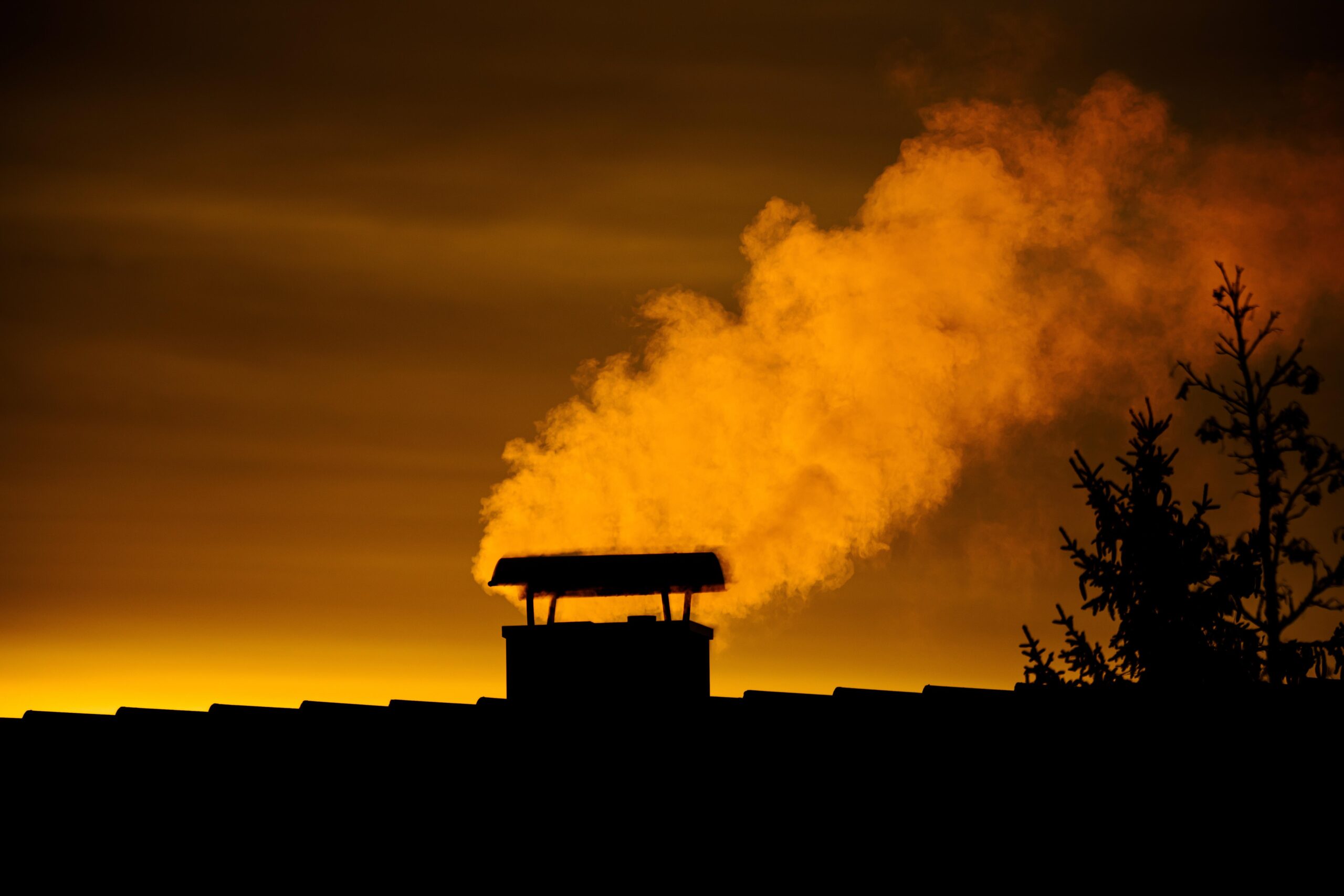
Creosote condenses out of flue gas below 250°F. That single number from University of Missouri Extension explains most of what goes wrong in a wood-burning system, and it is why the chimney check happens now rather than in December.
Wood breaks down chemically around 500°F, and the volatile gases it releases need roughly 1,100°F to ignite. Missouri Extension puts 50 to 60 percent of wood’s heat value in those volatiles. Below the ignition point they go up the flue unburned, hit cool pipe, and condense. Michigan State Extension adds the lower marker: under 150°F the deposits stop being flaky and turn thick, sticky and tar-like.
The heaviest buildup is not where most people look. Missouri says the largest concentration sits in the upper third of the chimney, the coolest part of the run. University of Arkansas notes that creosote up there can ignite and set the roof on fire.
The number to inspect against
The Chimney Safety Institute of America quotes NFPA 211 as requiring chimneys, fireplaces and vents to be inspected at least once a year for soundness, freedom from deposits, and correct clearances. CSIA’s own cleaning trigger is a measurement rather than a date: sweep at one-eighth inch of sooty buildup, and sooner if there is any glaze present.
Annual is a floor, not a schedule. Missouri Extension says check the stovepipe at least once a month on an airtight stove. Michigan State says some authorities recommend cleaning after every third cord burned, and suggests a new system be checked at two weeks, one month and two months after an initial cleaning to learn its rate. A household burning four cords a season and going by the calendar is guessing.
One caution on sourcing. CSIA is a nonprofit certification body for chimney sweeps, not a government agency or a land-grant university. No extension publication found gives a thickness number at all, so the one-eighth inch figure is worth using and worth attributing by name.
Three kinds of creosote, and only two you can brush
CSIA describes three appearances: crusty and flaky, tar-like and drippy, and shiny hardened glaze. All three often occur in one chimney. The stage-one, stage-two, stage-three numbering that circulates online is not CSIA’s language, and no institutional source found publishes it as a formal taxonomy.
The line that does exist is about glaze. CSIA says glazed creosote needs professional-grade chemicals, usually a powder, applied by a sweep to change it into a form that can be removed. The chemical does not remove anything by itself. Mechanical sweeping takes creosote off the flue surface and takes out the loose soot it produces, which is the part a chemical cleaner leaves sitting in the chimney.
You cannot burn it out
The hot-fire advice is half right and gets applied backwards. A hot fire deposits less creosote. University of Arkansas states it directly: a smoldering low-temperature fire produces more creosote than a roaring high-temperature one. Missouri Extension recommends burning an intense fire for at least half an hour daily with the damper open, specifically for high-efficiency stoves.
That is prevention. Nothing in any source found treats a hot fire as a removal method. Deliberately igniting accumulated creosote is a chimney fire, and Missouri documents those reaching 2,000°F.
Sweeping logs land in the same category. CSIA’s position on the Creosote Sweeping Log is that it does not take the place of inspection and professional cleaning, and the product’s own packaging says it will not tell you whether the chimney is blocked or structurally damaged. CSIA executive director Mark McSweeney gave the general rule: chemical cleaners should not replace any service provided by a qualified professional.
The overnight burn is the problem
Damping a stove down for a long low burn is the standard way to hold a fire overnight, and it is the standard way to build creosote. Missouri names slow burning and cool surfaces as two of the three causes, alongside wet wood. Michigan State names low burn rates during mild weather, poor draft and cold chimney walls as aggravating conditions.
Shoulder season is the trap. October and April are exactly when a stove gets run damped down because the house does not need the heat, and exactly when flue temperatures spend the most time under 250°F.
Wet wood does the same thing from the other direction. Arkansas puts green wood at up to 50 percent moisture by weight against 20 percent or less for seasoned, and says wet wood means more creosote in the stovepipe. Penn State calculates about 12 percent more available energy from dried wood than from fresh-cut at 45 percent. No source found gives a degrees-lost-per-percent figure, so the effect is directional.
What the fire statistics actually say
The US Fire Administration reports an annual average of 34,200 residential heating fires for 2017 through 2019, causing 165 deaths, 600 injuries and $367 million in property loss. Heating is the second-leading cause of residential building fires after cooking.
Of those heating fires, 77 percent were confined fires, and chimney or flue fires confined to the chimney accounted for 49.43 percent of the total. In the nonconfined fires the largest single contributing factor was a heat source too close to combustibles, at 27 percent.
EPA’s Burn Wise material states that dirty chimneys cause 30 percent of home heating fires. That figure and the USFA’s 49 percent get quoted interchangeably and they are not measuring the same thing, one being an attributed cause and the other an incident classification. The USFA number comes with a stated reporting period, which makes it the better one to cite. Worth noting that EPA’s Burn Wise program ran from 2009 to 2025 and the agency stopped updating those pages in October 2025.
Clearances and the number not to guess at
The widely quoted NFPA 211 baselines, 36 inches for an unprotected stove and 18 inches for single-wall stovepipe, could not be verified against the standard itself, which is paywalled. The manufacturer’s listing and local code settle it.
Missouri Extension publishes what wall protection buys. Behind a 3.5-inch masonry wall with no ventilated air space, 24 inches. Behind half-inch noncombustible board over an inch of glass fiber, 18 inches. Behind 24-gauge sheet metal over an inch of glass fiber with a one-inch ventilated air space, 12 inches.
Missouri’s other specs are worth a tape measure this month. Floor protection extends 18 inches on all sides of the stove. Stovepipe should be 24-gauge or heavier, with a total run no longer than 8 to 10 feet, no more than two 90-degree elbows, and horizontal runs sloped a quarter inch per foot back toward the stove. Where it passes through a wall it keeps 18 inches from framing. A masonry chimney wants 2 inches of clearance to combustibles all around, extends 3 feet above a flat roof and 2 feet above the ridge or anything else within 10 feet, and takes a flue about 25 percent larger than the stovepipe.
The US Fire Administration covers the rest of the room. Keep anything that can burn at least 3 feet from the stove. Keep the doors closed except when loading. Put ash containers outside, at least 10 feet from the house.
If it is already burning
Missouri describes a chimney fire in progress as a very intense fire, a roaring noise, and flames and sparks shooting from the top. Michigan State adds sucking sounds and shaking pipes. Call the fire department first, then close all openings and draft controls to starve it, and a multi-purpose dry chemical extinguisher or baking soda thrown on the fire can help.
Afterward, CSIA says do not use the chimney again until it has been swept and evaluated by a qualified professional. The evidence a sweep looks for includes puffy or honeycombed creosote, warped damper or connector metal, cracked or collapsed flue tiles, a distorted rain cap, creosote debris on the roof, and smoke escaping through mortar joints. A chimney fire that seemed to put itself out still cracks tile.
Carbon monoxide alarms belong on each level of the house and outside sleeping areas, per the Consumer Product Safety Commission, with batteries replaced yearly and a monthly test. They should not go in attics or unfinished basements. That test takes about a minute and is the cheapest item on this list.
Sources
- University of Missouri Extension G1731, Wood Fuel for Heating — https://extension.missouri.edu/publications/g1731
- University of Missouri Extension G1735, Chimney and Stovepipe Maintenance — https://extension.missouri.edu/publications/g1735
- University of Missouri Extension G1730, Wood Stove Installation and Clearances — https://extension.missouri.edu/publications/g1730
- University of Missouri Extension G1732, Chimneys for Wood Heating — https://extension.missouri.edu/publications/g1732
- Michigan State University Extension Bulletin E1388, Wood Heating Safety — https://archive.lib.msu.edu/DMC/extension_publications/E1388/e1388_84.pdf
- University of Arkansas Division of Agriculture, Fireplace and Wood Stove Safety (FSA1091) — https://www.uaex.uada.edu/publications/pdf/FSA_1091.pdf
- University of Arkansas Division of Agriculture, Fireplace Safety — https://www.uaex.uada.edu/environment-nature/energy/fireplace-safety.aspx
- Penn State Extension, Using Your Wood Stove Efficiently and Effectively — https://extension.psu.edu/using-your-wood-stove-efficiently-and-effectively
- Chimney Safety Institute of America, Homeowner Resources — https://www.csia.org/homeowner-resources
- Chimney Safety Institute of America, Preventing Chimney Fires — https://www.csia.org/latest-news/preventing-chimney-fires
- Chimney Safety Institute of America, After a Chimney Fire — https://www.csia.org/after-chimney-fire
- Chimney Safety Institute of America, statement on the Creosote Sweeping Log — https://web.csia.org/news/newsarticledisplay.aspx?ArticleID=22
- US Fire Administration, Heating Fires in Residential Buildings (2017-2019) — https://www.usfa.fema.gov/statistics/reports/fire-causes/heating-fires-residential-buildings-v21i10.html
- US Fire Administration, Topical Fire Report Series V21I10 — https://www.usfa.fema.gov/downloads/pdf/statistics/v21i10.pdf
- US Fire Administration, Fireplace and Wood Stove Safety — https://www.usfa.fema.gov/downloads/pdf/publications/fireplace_woodstove_safety_card.pdf
- US EPA Burn Wise, Fast Facts — https://www.epa.gov/sites/default/files/2016-11/documents/kit_2_fast_facts.pdf
- US EPA Burn Wise, EPA-Certified Wood Stoves — https://www.epa.gov/burnwise/epa-certified-wood-stoves
- US Consumer Product Safety Commission, CO Alarms — https://www.cpsc.gov/Safety-Education/Safety-Education-Centers/Carbon-Monoxide-Information-Center/CO-Alarms