
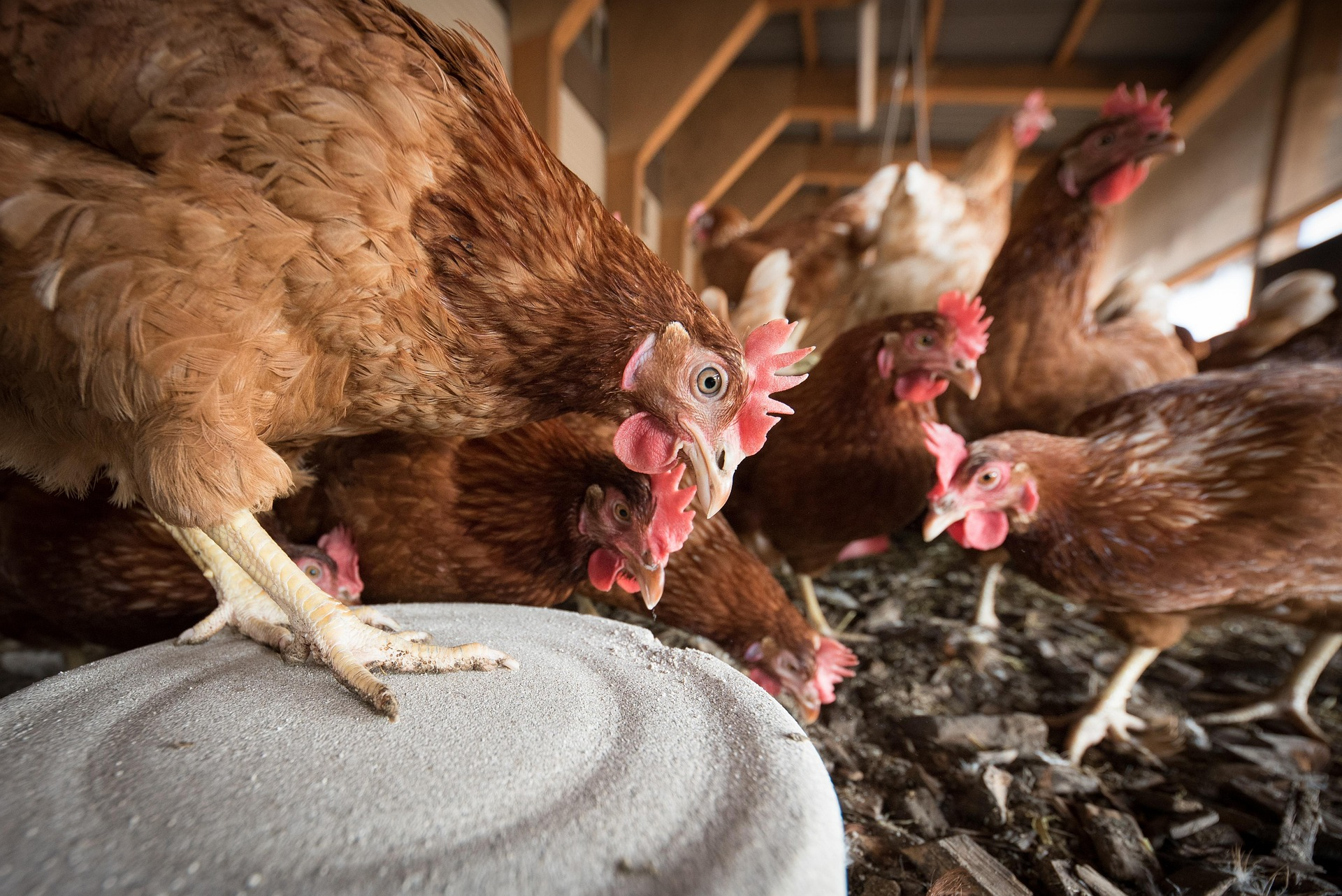
October is the worst month of the year to judge a hen by her output. Penn State Extension names the cause: production falls off when the photoperiod drops below 12 hours a day, which happens most often in September and October. The University of New Hampshire is blunter, saying that by October 31 the days are short enough to stop the flock laying altogether. So an empty nest box in late fall is telling you about the sun.
Which means the decision about who stays through winter has to be made by reading the bird instead. Extension services have a set of physical checks for that, and they are older and more specific than most backyard advice gives them credit for.
The vent and the bones
Mississippi State University Extension describes a laying hen’s vent as large, moist and bleached, running white, pink or bluish-white. A hen out of production has a small, dry, puckered, yellow vent. Utah State University Extension says the same thing in different words: soft and pliable in production, shrunken and dry out of it. Kansas State adds that the laying vent tends to go oblong while the non-producer’s stays round with thin, prominent edges.
Then the pelvic bones, where the sources stop agreeing. Mississippi State says a layer has at least two finger widths between the pubic bones and a non-layer has one or less. Utah State says producers take three to four fingers and non-producers one or two. Kansas State lands with Utah State. Two fingers is a layer to one institution and a non-layer to the other two, so the honest read is that three or more fingers means she is working, one finger means she is not, and two fingers tells you very little.
Mississippi State is the only source that converts the unit, putting one finger width at three-quarters of an inch. The University of Kentucky’s national judging manual goes further and tells judges outright not to quote finger counts in oral reasoning, because finger size varies between people. Kentucky’s own fact sheet says the method works as long as the same person measures every hen. That is the honest framing of the whole technique. It ranks birds within one flock, by one hand, on one afternoon.
Depth from the keel to the pubic bones is the second measurement, and it splits the same way. Mississippi State calls three or four finger widths, about two and a half to three inches, a layer, and two fingers a non-layer. Kansas State calls four to five fingers a good producer and two or three fair to poor. Those Kansas State numbers come out of a 1922 circular written for heavy dual-purpose farm stock; Mississippi State is describing lighter modern layers. Same measurement, different birds.
One warning is worth more than any of the numbers. Kansas State says a hen with a hard, rubbery, unyielding abdomen full of fat should not be mistaken for a good layer even when the spread measures well. Capacity is half the signal. Softness is the other half.
Pigment, and why it fails on most backyard flocks
A laying hen pulls yellow pigment out of her skin in a fixed order: vent, eye ring, ear lobe, beak from the corner of the mouth outward, bottom of the foot, shank, then hock and the tops of the toes. Kentucky, Georgia, Mississippi State and Utah State all publish that sequence and they agree on it completely.
The University of Wisconsin is the only one that attaches egg counts. Its table runs a bleached vent at nought to 10 eggs, a fully bleached beak at about 35, a bleached shank at 159, and hock and toes at 180. So a hen with pale shanks has done real work this year, and a hen whose legs are still bright yellow in October has not.
That reverses the folk reading, where bright yellow legs get taken as a sign of a healthy productive bird. In a yellow-skinned breed they mean the opposite.
Here is the limitation nobody mentions. Utah State restricts the whole pigment method to genetically yellow-skinned breeds fed a diet containing xanthophyll, and names Dorking, Sussex and Orpington as excluded. Kansas State excludes those three plus dark-shanked breeds like Langshans and Andalusians. Mississippi State says that in white-skinned breeds the bleaching is less pronounced and harder to detect. Leghorns, Plymouth Rocks, Rhode Island Reds, New Hampshires and production sex-links work. A good share of what sits in backyard coops does not, and no extension source offers a substitute test for those birds.
The timing figures disagree too, and the disagreement is instructive. Utah State puts a fully faded beak at four to six weeks into production, Wisconsin at five to eight, Mississippi State at six to eight for the tip alone. Two things drive that. The sources split the beak and shank into different numbers of sub-stages, so a bleached beak is not the same claim from one publication to the next, and bleaching rate depends on how much xanthophyll the bird is eating. A hen on pasture and a hen on plain layer feed will not fade at the same speed, and none of the week counts adjust for it.
The molt is a signal, not a verdict
A bird in hard molt looks finished and usually is not. Mississippi State says late molters lay for 12 to 14 months before molting and then shed quickly, in two to three months, and that these are generally the better hens. Early molters may start after only a few months in production and can take four to six months to finish. The bird that is still in full feather and laying in October is the one to think hardest about keeping.
The condition of the plumage reads backwards from instinct as well. Kansas State describes the good late-molting layer as rough, soiled, dry and worn threadbare, and the low-producing early molter as clean and bright. A tidy hen in autumn has been resting.
Mississippi State also says to delay culling when a significant part of the flock is in or recovering from a molt, and to handle the birds at night, because sorting a flock in daylight costs eggs from the hens you meant to keep.
What a second-year hen actually costs
Production drops in year two, but not off a cliff. Kansas State published actual counts: Leghorns went 198 eggs in year one, 151 in year two, 120 in year three; Rocks and Reds went 170, 140, 104. That is 76 percent and 82 percent of first-year output respectively, converging at 61 percent in year three. Rutgers gives roughly 20 percent fewer eggs in a second cycle, which is a fair average that hides a real breed difference. Treat those Kansas State absolute numbers as history rather than a target, since they describe 1920s genetics against New Hampshire’s modern figure of 250 to 300 eggs a year from a white Leghorn.
Feed is the other half of the arithmetic, and it is yours to do. Alabama Cooperative Extension puts a laying hen at 100 to 150 grams of feed a day, roughly a quarter pound. Rutgers gives 18 to 24 pounds a week per 10 birds. New Hampshire says 90 to 100 pounds a year. The University of Maryland explains most of the spread by measuring brown and white layers separately from 19 to 70 weeks: 104 pounds against 80. Brown birds eat about 30 percent more for the same period, which is why a single national figure never fits.
How long a hen stays worth feeding depends on which question is being asked. The University of Kentucky says most hens are economically productive for only two years. Kentucky’s own poultry extension site says home flocks lay on and off for three to four years. Both are from the same institution and neither is wrong. One is an economic threshold and the other is a biological one, and extension literature tends to answer the first while homesteaders are usually asking the second.
Kansas State put the practical culling season from about the middle of July through the middle of October, and said systematic culling outside that window is not practical. That window is closing.
Sources
- Mississippi State University Extension Service, Culling Hens — extension.msstate.edu and poultry.msstate.edu
- Mississippi State University Extension Service, Molting Laying Hens — extension.msstate.edu
- Utah State University Extension, Molting and Determining Production of Laying Hens — extension.usu.edu
- Kansas State University Extension, Sc147 Culling Poultry — extension.k-state.edu
- Kansas State University Extension, Sc093 Culling Farm Poultry — extension.k-state.edu
- University of Wisconsin–Madison Division of Extension, Judging Ready-to-Lay Pullets — livestock.extension.wisc.edu
- University of Kentucky, National 4-H Poultry Judging Manual — national4hpoultry.mgcafe.uky.edu
- University of Kentucky Cooperative Extension, 4AJ-07PA — publications.mgcafe.uky.edu
- University of Georgia Extension, poultry judging notes — extension.uga.edu
- Penn State Extension, Artificial Lighting for Winter Egg Production — extension.psu.edu
- University of New Hampshire Extension, Producing Your Own Eggs — extension.unh.edu
- Rutgers NJAES, FS148 Helpful Hints for Small Flock Management — njaes.rutgers.edu
- Alabama Cooperative Extension System, Feeding the Laying Hen — aces.edu
- University of Maryland Extension, Feeding the Flock — extension.umd.edu
- University of Kentucky Cooperative Extension, ASC-192 Why Have My Hens Stopped Laying? — ASC-192
- Poultry Extension (University of Kentucky), Raising Chickens for Egg Production — poultry.extension.org
Leave a Reply