
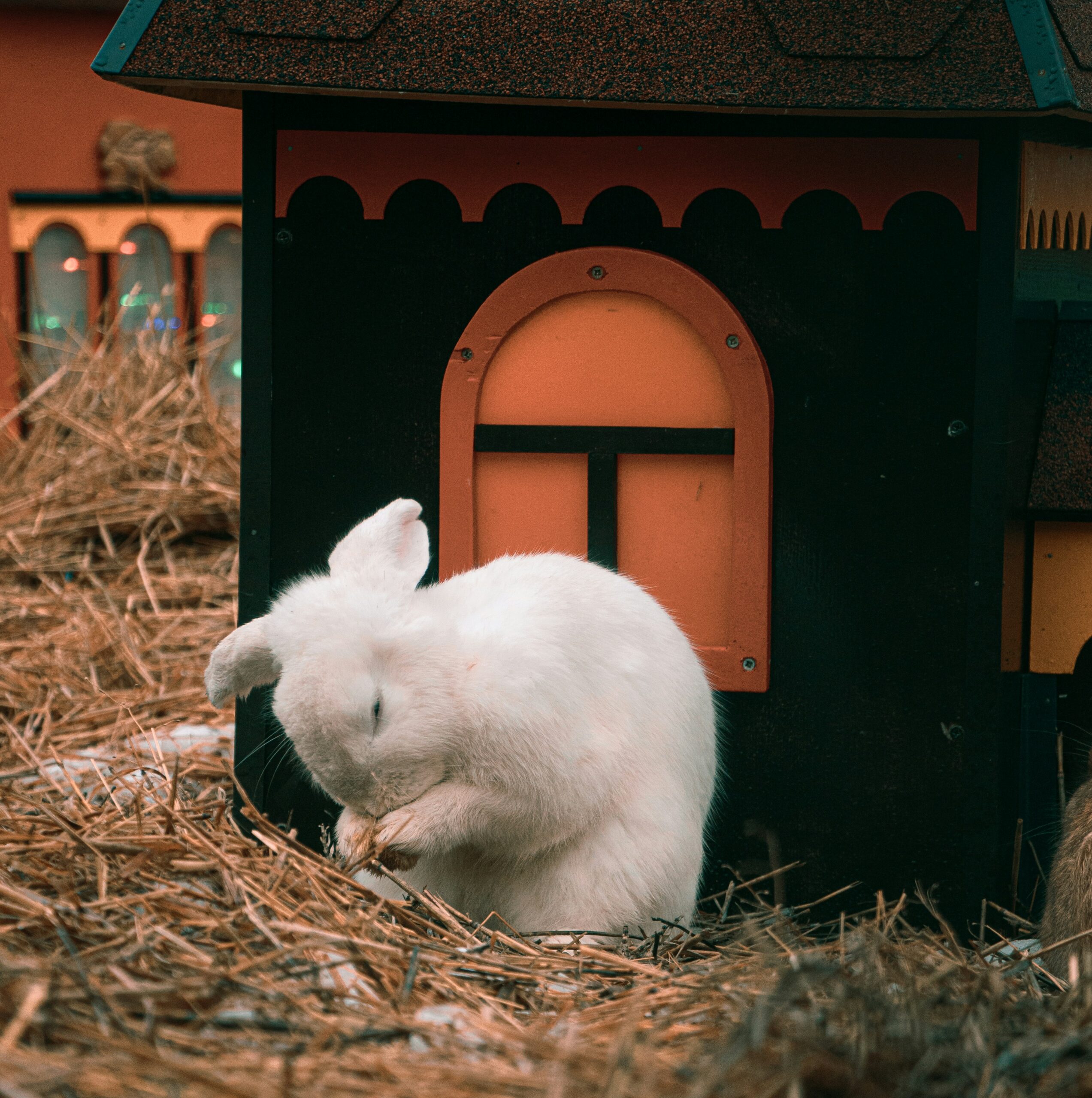
Rabbits handle cold far better than heat, and the extension sources are unusually direct about it. Michigan State University Extension puts it in one sentence: domestic rabbits need more protection from summer sun and high temperatures than they do from the cold wind and snow of winter. The mechanism is that rabbits do not sweat. They shed heat through their breath and through air moving across the body, which works well in January and poorly in July.
That is where most of the internet stops reading, and it is where the useful part starts. Michigan State bounds the claim: temperatures of 20 to 60 degrees F are not usually much of a problem, given proper protection. Twenty degrees is the floor in that sentence, not an open invitation to sub-zero exposure.
Nobody agrees on the comfortable range
Michigan State gives 60 to 65 degrees as the comfort zone. The American Rabbit Breeders Association says 55 to 70. Alabama Cooperative Extension says 50 to 60. Those three ranges overlap but do not match, and none of them is a temperature you can hold in an outdoor hutch anyway, so treat them as context rather than a target.
The heat end is worth carrying in your head for next summer, because the numbers there split too. Overheating signs start above 85 degrees according to eXtension and ARBA. Michigan State and Mississippi State both put heat prostration above 92. Separately, Michigan State and the University of Maine agree that mature bucks often go sterile after four or five straight days above 85. Those are three different endpoints being quoted as one threshold, which is how 85 degrees ended up online as the collapse point when two of the five sources put collapse at 92.
Wind and wet, not temperature
Michigan State says to face hutches south or east, away from prevailing northwest wind and storms. Put them beside a building, a solid fence or a woodlot, or drape lightweight plastic sheeting over them. eXtension gives the same layout from the other direction: solid back facing north, sides boarded up, and the south-facing front only partially covered so wind-whipped snow stays out. Raise the hutch off the ground so water and snow cannot get in underneath.
Partially is the operative word. Michigan State warns that everything you do to stop heat loss can also stop airflow, leaving pens damp or wet and letting odors and ammonia build. eXtension says the same thing more bluntly: do not close off the cage too tightly. The target Michigan State describes is gentle air movement around each animal with no drafts, no pockets of stale air and no sudden temperature swings. Mississippi State adds a specific failure mode. Solid-sided cages with wire floors create up-drafts. That is the one draft people build on purpose without meaning to.
You will see a figure quoted as the winter rabbitry temperature, 40 to 80 degrees with humidity under 60 percent. That is Michigan State, and it is a specification for a ventilation system, not a heating setpoint. No extension source I could find recommends heating a hutch or a rabbitry at all. That is a genuine gap in the published guidance rather than an endorsement, but the direction the sources push is clear enough: block wind, keep things dry, keep air moving.
Water is the actual winter job
Everything else on this list is a one-afternoon fix. Water is a twice-a-day problem for four months. Michigan State’s instruction is to water two or three times a day whenever the temperature sits at or below freezing, and to keep two sets of dishes so one thaws while the other is out. eXtension is direct about bottles: do not use them in winter, because they freeze and crack. Bowls, rotated several times a day in hard cold.
For how much, eXtension gives a formula rather than a number, roughly 8 teaspoons of water per pound of body weight per day, which works out to about 40 teaspoons for a 5-pound rabbit. Michigan State frames it as a ratio instead: rabbits normally drink about twice as much water as feed.
The gallon-a-day figure needs a caveat that almost never travels with it. Penn State, Michigan State and Texas A&M AgriLife all give one gallon per day for a doe and her litter, and Penn State qualifies that further as warm weather. It is not the intake of one rabbit. Applying it to a single buck misstates all three sources by a wide margin. Mississippi State lists lack of water among the causes of cannibalism and abortion in does, which is the reason the watering schedule is not the thing to let slide when it is 15 degrees and you are already late for work.
Feed goes up, and nobody will tell you by how much
Michigan State says cold winter temperatures increase the energy needs of rabbits. It gives no percentage. eXtension suggests adding a little corn and a little more feed to the bowl, with no quantity attached to either. I went looking for a number and there is not one in the extension literature, so any blog quoting a tidy percentage increase for winter feed is quoting itself.
Baseline rations do not agree either. Penn State puts bucks and dry does at 6 to 8 ounces of pellets a day. Texas A&M AgriLife says 3 to 6 ounces for the same animals. Oregon State gives 3 to 9 ounces as the general range, which is wide enough to contain both. Weigh what your own rabbits clean up and adjust from there, because that spread is telling you the published numbers are starting points.
Kindling in the cold
ARBA puts the nest box in at day 28 of a 30- to 31-day gestation. Box dimensions vary by source: Maine says 10 by 16 by 8 inches, Texas A&M 16 by 10 by 8, Mississippi State 12 by 18 by 10 filled two-thirds with clean hay or straw. Any of those work. What matters more in winter is what Michigan State identifies as the loss mechanism, and it is not cold air. The doe’s breath condenses on the fur in the nest box, the nest goes damp, and wet kits do not make it. Check the nest and replace wet material. eXtension recommends straw over hay for bedding, on the grounds that straw insulates better, and it needs changing periodically.
Michigan State also suggests saving clean dry fur from old nests to supplement what the doe pulls.
Two places the sources contradict each other outright
Resting boards. Maine recommends a quarter-inch plywood board, 6 by 8 inches, for heavy rabbits. Mississippi State says do not place boards in wire cages because they promote unsanitary conditions. Both are extension guidance and they cannot both be followed. Read Maine’s version as a foot-pressure measure for heavy animals rather than a warmth measure, and Mississippi State’s as a sanitation warning, and then decide which problem you actually have.
Cage space. UC Agriculture and Natural Resources uses a per-pound rule, a minimum of 0.75 square feet per pound, so an 8-pound rabbit needs 6 square feet. ARBA uses fixed tiers and asks for 3.0 square feet for anything from 4.4 to 8.8 pounds. That is roughly a twofold difference for an ordinary meat-breed rabbit. The fixed-dimension sources side with the larger figure: Penn State, Maine, Mississippi State and UMass all describe a 30-by-30 cage, which is 6.25 square feet.
One more thing worth knowing about the sources themselves. The Michigan State bulletin that carries most of the winter-specific detail, Rabbit Tracks 4H1439, is dated 1988. The husbandry in it has not been superseded by anything newer that I could find, which says more about how little winter rabbit research gets published than about the bulletin.
Sources
- Michigan State University Extension, 4-H Rabbit Tracks: Winter Rabbit Care (4H1439)
- Michigan State University Extension, 4-H Rabbit Tracks: Summer Rabbit Care (4H1440)
- Michigan State University Extension, 4-H Rabbit Tracks: Feeds and Feeding (4H1465)
- eXtension Companion Animals, Cold Weather Care for Rabbits
- eXtension Companion Animals, Hot Weather Care for Rabbits
- eXtension Companion Animals, Nutrients Required by Rabbits
- Penn State Extension, Rabbit Production
- University of Maine Cooperative Extension Bulletin #1044, Backyard Production of Meat Rabbits
- Mississippi State University Extension, Commercial Rabbit Production
- Texas A&M AgriLife Extension, Rabbit Project Reference Manual
- Alabama Cooperative Extension System UNP-0082, Summer Heat and Rabbit Production
- American Rabbit Breeders Association, Recommendations for the Care of Rabbits and Cavies
- University of California Agriculture and Natural Resources, Rabbit Care
- UMass Amherst Center for Agriculture, Rabbit Housing
- Oregon State University Extension, Raising Rabbits for Meat: Providing Basic Care