
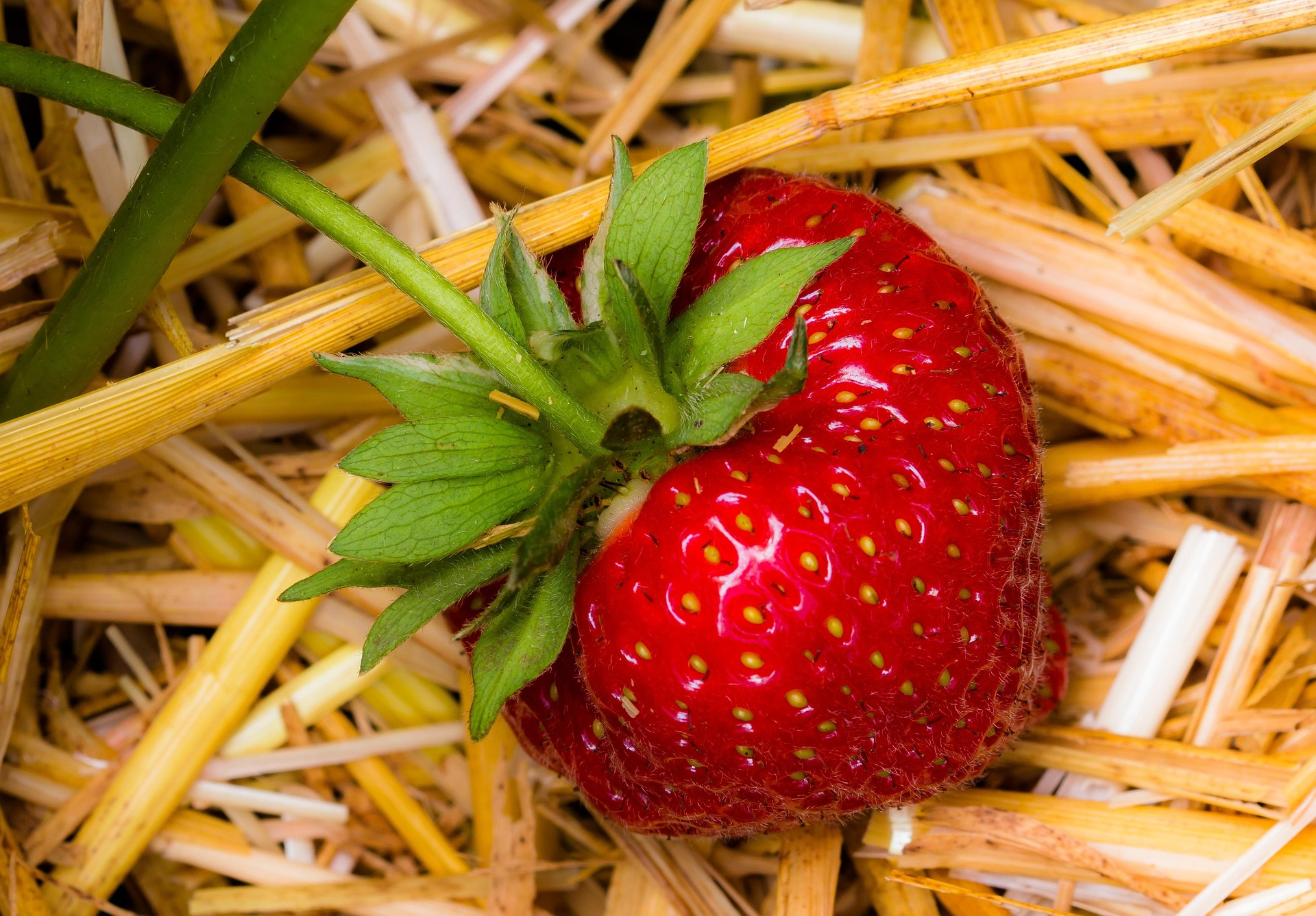
Winter mulch does not keep plants warm. Purdue University Extension states the goal outright: to keep the plants dormant, rather than to keep them warm. The job is to stop the soil swinging through freeze and thaw cycles that work crowns and roots up out of the ground, which Iowa State and the University of Minnesota both call frost heaving. Wisconsin Extension puts it negatively: the aim is to avoid freeze and thaw, not to keep the ground unfrozen.
Get that backwards and the timing goes with it. A gardener who thinks mulch is a blanket puts it down when the weather turns cold, which is usually about six weeks too early.
The one number everyone quotes, in two opposite directions
Both Iowa State and the University of Illinois build their strawberry advice around 20°F, and they use it to mean opposite things.
Illinois says to apply straw after several frosts but before the temperature drops below 20°F. That is a deadline. Iowa State says temperatures below 20°F signal dormancy, which makes it a starting gun. A gardener reading both would get it exactly backwards half the time. Manitoba Agriculture and the Ontario agriculture ministry both settle it the way Illinois does, telling growers to mulch before the air reaches minus 6.7 to minus 7°C, which is 19 to 19.4°F. Treat 20°F as the line you want to beat, not the cue to start.
The soil-temperature version is cleaner. Minnesota Extension says to mulch once soil at four inches has held at or below 40°F for three consecutive days. Cornell says 40°F after three hard freezes. Manitoba uses 4 to 5°C at four to five inches for three days, and credits the University of Illinois for the guideline. Those are not three separate results that happen to agree. They are one rule, reprinted.
Penn State takes a different line and puts the trigger on the plant rather than the thermometer: mulch after the plants are fully acclimated, which in Pennsylvania usually means early December. Penn State also supplies the reason the timing is so unforgiving. Daylength alone hardens a strawberry to only about 25°F. Full cold tolerance arrives later, and plants de-acclimate again above about 50°F.
Manitoba publishes a field test that beats any thermometer. Lay a piece of plywood over some plants and lift it after a couple of days. Yellow means they are still growing and not ready; green means dormant. Minnesota gives the same test with a three-day interval.
The calendar dates run from late October in Manitoba through mid-November in Maine, New Hampshire and Ontario, early December in Pennsylvania, mid-December in Missouri, and mid-to-late December in Oklahoma. That is a two-month latitude gradient. Any single date offered as the date to mulch strawberries is somebody’s local answer.
Why early is worse than late
Minnesota says plants mulched before dormancy are weakened by trying to grow under the straw. Purdue says early mulch can smother the plant and encourage disease. Iowa State says it slows plants from going dormant and makes them more vulnerable to cold. Ontario warns about crown and leaf rot. Oklahoma State says mulching earlier may cause serious injury over the winter.
Four extension services and a provincial ministry all describe the same failure. Nobody warns about mulching a week late.
How deep, and why the answers look four times apart
Ohio State, Minnesota and Cornell say 2 to 3 inches. Iowa State says 3 to 5. Illinois and Oklahoma State say 3 to 4. New Hampshire says 3 to 6. Maine says 6 to 8. That spread mostly dissolves once you notice which moment each source is describing.
Iowa State says 3 to 5 inches at application settling to 2 to 4. Manitoba says 4 to 6 inches settling to 2 to 3. Cornell’s 2 to 3 inches is specified as the depth after settling. So Cornell and Manitoba are giving the same instruction from opposite ends of the same event. For a home bed Illinois gives the figure directly: 100 to 150 pounds of straw per 1,000 square feet, which is two to four bales, at three to four inches. Wisconsin gives the rule of thumb that one bale covers about 100 square feet three inches deep.
Raised beds need more, and not because they are colder overnight. They freeze from the sides as well as the top. Iowa State calls for 6 to 8 inches on raised beds against 3 to 5 on flat ground.
Straw, not hay, and not whole leaves
Maine says plainly not to use hay because it carries weed seed. Ontario calls hay too full of grass and weed seed. New Hampshire agrees and Missouri notes hay often contains grain seed. The one real exception is marsh hay, which Wisconsin recommends by name because it is cut from wetland sedges whose seed will not germinate in a garden bed.
Leaves are the other trap, and the objection is narrower than it first looks. Iowa State says leaves mat together in layers and are unsuitable for strawberries. Ontario says they smother the plants. Wisconsin and Virginia Tech say the same. Yet Minnesota lists chopped leaves as a workable option and Iowa State’s own general mulch guide says shredding prevents matting. One institution contradicting itself across two pages is a fair signal of where the truth sits: shred them and they work, pile them whole and they suffocate the crowns.
Over the crown, or not?
Virginia Tech says never apply mulch over the crown, and to keep it three to four inches off trunks. Every strawberry publication says to cover the plants completely. Minnesota says to cover the plants by 2 to 3 inches.
Those two rules are about different things and no source states the distinction. Permanent mulch against a crown holds moisture against living tissue all year and rots it. Winter mulch over a strawberry crown is a temporary covering that only works because it comes off in spring. If it does not come off, it becomes the permanent kind, and Cornell reports the result as crown rot and starved plants.
Mulch brings voles
The belief that mulch protects plants from rodents runs backwards too. Missouri Extension states that mulching with sawdust or wood chips provides habitat for voles, and lists snow cover, leaves and brush piles alongside it. Virginia Tech notes straw is attractive to rodents.
The countermeasure is mechanical rather than chemical. Missouri specifies hardware cloth cylinders of quarter-inch mesh or finer, buried about six inches so voles cannot tunnel underneath. Minnesota adds that guards have to stand taller than the winter snow line, because the chewing happens under the snow where nobody sees it until spring.
Most established perennials need nothing
Penn State draws a line the other sources leave blurry: winter mulch is for newly planted or divided perennials and tender plants. Not the whole bed. Missouri narrows it by species instead, naming small bulbs, aconite, coral bells, peony and plantain lily as the heave-prone ones.
Where mulch is warranted, Iowa State and Wisconsin both say 6 to 8 inches over herbaceous perennial crowns in the upper Midwest, while Purdue, Missouri and Virginia Tech say 2 to 4 inches. Virginia Tech gives the physical reason for the low end, capping fine-textured material at 1 to 2 inches because it lets less oxygen reach the root zone. Depth depends on climate and on particle size, so a number quoted without naming the material is only half a recommendation. Iowa State adds one flat prohibition: no Styrofoam rose cones or domes, because they warm up early in spring and pull plants out of dormancy.
Snow does the same job, when it shows up
Iowa State measured heavy snow cover holding the soil surface up to 20 degrees warmer than exposed ground. North Dakota State reported soil at 12 inches sitting at 31°F on a day the air was 4°F. Minnesota found 4 to 10 inches of snow gives effective insulation, and cited Michigan data showing 3 to 42 percent winterkill under four inches of snow against 39 to 98 percent with none.
Minnesota still says not to count on it. Iowa State documents the failure mode from the other direction: on dry soil with no snow, mulch blows off and soil temperatures drop. The two are backup for each other, and in a dry, snowless winter both can fail at once.
Sources
- Purdue University Extension, Mulch for Winter Protection — purdue.edu
- Iowa State University Extension and Outreach, overwintering strawberries — yardandgarden.extension.iastate.edu
- Iowa State University Extension, perennials FAQ and Using Mulch in the Garden — perennials, mulch guide
- Iowa State University Extension, winter injury and snow cover — yardandgarden.extension.iastate.edu
- University of Minnesota Extension, adding and removing straw mulch — extension.umn.edu
- University of Minnesota Extension, covering strawberries for winter — extension.umn.edu
- University of Minnesota Extension, snow and winterkill — blog-crop-news.extension.umn.edu
- Cornell Cooperative Extension, overwintering strawberries — blogs.cornell.edu
- University of Illinois Extension, Growing Strawberries — extension.illinois.edu
- Penn State Extension, Strawberry Plants and Winter: Ready or Not — extension.psu.edu
- Penn State Extension, Care and Maintenance of Perennials — extension.psu.edu
- Ohio State University Extension, HYG-1424 — ohioline.osu.edu
- Oklahoma State University Extension, Growing Strawberries in the Home Garden — extension.okstate.edu
- University of Maine Cooperative Extension, Bulletin #2067 — extension.umaine.edu
- University of New Hampshire Extension, Growing Fruit: Strawberries — extension.unh.edu
- Province of Manitoba Agriculture, timing winter protection on strawberries — gov.mb.ca and timing PDF
- Government of Ontario, Growing Strawberries for Home Gardens, 22-035 — files.ontario.ca
- Virginia Cooperative Extension, SPES-661 — pubs.ext.vt.edu
- University of Wisconsin–Madison Extension, winter mulch and preparing landscape plants — kenosha.extension.wisc.edu, hort.extension.wisc.edu
- University of Missouri Extension, G6960 and G9445 — G6960, G9445
- North Dakota State University Extension, Dakota Gardener: Winter Insulation — ag.ndsu.edu
Leave a Reply