
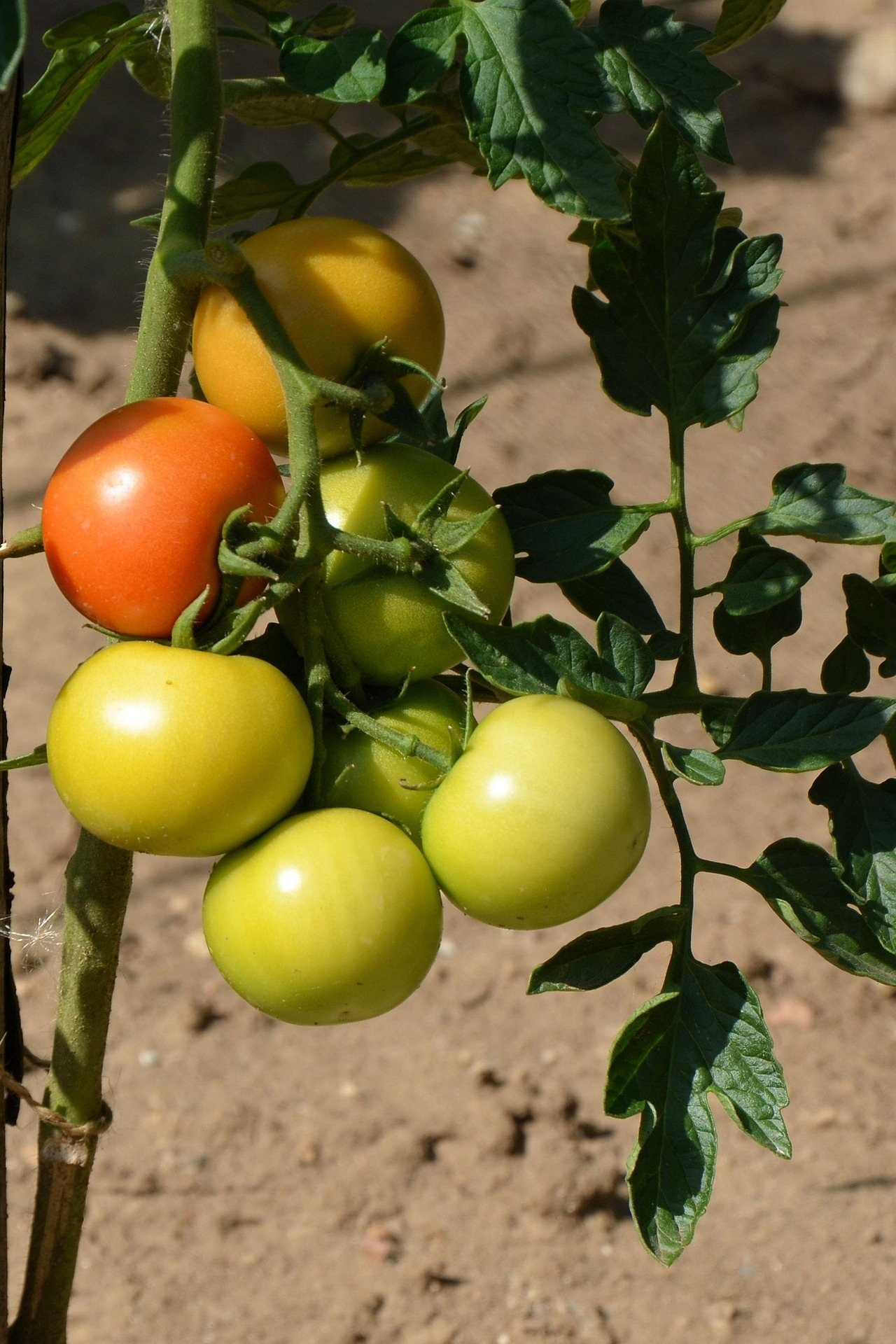
Cut one open before you pick the rest. USDA’s Agriculture Handbook 66 sorts green tomatoes into four internal maturity stages, and the sorting decides the whole job. At M-1 the seeds are white, a knife slices them, and there is no gel in the cavities. M-2 has tan seeds and gel in at least two of them. At M-3 the seeds are pushed aside rather than cut, every cavity has gel, and the flesh is still green. M-4 shows the first red in the gel.
Then the payoff, in the Handbook’s own words: fruit at M-3 or M-4 “will ripen to high quality if handled properly,” M-2 fruit “will ripen to moderate quality,” and M-1 fruit “will not ripen to acceptable levels of quality.” Not every green tomato is going to become a tomato. One sacrificed fruit tells you how much of the basket is worth carrying inside.
The outside tests, and why they disagree
Nobody wants to cut fruit open, so extension services publish external proxies, and they are not the same proxy. Colorado State grades by blossom-end color: fruit showing a pink blush “will ripen off the vine without any loss of flavor,” fruit with “a white to light green star shape on the blossom end” ripens with reduced flavor, and matte-green fruit will not ripen at all. Alaska Fairbanks looks for cream-colored streaks at the blossom end and adds a thumbnail test, where a mature fruit’s skin is “not easily broken or rubbed loose when scraped.” UConn and Nebraska simply say full-sized and “glossy, whitish green,” with no internal check at all.
Those proxies are all trying to find M-2 or better from the outside. Cut one and you know; go by skin color and you are estimating.
One piece of received wisdom dies here. Penn State states that at the breaker stage “the tomato receives no additional nutrients from the plant,” and that a tomato is physiologically ripe at breaker. So leaving fruit on the vine past the first blush of color buys you nothing the fruit could not do on a shelf, and the idea that a tomato keeps feeding from the plant until it turns red is simply wrong.
Temperature is the dial, and there is a floor
Warm and fast, or cool and slow. Pick one on purpose. UConn gives the cleanest pair of numbers: 65 to 70°F ripens mature-green fruit in about two weeks, while 55°F stretches it to three or four. Colorado State agrees, calling 70°F a matter of weeks and 55°F about a month. USDA puts ideal ripening at 66 to 70°F with 90 to 95 percent humidity, and UC Davis lands at 65 to 70°F, naming 68°F as the temperature that gives the best eating quality.
The floor is where the sources fight, and the fight is worth understanding because it is not really a contradiction. USDA says storage below 55°F “retards ripening and can lead to development of chilling injury, particularly in tomatoes at the mature-green stage.” UF/IFAS agrees that below 55°F causes abnormal ripening. But Clemson and Maryland both file green tomatoes at 50 to 70°F for one to three weeks, and Colorado State puts the chilling threshold at 50°F flat.
UC Davis is the only source that treats it as a dose rather than a line: injury occurs below 50°F if fruit is held longer than two weeks, or at 41°F after six to eight days. That resolves it. Fifty degrees for five days is not the same exposure as fifty degrees for a month, and the sources quoting a single threshold are compressing a time-and-temperature relationship into one number. Hold at 55 to 60°F if you want the long, slow version, and do not go below 50°F at all.
The ceiling is real too, and it kills the idea that a hot spot ripens faster. UC Davis says above 77°F fruit turns “more yellow and less red.” USDA says above 81°F reduces the intensity of red color. Purdue, Colorado State and Penn State all put the cutoff at 85°F, with Purdue stating that tomatoes do not produce lycopene and carotene above it, and SDSU says 86°F. The exact number is contested. The direction is not.
Ethylene, bags and the sunny windowsill
The ethylene part is real and smaller than people think. USDA reports that as little as 0.5 µL per liter is enough to trigger ripening, and that once a tomato reaches breaker it produces enough on its own and “no longer require gassing.” So tossing one or two ripe tomatoes in with the green ones works, as SDSU and Colorado State both recommend.
What nobody has published is any comparison. No acceptable source quantifies a banana against a ripe tomato, gives a day count for the bag method, or measures a closed paper bag against an open box. Wrapping each fruit in newspaper is prescribed by Iowa State, Nebraska, SDSU and UConn, and not one of them compares it to leaving the fruit bare. Treat the bag and the newspaper as humidity management, which is what SDSU actually says they do, rather than as accelerants.
The windowsill is worse than useless. SDSU: “Do not place the fruit in a sunny window; this will shorten shelf life, and light is not necessary for ripening.” Alaska Fairbanks: “Light is not needed to ripen the tomatoes.” Penn State: “sunlight is not a factor in fruit ripening.” Store them in the dark: a basement, cellar or closet.
How to lay them out
Not deep. USDA notes tomato fruit are sensitive to compression stress, and the layout rules follow from that: Iowa State says a single layer, UConn says no more than two deep, Colorado State says one to two, and SDSU allows three layers as long as the fruit are not touching each other. Humidity targets run 85 to 95 percent across USDA, UC Davis, UF/IFAS and Alaska Fairbanks. Colorado State skips the number and gives the tradeoff instead, which is that too much humidity molds the fruit and too little shrivels it.
Stems are genuinely contested among acceptable sources, so pick by your own storage. Iowa State, Nebraska, UConn and Colorado State’s own extension page all say remove them, and UConn gives the reason: stems puncture neighboring fruit. Colorado State’s PlantTalk page instead says to clip a very short stem piece. SDSU sidesteps it by storing fruit stem-side down. If the fruit are touching, take the stems off.
The frost deadline, and the refrigerator
Nebraska Extension draws the hard line: green tomatoes harvested before frost “can be stored at 50 to 55 degrees F and ripened for weeks. Those picked after frost will not ripen or keep long, however.” Tomato is a tender crop, damaged at 28 to 32°F, and USDA puts the fruit’s freezing point at 30 to 31°F. A light frost is 28 to 32°F by Nebraska’s own definition, so the night that ends the season ends the salvage window too. Pick before it, not after.
Then leave the ripe ones out of the refrigerator. USDA cites a trained sensory panel finding that fruit stored at 36, 41, 50 and 55°F “had reduced levels of important volatiles and had less-ripe aroma and flavor as well as more off flavors” compared to fruit held at 68°F, and that fruit at 50°F rated below fruit at 55°F. UF/IFAS calls storage below 50°F, “both during handling and in the home,” a major contributor to poor tomato flavor. Clemson allows four to seven days in the refrigerator while warning of reduced flavor and a mealy texture, and UC Davis recommends 44 to 50°F for three to five days for firm-ripe fruit. Maryland and Colorado State just say do not.
One last disagreement, and it is the one that matters most tonight. Maryland says “You will not be able to tell the difference between fruits ripened indoors compared to fruits that ripen on the plant.” Colorado State says only blush-stage fruit ripens without flavor loss, and mature-green fruit comes in with reduced flavor development. USDA splits the difference with a specific condition: mature-green fruit that reaches breaker within three days ripens to quality similar to fruit picked at breaker or later. Speed off the vine is the variable. A tomato that sits green on the counter for three weeks is not going to taste like September no matter what you wrap it in.
Sources
- USDA Agricultural Research Service, The Commercial Storage of Fruits, Vegetables, and Florist and Nursery Stocks, Agriculture Handbook Number 66, revised 2016 (Tomato chapter by Sargent and Moretti)
- UC Davis Postharvest Research and Extension Center, Tomato produce facts sheet
- University of Florida IFAS Extension, Handling Florida Tomatoes—Round and Roma Types (SS-VEC-928/VH079)
- University of Alaska Fairbanks Cooperative Extension Service, A Harvest of Green Tomatoes (FNH-00024)
- Colorado State University Extension, Ripening Tomatoes Indoors; PlantTalk Colorado How to Ripen Green Tomatoes and Harvesting and Ripening Tomatoes
- UConn Extension, Is your garden bursting with fall tomatoes?
- University of Maryland Extension, Growing Tomatoes in a Home Garden
- Clemson Cooperative Extension Home & Garden Information Center, Tomato
- Purdue University Consumer Horticulture, Tomatoes Not Ripening?
- South Dakota State University Extension, How to Handle Those Green Tomatoes and Will Heat Make My Tomatoes Ripen Faster?
- Penn State Extension, Is This Tomato Ready to Harvest?
- Nebraska Extension in Lancaster County, Frost — Cold Temperatures Bring an End to the Gardening Season and Late Season Harvesting of Tomatoes and Pumpkins
- Iowa State University Extension and Outreach, Can I ripen green tomatoes indoors before frost?
- Utah State University Extension, How to Grow Tomatoes in Your Garden
- Related prior post on chilling injury and storage temperature in other crops: Curing Squash and Onions for Storage
Leave a Reply