
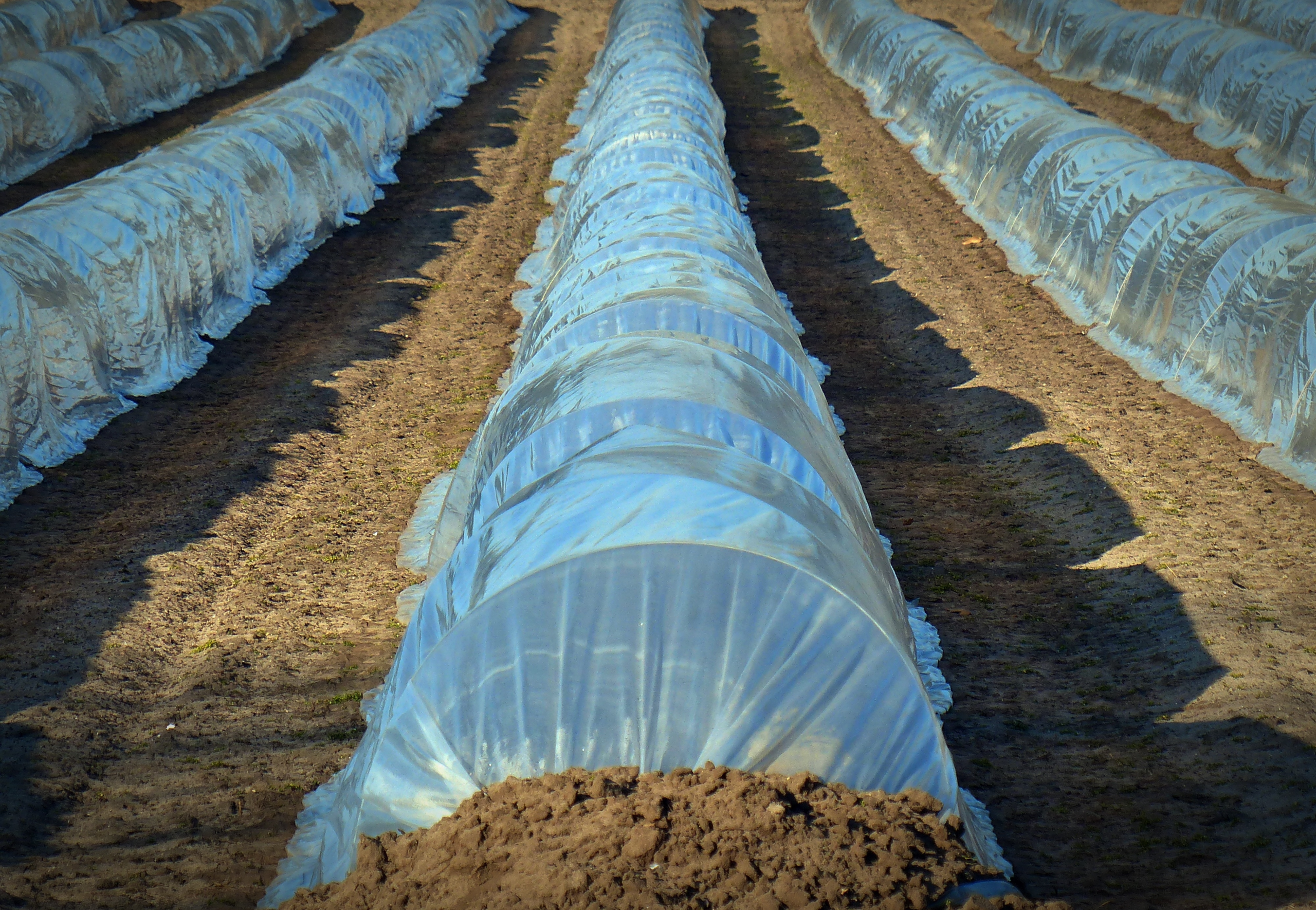
Row cover weight decides how much frost protection you get, and almost every number quoted online leaves the weight out. University of Maryland Extension puts lightweight spunbonded fabric at 0.45 ounces per square yard and 2 degrees F of protection. Medium weight, 0.5 to 1.0 ounces, buys 4 to 6 degrees. Heavyweight at 1.5 to 2.2 ounces gets up to 8. A bare claim of four to eight degrees with no fabric weight attached tells you nothing about the roll in your shed.
The lightweight fabric may give you nothing
Washington State University Extension rates 0.45-ounce fabric at None for frost protection and lists it under insect control. Maryland says 2 degrees. UMass Amherst calls it mainly insect netting with only a small daytime heat gain, and NC State says covers under 0.5 ounces hold almost no heat overnight. Three of those four land on roughly zero. Buy the lightest cover for cabbage worms and cucumber beetles. Do not buy it for October.
Degrees of protection and a temperature floor are two different claims
Maryland and UMass give a delta: so many degrees warmer than the air outside. Washington State and Utah State give an absolute floor instead, protection down to 24 to 28 degrees F. Those get quoted interchangeably and they should not be. Iowa State Extension caps the whole idea at about 28 degrees, and adds that plants under cover still take damage once a freeze runs five hours or longer. Check which one your source means before you plan the week around it.
The heat comes out of the ground
Colorado State University Extension states it plainly. Soil warmed by daytime sun is the source of the heat that protects plants at night. That changes how the cover goes on. It has to reach the ground on every side to trap radiant heat, and it has to pass enough light during the day to recharge the soil underneath. Fabric thrown over a bed and left flapping at the edges does very little. The same cover performs better in fall than in spring, and New Mexico State Extension gives the reason: the soil is still warm.
Heavier cover costs you light
Heavy fabric drops light transmission to 30 to 50 percent, according to both Maryland and UMass. NC State flags a real loss above 1.75 ounces. In July you can absorb that. November is another matter, because Cornell Cooperative Extension puts the floor for useful plant growth at about 10 hours of daylight, and halving what little light there is costs you growth you cannot get back. Match the weight to the coldest night you actually expect. Then stop.
Venting is where crops get cooked
Colorado State measured over 130 degrees F under a closed cover after one hour of sun. Virginia Tech recorded 120 to 140 degrees under micro tunnels in Louisiana and the Virgin Islands. Extension services do not agree on when to open up, and part of that disagreement is that they are measuring different things. Iowa State says vent when it climbs above 40 degrees outside. West Virginia University says above 55 degrees outside for cool-season crops. Utah State gives a ceiling rather than a trigger, keep the inside under 90 degrees, and notes tunnel air can run 25 to 30 degrees above outside air on a sunny day. An outside-air trigger and an inside-air ceiling are not the same instruction. If only one rule survives the winter in your head, make it this: a sealed tunnel on a clear 45-degree afternoon is a greenhouse.
Hoop spacing runs from 2 feet to 6 depending who you ask
Maryland says 2 to 4 feet between hoops. UMass and Utah State say 3 to 6. Oregon State, West Virginia, New Mexico State and Virginia Tech all land on 4 to 5. Illinois Extension says 5 to 6. A threefold spread on the same structure tells you the spacing number is not the thing carrying the load. The material is. Oregon State tightens spacing to 4 feet in snow country and states outright that low tunnels have not been evaluated for snow load at all. Illinois is blunter about it: wire and PVC fail under snow, use half-inch EMT conduit and a bender.
What earns a cover
South Dakota State Extension sorts fall vegetables into tiers worth memorizing. Beans, sweet corn, peppers, eggplant, cucumbers, summer squash and melons have no frost tolerance at all, so covering them past a hard freeze is wasted fabric. Beets, carrots, lettuce, spinach, chard, peas and radishes take a light freeze of 28 to 32 degrees. Broccoli, cabbage, kale, kohlrabi and turnip handle 24 to 28. Parsnips, salsify and Brussels sprouts come out better after several freezes in that range, and root crops sweeten once soil temperature drops below 40 degrees. Cover the middle group. The rest is either hardy enough already or finished.
Cover extends the harvest, not the growing
This is the part that catches people out. Maryland puts useful growth at a floor of about 10 hours of daylight. Cornell runs the same number out to calendar dates: in Watertown, New York, that window is November 10 to February 4, roughly 86 days. Underneath it, plants hold. They do not grow. Cornell’s answer is to plant cold-hardy crops at least 8 weeks before the daylight floor arrives, which for that part of New York means seed in the ground by about September 10. Iowa State says the same thing another way, that plants should be full-sized by the beginning of November and most cold-hardy crops should come out by the end of December. Miss the planting window and no fabric fixes it.
The hardiness zone claim
You will see it everywhere. Row cover moves you one to one and a half USDA hardiness zones south, and a low tunnel over row cover moves you two. No extension publication says this. The claim traces back to Eliot Coleman’s popular writing, and it may be a serviceable rule of thumb, but there is no sourced figure behind it and the sourced figures all depend on fabric weight and on what kind of frost is coming. Colorado State draws a distinction almost nobody else bothers with. Radiation frost arrives on a calm clear night and drops only a few degrees below the critical point, which is exactly the situation a cover is built for. Advective frost comes in on a front, drops temperatures far below critical, and Colorado State says protection is much less effective against it. Watch the forecast for wind, not just for the low.
Sources
- University of Maryland Extension, Row Covers
- University of Maryland Extension, Fall Vegetable Gardening
- Washington State University Extension FS089E, Install a Floating Row Cover
- UMass Amherst, New England Vegetable Management Guide: Slitted and Floating Row Covers
- NC State Extension, Growing Small Farms: Season Extension
- Utah State University Extension, Mulches and Row Covers
- Iowa State University Extension, Using Low Tunnels to Extend the Season
- Iowa State University Extension, How to Protect Plants from Frost and Freeze
- Colorado State University Extension, GardenNotes #722
- New Mexico State University Extension H-251
- Virginia Tech Extension HORT-291
- West Virginia University Extension, Low Tunnels for Beginners
- Oregon State University Extension EM 9333, Low Tunnels for Season Extension
- University of Illinois Extension, Extend Your Growing Season with Low Tunnels
- South Dakota State University Extension, Fall Frost Tolerance of Common Vegetables
- Cornell Cooperative Extension, Day Length Matters