
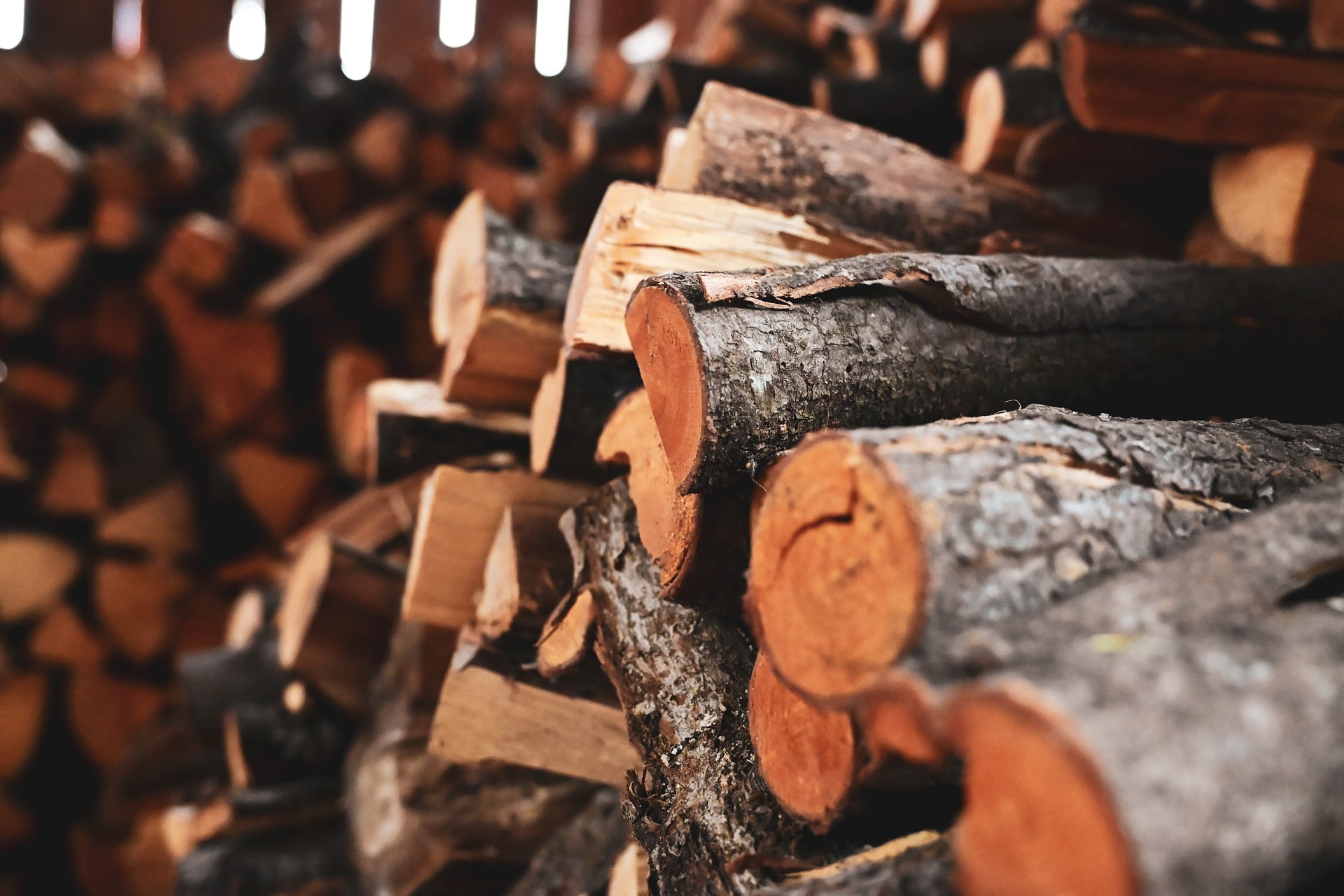
Wood you cut this month is not burning well this December. That is the honest starting point, and everything else follows from it.
EPA puts the target at under 20% moisture content. Freshly cut hardwood runs nowhere near that. Missouri Extension measured Missouri hardwoods averaging 75% moisture green, Penn State gives red oak at 60 to 80%, and Cornell notes that green wood can hit 100% or more, meaning half the weight of the log is water.
What the water costs you
University of Wisconsin Extension published the number that makes this concrete. Usable heat per pound of wood:
- 8,600 BTU at 0% moisture, oven dry
- 7,100 BTU at 20%, air dried
- 5,900 BTU at 45%
- 4,900 BTU at 75%, green
Green wood gives up roughly 31% less energy per pound than seasoned wood. Wisconsin runs it out to the practical end: a house that takes 4 cords at 20% moisture takes 5.8 cords at 75%. You cut, split, haul, and stack almost two extra cords to heat the same building, and you get more creosote for the trouble.
The mechanism is not complicated. Water has to boil off before the wood can burn, and the heat doing that boiling comes out of your fire instead of your house. What leaves the stove instead of heat is smoke, which is unburned fuel, which condenses in the flue as creosote. Utah State and EPA both make the same connection.
How long it takes
EPA gives six months for softwood and at least a year for hardwood. Most of the extension sources agree on a year as the working rule. Cornell adds the exception that matters if you burn oak: some species take two years or more of air drying.
Penn State says cut by April to get six months in before heating season. Since it is August, that means the wood for this winter should already be stacked and the wood you cut now is for next year. Buy a year ahead, as Cornell recommends, and the problem stops being a problem permanently.
Split it. UNH calls splitting critical to speeding the drying, and EPA says split to no larger than 6 inches. No extension source I found quantifies how much faster split wood dries than rounds, so treat any specific multiplier you have heard as folklore. The direction is not in doubt.
Stacking
Four things, and they are all about air.
Off the ground. Every source says it, none gives a number of inches, and the specific “4 to 6 inches” you have read is not extension-sourced. Cornell’s practical version is that pallets make a good first layer.
Cover the top only. EPA is blunt that covering the sides traps moisture in. Cornell says the same and adds to leave space between the cover and the wood.
Sun and wind on it. UNH wants an open, sunny spot with airflow on all sides. Nobody specifies a compass orientation, so the “run the rows with the prevailing wind” advice is another one with nothing behind it.
Not against the house. Cornell says stack about 30 feet away, which is a fire and pest answer more than a drying one.
Cornell also suggests stacking no more than two rows deep. Nothing in the extension literature evaluates the round holz hausen stack at all, in either direction.
Reading a BTU chart without getting fooled
This is where firewood comparisons usually go wrong. Two different families of numbers circulate and they are not comparable.
Gross heat content per cord: Penn State puts white oak at 25.7 million BTU, sugar maple and red oak at 24.0, white ash at 23.6, red and silver maple at 18.7. Utah State’s table runs higher for the same species, white oak at 29.1 and red oak at 24.6, because it is a different underlying dataset. Pick one table and stay in it.
Available heat after appliance losses: Arkansas Extension applies a 50% burning efficiency and lists white oak at 12.8 million BTU per cord. Missouri gives 11.4 million available BTU for air-dried hardwood generally. These numbers are roughly half the others and they are not wrong. They are answering a different question.
Quote one of each in the same sentence and you will conclude something false about your wood pile. It happens constantly in firewood comparisons online.
Testing it
A moisture meter costs about what a bad cord costs and settles the argument. EPA’s method: split a piece, test the freshly exposed face, push the probes into the grain. Under 20% and you are ready.
Testing the outside of a log that has sat in the weather tells you about the weather. Forest Products Laboratory adds that resistance meters are calibrated to 70°F and useful from about 7% to 30% moisture, so a frozen log in January reads low and a soaking-wet round reads as approximately nothing useful.
Without a meter, UNH and Arkansas both give the same field checks. Deep radial cracks in the end grain. Noticeably lighter than green wood of the same size. Two pieces knocked together ring rather than thud.
Buying it
A cord is 128 cubic feet, stacked 4 by 4 by 8. Missouri notes that only about 80 of those cubic feet are actually wood in the Midwest average, the rest being bark and air. A face cord is 4 feet by 8 feet by whatever the pieces are long, typically 16 inches, which Arkansas puts at about a third of a cord. Missouri defines a rick as the same footprint at 18 to 24 inches deep. Penn State says face cords range from 12 to 32 inches in practice.
So a face cord is somewhere between a quarter and a half of a cord, depending on a number the seller chose. Ask for the depth in inches before you ask the price.
Where it came from
Buy it near where you burn it. The National Park Service puts 50 miles as too far and 10 miles or less as the target, because beetles, eggs, and fungal spores that cannot fly across a county ride in a truckload of logs. Asian longhorned beetle, oak wilt, and laurel wilt all move this way.
One correction worth having. There is no federal firewood quarantine anymore, since APHIS removed the emerald ash borer rules effective January 2021. What remains is state law, and it varies. New York, for instance, caps untreated in-state firewood movement at 50 linear miles and bans untreated imports outright, with heat treatment defined as 160°F for 75 minutes.
Check your own state before you haul a load to deer camp, because the fine is larger than the wood is worth.
Sources
- US EPA Burn Wise, Best Wood Burning Practices
- University of Wisconsin Extension, Energy Efficient Wood Heating
- University of Missouri Extension, G5450
- Penn State Extension, Heating with Wood
- Cornell Cooperative Extension, Storing and Drying Firewood
- UNH Extension, Drying Firewood
- University of Arkansas Extension, FSA-1091
- USDA Forest Products Laboratory, GTR-6
- National Park Service, Don’t Move Firewood