
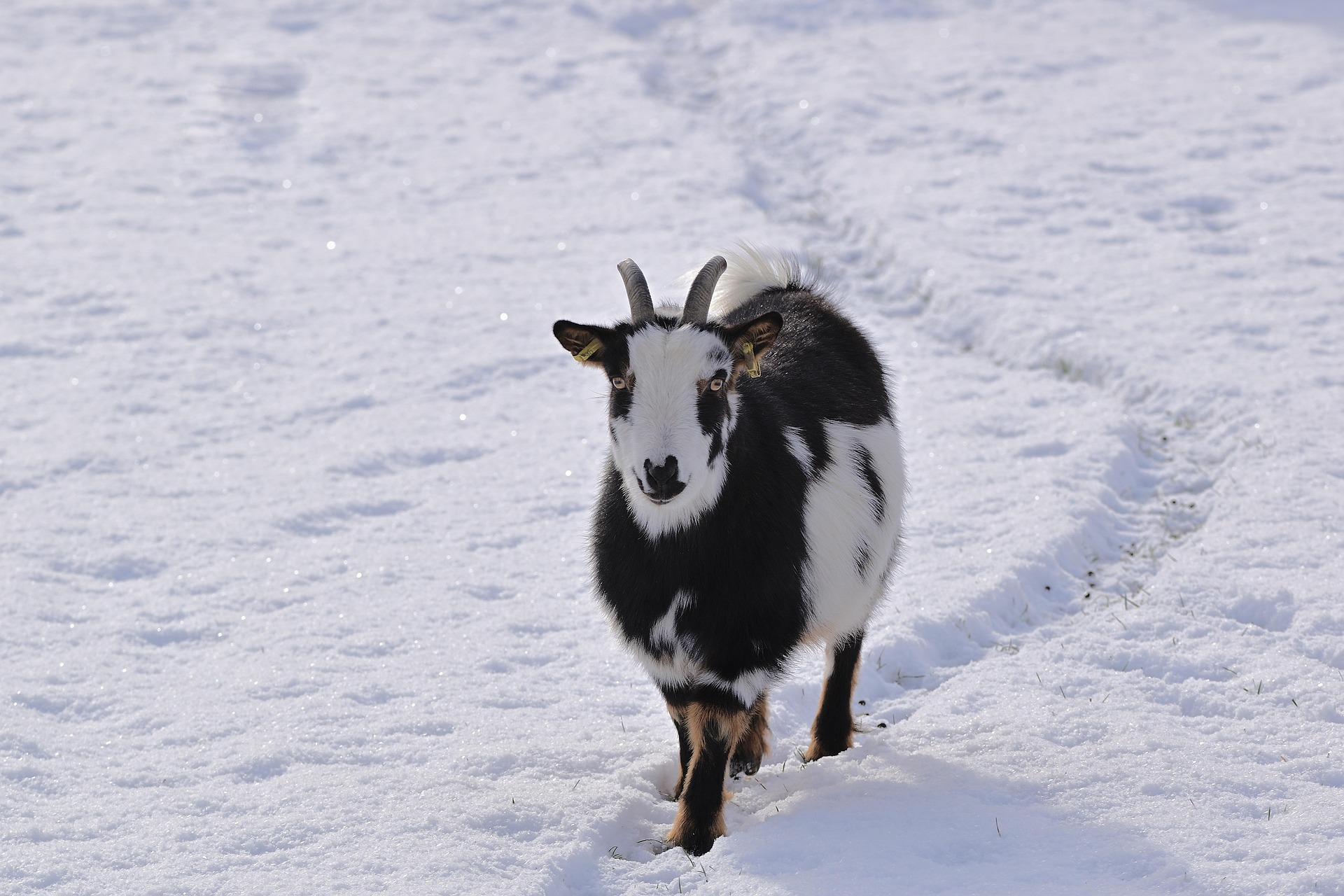
Goats handle cold worse than sheep for a mechanical reason. Wool keeps some insulating value when it is wet and hair does not. Alabama Extension describes the failure directly, saying moisture flattens the hair fibers and collapses the air layer trapped inside the coat. The eXtension goat guidance says the same thing in one line, that goats are less tolerant of wet and cold conditions than sheep and cattle.
That points every winter decision in the same direction. Dry beats warm. Nearly every heat-adding fix people reach for is either discouraged by extension services or hedged with warnings, while every moisture-control fix is recommended without qualification.
Shelter
Ohio State Extension in Wayne County puts the goat lower critical temperature at 32 degrees, which is the point below which the animal starts spending feed energy on staying warm. A wet coat pushes that figure up to roughly 58. Ohio State’s own small ruminant team uses 25 degrees in a worked example, so treat 32 as a planning number rather than a constant.
Space per goat is the least settled figure in the literature. Purdue says 20 to 25 square feet of enclosed housing plus 50 square feet of exercise area. Oklahoma State says 10 to 15 square feet of bedding space in open housing, or 20 square feet in confinement with a separate 25-square-foot yard. NC State and eXtension both say 8 to 10 square feet for open housing. Purdue’s numbers describe dairy goats in barns and the lower ones describe meat goats in open housing, which explains part of the gap but not all of it.
The shed itself is well agreed on. Three sides, with the open side facing south and away from prevailing winter wind. Rear eaves 3 to 4 feet, front eaves 5 to 6, roof sloped so runoff drains to the back. Site it high and well drained.
Do not heat it. Oklahoma State’s position is that additional heating normally is not required if the bedding is dry and there are no drafts. Purdue adds a number that makes the case for leaving well enough alone, which is that for dairy goats, temperatures between 0 and 55 degrees do not affect milk production or feed consumption.
Air
The reflex to close a barn up tight in January is the one that does real damage. Ohio State specifies 4 to 15 air changes per hour, or 20 cubic feet per minute per animal, and Oklahoma State independently gives the same 20 CFM winter figure. Ventilation goes down in winter. It does not go away.
Three signs tell you it went too far, and checking all three costs nothing. A strong ammonia smell. Condensation standing on walls and ceiling. Coughing or nasal discharge. What follows is bacterial pneumonia and the lung damage that outlasts it. Ammonia settles low, which is why kids take the worst of it.
Bedding
Oklahoma State gives 3 to 4 inches of wheat straw or poor-quality hay on dirt floors, and 5 to 6 inches on concrete. Straw beats hay for insulation. Wet bedding is worse than no bedding at all, because it pulls heat out of the animal by conduction, which is why the standard is prompt replacement rather than topping off.
Feed and water
Cold raises the feed bill and there is a rule for it. Ohio State says energy intake needs to go up 1 percent for every degree below the lower critical temperature, a figure SDSU repeats for cattle. Alabama says 1 to 2 percent. Ohio State’s small ruminant team uses a different unit entirely, a quarter pound of total digestible nutrients per 10 degrees below the threshold, and works an example at 0 degrees outside that comes to 2.5 pounds of extra feed.
Forage first. Maryland’s small ruminant guidance says grain is not necessary unless the forage is exceptionally poor or the females are underconditioned. The eXtension guidance treats energy-dense feed as a fallback for animals losing condition despite eating all the roughage they can hold. Penn State ties grain to late gestation instead of to cold weather, and the reason is physical. Kids take up room, there is less space for the rumen to expand, and a doe six weeks out cannot eat her way to the energy she needs on hay alone. Late gestation runs 4 to 5 pounds of hay a day plus half a pound to a pound of grain.
The claim that hay keeps a goat warm and grain does not is repeated everywhere and does not appear in the extension literature in that form. Ruminal fermentation does generate heat, which SDSU states plainly, and slowed fermentation produces less of it. No extension source found compares heat production between forage and concentrate. Feed more forage in the cold because the sources say to, not because of a mechanism nobody has written down.
Water is where winter quietly costs you. Oklahoma State puts a mature goat at three-quarters to one and a half gallons a day, and Maryland says two to three gallons in late gestation and early lactation. Ohio State gives an optimal water temperature band of 37 to 65 degrees, which is cool rather than warm. The target is unfrozen and palatable.
One number is worth knowing about heated buckets. Stray AC current above three to four volts is enough to cut water intake. A goat that suddenly stops drinking from a heated bucket may be telling you about a wiring fault rather than a preference.
Condition, minerals and feet
Body condition score runs 1 to 5 in half-point steps, judged by hand at the loin, at the ribs and at the fat pad on the sternum. The eXtension guidance wants a minimum of 3.0 going into winter and says scoring means touching each animal, more often in cold weather, because a winter coat hides loss until it is well advanced. Fatter is not safer at the top end. A score of 4.5 or higher raises pregnancy toxemia risk the same way 2.0 or lower does, and that is a conversation for your veterinarian rather than a feed change you improvise in February.
Do not run one mineral for a mixed flock. Ohio State is blunt about it: the toxicity level of copper for sheep and the deficiency level for goats leave a slim margin of error. Sheep need 4 to 8 ppm and see toxicity at 20. Goats need 15 to 25. Those two ranges overlap inside the band that kills sheep.
Wet footing is last on the list and it is the item that shows up in February. Foot scald and foot rot outbreaks track persistent rain and muddy ground, and the organisms survive in soil for several weeks. Overgrown hooves make it worse by holding moisture between the toes. Trim before the ground turns, not after.
If a heat lamp seems like the answer for a January kidding pen, Cornell’s summary is that heat lamps are a major cause of barn fires. Ohio State’s guidance on using one safely runs to non-flammable chain hangers, thick glass bulbs, no extension cords, GFCI and AFCI outlets, and a fire extinguisher at each barn entrance. That is a great deal of engineering to avoid the simpler answer, which is to breed for kids that arrive when it is warmer.
Sources
- Goat Pastures and Shelter, eXtension Goats
- Care of Goats in Severe Winter Weather, eXtension Goats
- Goat Body Condition Score, eXtension Goats
- Goat Nutrition: Copper, eXtension Goats
- Cold Stress in Small Ruminants During Wet Weather, Alabama Cooperative Extension System
- Managing Foot Rot and Scald in Goats and Sheep, Alabama Cooperative Extension System
- Winter Feeding Guidelines for Sheep and Goats, Ohio State University Extension, Wayne County
- Do Sheep and Goats Get Cold?, OSU Sheep Team
- Small Ruminant Housing: Proper Airflow Is Important, OSU Sheep Team
- Livestock Water in Winter, OSU Sheep Team
- Common Hazards Associated with Sheep and Goat Feed, OSU Sheep Team
- Safe Use of Heat Lamps and Barn Monitoring Systems, OSU Sheep Team
- Winter Management Tips for Sheep and Goats, OSU Sheep Team
- Goat Housing, Purdue University Animal Sciences
- Meat Goat Production Handbook, Chapter 12: Housing and Corrals, Oklahoma State University Extension
- Meat Goat Production Handbook, Chapter 5: Goat Nutrition, Oklahoma State University Extension
- Housing and Facilities for Meat Goats, NC State Extension
- General Guidelines for Feeding Sheep and Goats, Maryland Small Ruminant Page, University of Maryland Extension
- Pregnancy Toxemia, Maryland Small Ruminant Page, University of Maryland Extension
- Nutrition Throughout Pregnancy for Meat Goat Does, Penn State Extension
- Winter Cow Supplementation and Cold Stress, SDSU Extension
- Barn Fire Prevention, Cornell Cooperative Extension Southwest New York
Leave a Reply