
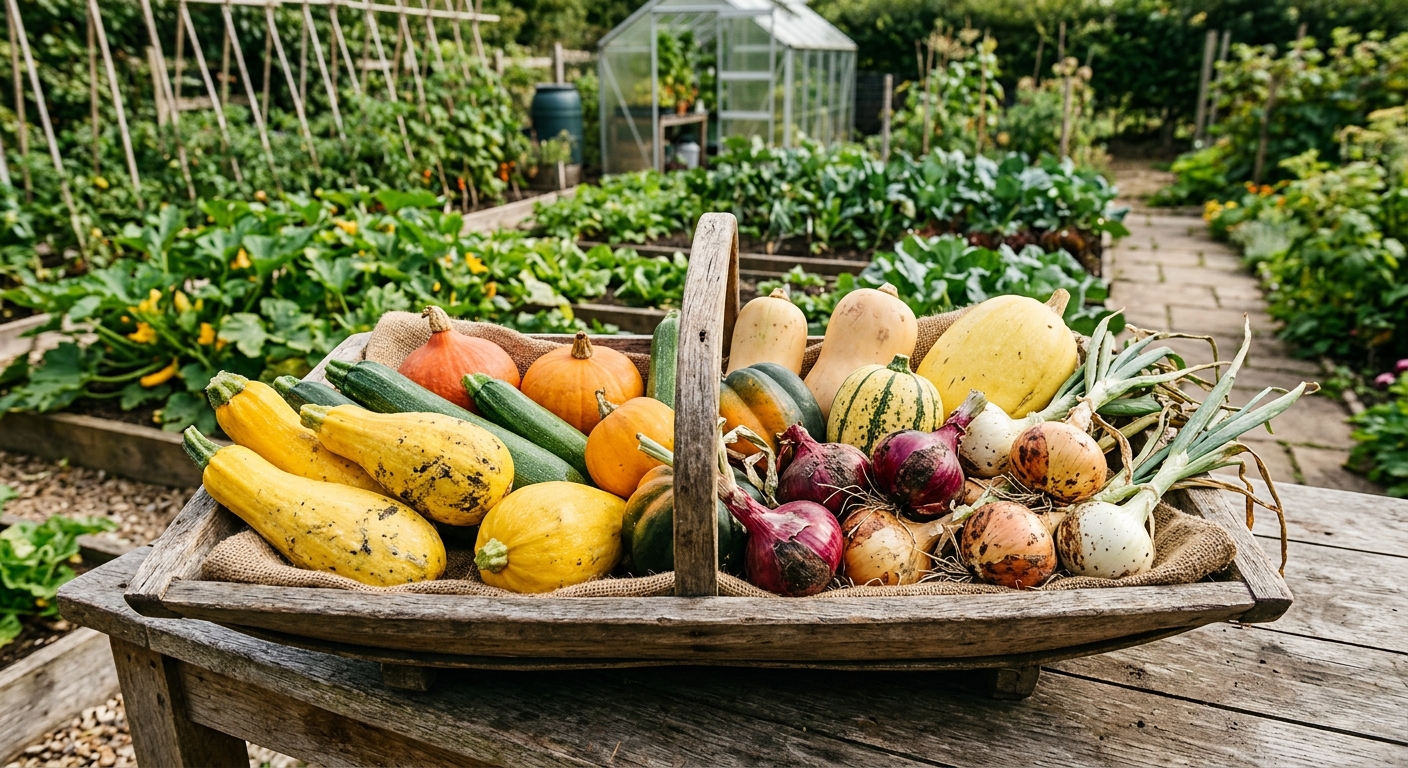
A winter squash that goes straight from the vine into the basement will be soft by Thanksgiving. The step between is curing, and it does two specific things. UMass Extension describes it as hardening the fruit skin and speeding wound healing so disease cannot get in. Skip it and every scrape from harvest stays an open door.
Cure at 80 to 85°F and 80 to 85 percent humidity for 5 to 10 days, per UMass, and Oregon State Extension gives the same temperature and humidity for 10 days. Penn State takes a looser field approach, 7 to 10 warm dry days at 70 to 80°F with the fruit spaced out and never piled. Minnesota Extension gives the finishing test instead of a clock: the squash is cured when a fingernail will not puncture it, and nicks and small cuts have scabbed over.
Acorn squash is not the only exception
Most storage writing knows that acorn squash should not be cured. UMass takes it further, and the wider version is the useful one. Curing can actually reduce storage life for all of Cucurbita pepo, which covers acorn, delicata, and sweet dumpling. Illinois Extension lists the same three. So the rule is a species, not a single variety.
Harvest on the rind, not the calendar
Oregon State gives the test in one line: the rind is ready when it resists a fingernail scratch. Minnesota adds that the stem attached to the fruit should be hard and woody, and Penn State says the handle dries out and goes corky as maturity approaches.
Catalog days-to-maturity numbers are worth distrusting. UMass puts acorn squash at 90 to 100 days against the 70 to 76 seed catalogs claim.
Get them in before hard frost. Illinois says harvest the main crop in September or October before heavy frosts, and Oregon State says fruit exposed to freezing before harvest deteriorates rapidly. The idea that a light frost sweetens winter squash has no extension source behind it, and the sources that address frost say the opposite.
Stems, and where the advice splits
Illinois puts it plainly: leave two inches of stem, because a stem cut too short is like an open wound that causes early decay. Oregon State says 2 to 4 inches. The pumpkin guidance runs longer at 3 to 4 inches, and Illinois adds that pumpkins without stems usually do not keep.
Two exceptions cut against the universal version of that rule. Oregon State says hubbard-type squash stores best with the stems removed completely. UMass says butternut stems can come off to stop them puncturing neighboring fruit in storage, provided the stem scars heal before the fruit goes in.
The 50°F line, and a real disagreement across it
After curing, squash wants roughly 50 to 55°F at 50 to 70 percent humidity. Oregon State and Minnesota both give 50 to 55°F. UMass says 50 to 60. Cornell says 55 to 60. Missouri Extension’s root cellar chart puts squash and pumpkin at 50 to 55°F and 60 to 75 percent.
Then Illinois says store at 45 to 50 degrees, a basement or garage. That sits inside the zone Penn State warns against. Penn State: keep storage above 50°F, because below that you get skin pitting and more decay once the squash comes out. Oregon State agrees. Utah State and Minnesota put the danger line lower, at 45°F.
An unheated basement running at 48°F is inside one extension service’s recommendation and outside another’s. The larger risk is the cold side, since chilling injury does not show up until the squash is already in the kitchen. Aim for the mid-50s and the disagreement stops mattering.
What each type will actually do
Storage life is not a property of winter squash generally. Oregon State’s list: acorn 1 to 2 months, butternut 2 to 3, hubbard 3 to 6, buttercup 3 to 6, jack-o-lantern pumpkins 2 to 3. Iowa State runs shorter on acorn at 5 to 8 weeks. UMass sorts by species instead, giving C. pepo 2 to 3 months and C. maxima 4 to 6.
Nothing in any source reaches a year. A plan that counts on squash into next spring should be built on hubbard or buttercup, and the acorn should get eaten in October and November. Illinois adds one storage rule that costs nothing: do not pile squash more than two fruits deep.
Washing is contested. Clemson says do not wash winter squash before storing. Penn State says take clumps of soil off with a dry cloth. Oregon State allows that a wipe with 1 part bleach to 10 parts water may help. A dry cloth is what all three can live with.
Onions want the neck dry, not the tops off
Harvest timing depends on what the onion is for. Penn State says most dry onions are harvested when a third to a half of the tops have fallen over. Iowa State waits until most of them have. UMass, aiming at maximum storage life, wants them out earlier, while 30 to 40 percent of the foliage is still standing, and gives the pinch test: necks should be soft and limber, and a neck too weak to hold the top up means the bulb is over-mature.
Cure at 75 to 90°F around 80 percent humidity with good air movement, which UMass says takes 2 to 4 weeks in the field or shed. Cured onions lose 3 to 5 percent of their weight. The test that matters is the neck: tight, with outer scales dry enough to rustle.
Cutting the tops off too early is the classic way to lose a crop. UMass explains the mechanism through botrytis neck rot, which can move through green tissue into the bulb but cannot move through dry tissue. Their advice is to leave 2 to 3 inches of neck so a pathogen has farther to travel, and to roll the neck between your fingers first. If the tissue slides, it is not dry. Penn State tops about 1 inch above the bulb.
Sweet onions are not storage onions
UC Davis puts numbers on a gap most writing hand-waves. Mild onions store half a month to one month at 32°F. Pungent onions store 6 to 9 months at the same temperature. Iowa State names names: Copra and Redwing keep for months, Walla Walla and Sweet Spanish for weeks.
The common explanation, that sulfur compounds preserve the pungent ones, could not be sourced to any extension or USDA publication found. The correlation is solid. The mechanism is folklore until someone cites it.
Store dry onions at 32 to 40°F and 65 to 70 percent humidity, in the dark, in mesh bags or slatted crates. UC Davis gives the range to avoid: 41 to 75°F favors sprouting. A braid hanging in a warm kitchen sits inside that window, which is why kitchen braids sprout in January. UMass also says to cool onions gradually rather than fast, to keep moisture from condensing on the bulbs.
The humidity conflict that decides your layout
Onions and garlic want 65 to 70 percent humidity. Potatoes want 40°F and 90 to 95 percent, per the same Iowa State chart. Those two conditions cannot coexist in one room, which is the real reason the onions and the potatoes do not share a cellar. No source found states the onion-potato rule directly, but the humidity numbers say it without help.
Ethylene is the other separator. Oregon State says ripening fruit gives off ethylene that yellows squash and shortens its storage life, and says not to store squash near apples or pears. Iowa State says the same about potatoes, where ethylene promotes sprouting. Garlic is the odd one out. UC Davis lists garlic as not sensitive to ethylene, so the apples-ruin-your-garlic warning is aimed at the wrong crop.
Garlic itself splits into two valid regimes, per UMass: 68 to 86°F at under 75 percent humidity for a month or two of eating stock, or 30 to 32°F at 60 to 70 percent for 6 to 7 months. UC Davis puts the sprouting band at 41 to 65°F, which is exactly where a cool cupboard sits. The refrigerator is fine for garlic you plan to eat. It is the wrong place for garlic you plan to plant, since UMass says storage below 40°F produces rough bulbs and side-shoot sprouting in seed stock.
Sources
- UMass Extension, Pumpkin and Winter Squash Harvest, Curing and Storage — https://www.umass.edu/agriculture-food-environment/vegetable/fact-sheets/pumpkin-winter-squash-harvest-curing-storage
- UMass Extension, Onions Harvest and Curing — https://www.umass.edu/agriculture-food-environment/vegetable/fact-sheets/onions-harvest-curing
- UMass Extension, Alliums Botrytis Neck Rot — https://www.umass.edu/agriculture-food-environment/vegetable/fact-sheets/alliums-botrytis-neck-rot
- UMass Extension, Garlic Harvest, Curing and Storage — https://www.umass.edu/agriculture-food-environment/vegetable/fact-sheets/garlic-harvest-curing-storage
- Oregon State University Extension, Storing Pumpkin and Winter Squash at Home (EC 1632) — https://extension.oregonstate.edu/catalog/pub/ec-1632-storing-pumpkin-winter-squash-home
- Penn State Extension, Prevent Rot of Winter Squash in Storage — https://extension.psu.edu/prevent-rot-of-winter-squash-in-storage
- Penn State Extension, Onion Production — https://extension.psu.edu/onion-production
- University of Minnesota Extension, Harvesting and Storing Melons, Squash and Pumpkins — https://extension.umn.edu/agriculture/specialty-crops/commercial-fruit-production/harvesting-and-storing-melons-squash-and-pumpkins
- University of Minnesota Extension, Harvesting and Storing Home Garden Vegetables — https://extension.umn.edu/planting-and-growing-guides/harvesting-and-storing-home-garden-vegetables
- University of Illinois Extension, Winter Squash — https://extension.illinois.edu/gardening/winter-squash
- University of Illinois Extension, Growing Pumpkins — https://extension.illinois.edu/pumpkins/growing-pumpkins
- Cornell Cooperative Extension St. Lawrence County, How Do I Know When Winter Squash Are Mature — https://stlawrence.cce.cornell.edu/resources/how-do-i-know-when-winter-squash-are-mature
- Iowa State University Extension and Outreach, Home Vegetable Storage Requirements — https://yardandgarden.extension.iastate.edu/article/2017/10/home-vegetable-storage-requirements
- Iowa State University Extension and Outreach, Harvesting, Drying and Storing Onions — https://www.extension.iastate.edu/news/yard-and-garden-harvesting-drying-and-storing-onions
- Clemson University HGIC, Using and Storing Winter Squash — https://hgic.clemson.edu/factsheet/using-storing-winter-squash/
- University of Missouri Extension MP562, Root Cellar Storage — https://extension.missouri.edu/publications/mp562
- Utah State University Extension, Harvest and Storage of Vegetables and Fruits — https://extension.usu.edu/yardandgarden/research/harvest-and-storage-of-vegetables-and-fruits
- UC Davis Postharvest Technology Center, Onions (Dry) — https://postharvest.ucdavis.edu/produce-facts-sheets/onions-dry
- UC Davis Postharvest Technology Center, Garlic — https://postharvest.ucdavis.edu/produce-facts-sheets/garlic