
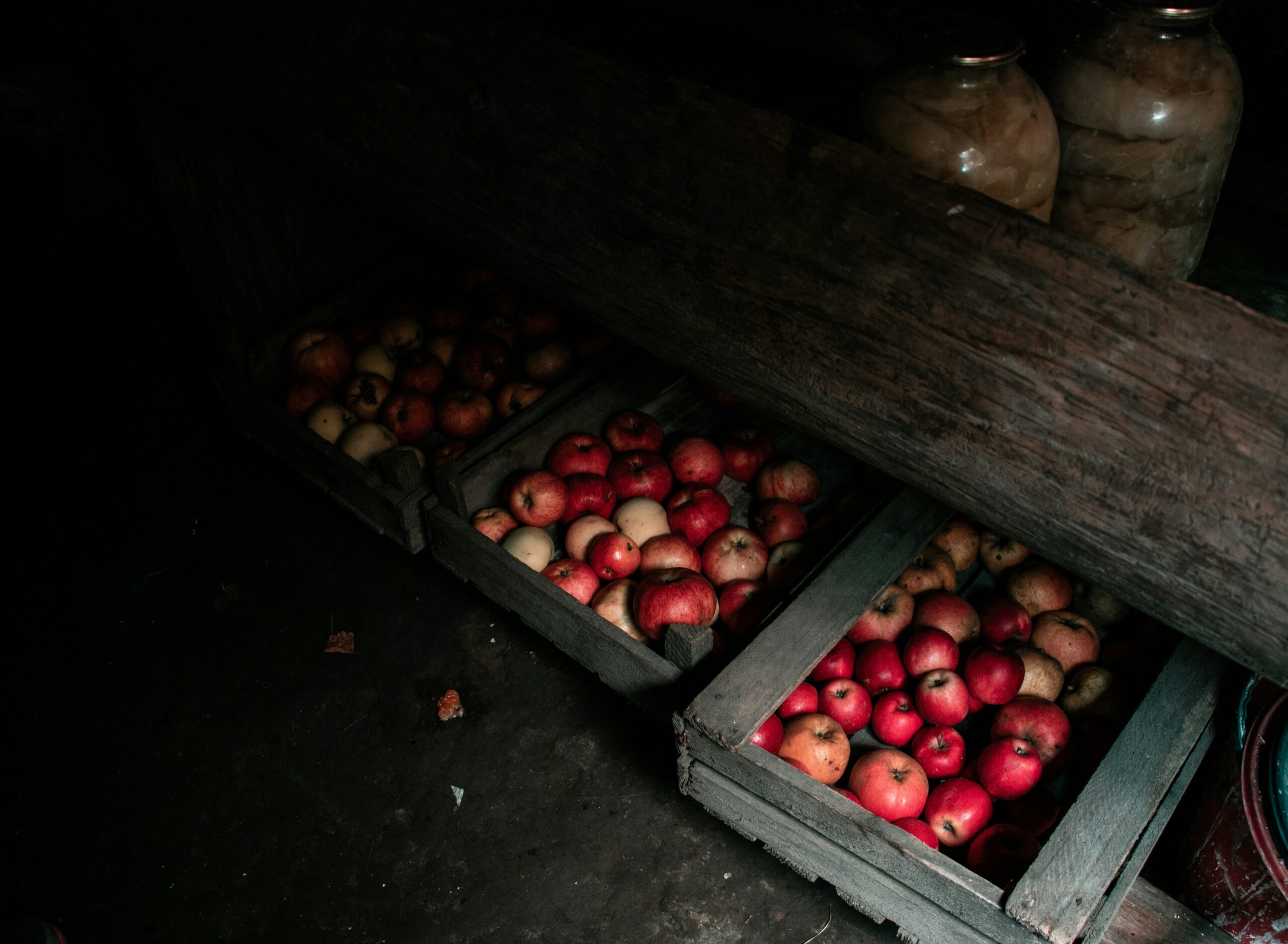
A basement in a heated house runs 50 to 60°F and stays dry, a figure both Washington State University Extension and the University of Connecticut publish. That is a good room for pumpkins, squash and onions. It is the wrong room for carrots. That single mismatch is why most attempts at root cellaring in a modern house end in a bin of limp roots by January.
No basement fixes this on its own. Produce sorts into groups that cannot share a room, and doing the sorting is most of the work.
Four groups, and they fight each other
The University of Alaska Fairbanks names them: cold and very moist, cold and moist, cool and dry, warm and dry. Utah State University Extension attaches numbers. Cold and moist is 32 to 40°F at 90 to 95 percent relative humidity, holding beets, cabbage, carrots, parsnips, turnips and kale. Warm and dry is 50 to 60°F at 50 to 70 percent, holding pumpkins, winter squash, sweet potatoes and green tomatoes. Those conditions sit 20 degrees and 40 humidity points apart. One room cannot do both.
Utah State is also the outlier worth knowing about. It files potatoes in the cold and dry group at 60 to 70 percent humidity, next to garlic and onions. Iowa State, the University of Wisconsin, the University of Missouri and the Government of New Brunswick all put potatoes at 85 to 95 percent instead. Four against one. Follow the low number over a winter and the tubers shrivel.
The potato temperature question has two right answers
North Dakota State University Extension says 38 to 40°F. Oregon State University Extension says 40 to 46°F. Both are correct, and what decides it is what you plan to do with the potato.
Cold potatoes turn starch into sugar. Oregon State says temperatures below 38°F cause sugar buildup and produce darker, oilier fried food. The Government of New Brunswick, writing for commercial storage, puts the onset of measurable reducing-sugar accumulation higher, below 45°F, with severe accumulation below 37.4°F. New Brunswick then publishes three separate holding temperatures for the same tuber: 3 to 4°C for seed, 4.5 to 5.5°C for table stock, and 10 to 12°C for chipping. Same potato. Three answers, sorted by the job it has to do.
For a homestead bin the trade reads simply. Colder keeps longer and fries worse. Oregon State gives seven to eight months at 40 to 46°F, falling to two or three months above 46°F with sprouting and shriveling on top of that. Pick a side and stop hunting for the one true number.
Cure first, and cure in the dark
Potatoes need curing before they go cold, and every source lands on 50 to 60°F for it. NDSU pairs that with about 95 percent humidity for two or three weeks, then a gradual drop to 38 to 40°F before December 1. Iowa State says 85 to 90 percent for two weeks. Nobody says sunlight.
Light is the thing to keep off them. Oregon State bulletin EM 9407 carries the numbers behind that warning: a normal tuber holds 12 to 20 milligrams of glycoalkaloid per kilogram, a green tuber runs 250 to 280, and the skin of a green tuber runs 1,500 to 2,200. Peeled Russet Burbank slices held under 200-footcandle fluorescent light for 48 hours went from 2 milligrams per kilogram to 74. Oregon State’s instruction is to discard potatoes with excessive greening rather than trim them.
Sweet potatoes want the opposite treatment. Penn State Extension cures them at 80 to 85°F and 85 to 95 percent humidity for four to seven days, then holds them at 55 to 60°F, and warns of chilling injury below 50 to 55°F. A sweet potato parked in the cold bin with the carrots is a ruined sweet potato.
Apples are the saboteur
The old advice to tuck an apple in with the potatoes so they will not sprout has it backwards. Washington State University Extension states that ethylene gas from apples causes potatoes to sprout and carrots to turn bitter. NDSU says the same in different words. UC Davis puts a threshold on the carrot half: as little as 0.5 ppm of ethylene produces perceptible bitterness within two weeks at normal storage conditions, through isocoumarin formation.
So keep the fruit out. Missouri Extension writes it as a rule rather than a suggestion, and WSU Clark County adds onions and shallots to the list of things that will sprout a potato.
Getting the humidity up in a dry room
Iowa State and UC Davis put carrots at 98 to 100 percent humidity. Alaska Fairbanks and the University of Saskatchewan say 90 to 95. That gap is achievable against optimal rather than a real dispute. The high figures come out of the commercial postharvest literature, where humidification equipment exists; the home publications quote what a person can actually hold without condensation running down the walls and growing mold on everything.
The levers are cheap. Pack roots in slightly damp sand, sawdust, peat or sphagnum moss. Use perforated plastic bags, which WSU specifies as about four quarter-inch holes for small bags and many quarter- to three-eighths-inch holes for larger ones. Wet the floor, or set open pans of water under the air intake. Alaska Fairbanks makes the point that a full cellar holds humidity better than a near-empty one, for the plain reason that vegetables are 90 percent water.
Crops that can stay where they grew
Parsnips, salsify and horseradish do not have to come in at all. Iowa State says to leave parsnips in the ground as long as possible and harvest before spring growth resumes, and lists rutabagas and salsify as crops to mulch heavily and dig through the winter.
Depth is where the sources scatter. WSU says a foot or more of mulch. Colorado State says 1 to 3 feet over a buried barrel and states outright that the figure depends on expected low temperatures. Wisconsin’s pit spec is 12 to 15 inches of alternating straw and soil. Anyone quoting six inches as the standard is quoting one region’s winter.
The buried container is the other option, and it carries a limit people leave out. WSU describes a 20-gallon trash can sunk in the ground with drainage holes in the bottom, the rim at least two inches above grade, covered with one to two feet of insulating material, metal chosen over plastic because it resists rodents better. UConn supplies the catch: once a mound or pit has been opened, the contents keep one or two weeks at most. That is a single cache, not a pantry you visit on Tuesdays.
Two freezing numbers that are not the same number
A carrot’s highest freezing point is 29.5°F, per the table the University of Maine and Kansas State publish. WSU says carrots are damaged at about 25°F. Both are right. The first is the temperature at which ice crystals begin forming in the tissue, a physical constant determined in a lab. The second is a field tolerance for roots sitting in soil under mulch, buffered and only briefly exposed. The two get quoted interchangeably, which is why people are surprised when a mulched row walks away from a night the chart said should have killed it.
WSU also names the crops that genuinely improve with a light freeze: parsnips, horseradish and turnips, between 28 and 34°F, as starch converts to sugar. Carrots are not on that list.
Then check it every week
UConn says to check the storage area at least weekly. That is the step that gets skipped, and it decides how the winter goes. One soft potato is a source of infection for the whole crate, and WSU recommends sorting stored tomatoes weekly for the same reason. Whatever interval you settle on, a rotting vegetable comes out the day you see it.
WSU adds a detail almost nobody repeats. Cabbage and turnips pass their odor to celery, pears and apples, and belong in outdoor storage only. Put a crate of cabbage in the basement and the whole house will know about it by February.
Sources
- Washington State University Extension, EB1326E, Storing Vegetables and Fruits at Home — s3.wp.wsu.edu
- WSU Clark County Extension, Storing Produce — s3.wp.wsu.edu
- University of Connecticut Extension, home storage of vegetables — extension.uconn.edu
- University of Alaska Fairbanks Cooperative Extension, HGA-00331, Vegetable Storage — uaf.edu
- Utah State University Extension, Harvest and Storage of Vegetables and Fruits — extension.usu.edu
- Iowa State University Extension and Outreach, Storing Winter Storage Vegetables — yardandgarden.extension.iastate.edu
- North Dakota State University Extension, Potatoes: Garden to Table — ndsu.edu
- Oregon State University Extension, Best practices for harvesting and storing homegrown potatoes — extension.oregonstate.edu
- Oregon State University Extension, EM 9407 — extension.oregonstate.edu
- Government of New Brunswick, Department of Agriculture, Aquaculture and Fisheries, potato storage — www2.gnb.ca
- Penn State Extension, Sweetpotato Curing and Storage — extension.psu.edu
- UC Davis Postharvest Research and Extension Center, Carrot — postharvest.ucdavis.edu
- University of Missouri Extension, MP562 — extension.missouri.edu
- University of Saskatchewan, Cold Storage of Root Crops, Winter Squash, Onions and Garlic — gardening.usask.ca
- Colorado State University Extension, Fact Sheet 7.601 — extension.colostate.edu
- University of Wisconsin Extension, Storing Vegetables at Home — barron.extension.wisc.edu
- University of Maine Cooperative Extension, Bulletin #4135 (Kansas State MF978 reprint) — extension.umaine.edu
Leave a Reply