
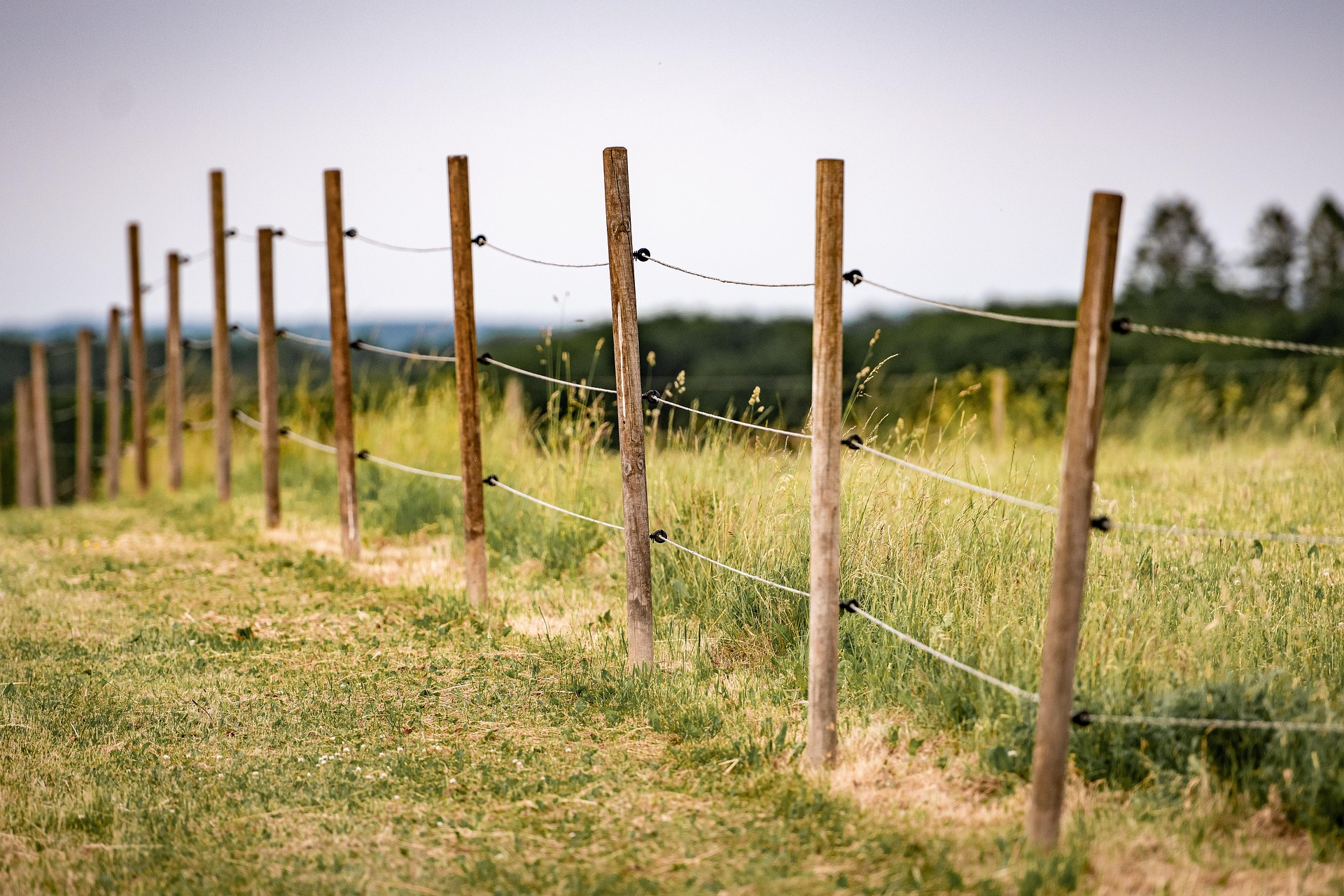
A standard electric fence does not shock an animal. The soil does. The pulse leaves the wire, goes through the animal, into the ground, and back to the energizer through the earth itself, which is why the University of Maine’s pasture course puts the winter problem in one sentence: moist soil conducts well, but when soil moisture is depleted “or not effective when frozen, animals will not be shocked by electric fences unless ground wires are included on the fence.”
That is not a voltage problem and you cannot fix it by buying a bigger energizer. The circuit is broken at the far end.
The fix is a return wire, and the agencies say so directly
USDA Natural Resources Conservation Service in Montana names frozen ground as a design trigger: “For dryland pasture, rangeland, or frozen conditions, an alternate hot and ground wire-design are recommended.” NRCS Ohio states the same rule from the other side, that an all-positive charged fence “will normally suffice” where ground moisture is high. The Forest Service bear-fence spec explains the mechanics, which is that a ground-wire-return fence works when the earth is too dry to conduct because the animal has to bridge two wires rather than one wire and the dirt.
A return-wire fence needs its own rods spaced along the line, not just at the energizer. Maine says every 1,500 feet, or every 3,000 where the soil stays moist year-round. NRCS Illinois says 1,300 to 1,500 feet.
How much ground rod, and who to believe
Here the numbers diverge badly enough that it changes what you buy. Virginia Tech says an energizer up to 15 joules needs “a minimum of three ground rods driven six feet deep,” which is 18 feet of rod. Michigan State Extension says “a minimum of 3 feet of grounding rod per joule of output capacity” and works the same 15-joule example out to 45 feet. Same charger, two and a half times the steel.
Worse, the three common rules are not even measuring the same thing. NRCS nationally, plus Ohio, Rhode Island, Utah State and Missouri, all use 3 feet of rod per output joule. NRCS Montana uses “one rod for every five joules of stored energy with three rods being a minimum.” Texas A&M uses 3 to 6 feet per stored joule. Stored and output joules are different quantities on the same box, so a rule quoted without its denominator is worthless.
What they do agree on: three rods is the floor for a livestock energizer, 10 feet apart is the standard spacing, and diameter runs a half inch of solid rod or three-quarter inch galvanized pipe. Copper is contested. Maine says “DO NOT USE COPPER” in capitals, Kentucky warns against it on electrolysis grounds, while Missouri lists copper as acceptable and NRCS permits it only where the energizer terminals are stainless steel, with the standing rule not to mix dissimilar metals. Do not use rebar, which Virginia Tech rules out because rust and corrosion cut its conductivity.
Test the ground bed, do not guess at it
This is the part worth doing before the first hard freeze, and USDA publishes the whole procedure. Walk 300 feet out from the charger and deliberately short the fence down to 2,000 volts or less, which may take laying three to six steel posts across the wires. Then put a digital voltmeter on the last ground rod in the bed, not on the posts you used to fault it. You want zero. Chargers tolerate up to 300 volts there. Anything higher means you add rods until the reading comes down.
The pass marks differ a little by source. NRCS Montana wants 0.2 kV or less measured in dry conditions. Utah State and NRCS nationally give 0.3 kV. Kentucky calls a difference above 250 volts a failure. Missouri is the only source stating the target in ohms at all, “preferably as low as 10 to 25 ohms,” with nothing to cross-check it against. If the fence itself reads under 2,000 volts when it should not, Virginia Tech’s bench test isolates the box: disconnect both terminals and a healthy energizer should pulse at 7,000 to 9,000 volts.
For a bed sitting in dry or frozen ground, two remedies are on the record. Virginia Tech recommends watering the soil at the rod, and gives a super-grounding mix of “two parts bentonite to one part coarse rock salt” poured as a slurry into a hole dug around each rod top. NRCS Rhode Island says the same about watering in dry weather. Better yet, site the bed where moisture lives: NRCS suggests the north side of a building under the drip line, or near a pond. And if you hit rock, “Do not cut the ground rods off.” Drive them at 45-degree angles and use more of them.
What voltage to hold, and why nobody agrees
The published minimums for cattle run from 700 volts, which is Colorado State’s figure for short-haired breeds, to Virginia Tech’s “ideally 5,000 volts.” Sheep run from 2,000 volts at NRCS Ohio and Illinois up to 7,000 at Virginia Tech. Goats are stranger still: NRCS Ohio splits them, putting hair goats at 2,000 volts and meat goats at 1,200, while Michigan State puts sheep and goats together at 4,000 to 5,000. Montana State requires at least 4,000 volts for deer and elk, and gives the reason, which is that hollow hair insulates.
Coat thickness is the variable doing most of that work, and coats are at their thickest in the exact season the ground stops conducting. Take the high figure. Missouri says so outright: “Up to 4,000 volts on all portions of the fence may be required for extremely dry conditions.”
Energizer sizing carries its own flat contradiction. Virginia Tech says roughly one output joule per mile of fence and states that “multiple wires do not require additional joules if properly connected.” Maine’s course does the opposite arithmetic, counting a one-mile perimeter with four charged strands as four miles of fence. NRCS Montana lands between them at 1 to 4 miles of wire per output joule, calling 3 miles the average under normal vegetation loads, which does not settle whose arithmetic is right.
What the literature does not say about snow
Snow is the first thing anyone asks about and there is nothing to tell you. Across extension services, USDA and state agencies, no acceptable source addresses snow’s electrical effect on a fence at all, in either direction. The claim that snow on the wires drains voltage is unsourced. So is the claim that snow under an animal’s feet insulates it and raises the voltage you need. Both get repeated constantly and neither has an agency behind it.
What does exist is mechanical. Nebraska says to clear snow off a solar panel so the energizer can recharge, and notes that frozen ground makes pulling posts a job for vise-grips. Texas A&M warns that solar units may not get enough winter sun to recharge and that the batteries “might freeze.” Montana State adds a useful frozen-ground trick that is easy to confuse with the rebar warning above: rebar or fiberglass rods make acceptable temporary posts when the ground is frozen. They still make poor ground rods.
Two safety items with numbers attached
Pulse length, not voltage, is the fire variable. A quality energizer delivers an “intense pulse lasting for 0.0003 seconds,” and Maine’s course states that these short pulses eliminate the fire risk, whereas poor-quality units run 0.003 to 0.3 seconds, long enough that “sparks to arc and heat to build up. This can cause fires.” USDA adds that during drought or high wildfire risk you should run the energizer on low power or turn it off. That is the only reason any acceptable source gives for switching a fence off, and frozen ground is not on the list.
Missouri Extension is blunt about the other hazard: buy a charger listed by Underwriters Laboratories, and “Do not use ‘homemade’ chargers; they may, and often do, kill people and animals.” Keep the ground bed away from utility grounds and buried metal pipe. Required separation runs from 30 feet at Missouri to 65 at NRCS. Take 65. Post warning signs at least every 300 feet where the public can reach the fence, never electrify barbed wire, never put two energizers on one fence, and never build the fence as a continuous loop.
Sources
- University of Maine Cooperative Extension, Electric Fence Design (Pasture Management Course, Lesson 3) and the course PDF, portions attributed to D.W. Pratt, UC Cooperative Extension
- USDA Natural Resources Conservation Service, Electric Fencing for Serious Graziers (2005)
- USDA NRCS Montana, Specification — Fence (Code 382), Power Fence (2017)
- USDA NRCS Ohio, Standard 382, Permanent Electric Wire Fence (2016)
- USDA NRCS Illinois, Practice Specification Fence (Code 382), Electric Fence Specifications (2019)
- USDA NRCS Rhode Island, Conservation Practice Job Sheet RI-382(c), Fence Electric (2010)
- Virginia Cooperative Extension, Matt Booher, Electric Fencing: How to Install a Grounding System (SPES-691P), Electric Fencing: Troubleshooting (SPES-692P), and Electric Fencing: How to Select and Install an Energizer (SPES-689P)
- University of Missouri Extension, Management-Intensive Grazing (EQ379)
- Utah State University Extension, High Tensile Permanent Electric Fence, Electrifying the Fence (AG/Fences/2020-02pr)
- University of Kentucky Cooperative Extension, Proper Grounding as Part of an Electric Fencing System (ID-276, 2023). One listed co-author works for a fence manufacturer; the figures used here are cross-checked against other sources where possible.
- Michigan State University Extension authors Thurlow, Guthrie and Harrigan, Considerations for Selecting and Installing an Electric Fence Charger, hosted by the Ohio State University Sheep Team (the MSU original would not load)
- Montana State University Extension, Electric Fencing to Control Deer and Elk on Montana’s Farms and Ranches
- Texas A&M AgriLife Extension Service, Deterring Bears with Electrified Fences: A Beginners Guide
- USDA Forest Service, Electric Fence Systems: Requirements for Meeting the NCDE Food Storage Special Order (9923-2321-MTDC, 1999)
- Colorado State University Extension, Temporary Fencing
- University of Nebraska–Lincoln, Considerations for Temporary Fence Around Cropland (2019)
- University of California Cooperative Extension, Electric Fence (Livestock Protection Tools Fact Sheet No. 4, 2019)
- Related prior post on stray voltage at winter waterers: Keeping Water Lines From Freezing
Leave a Reply