
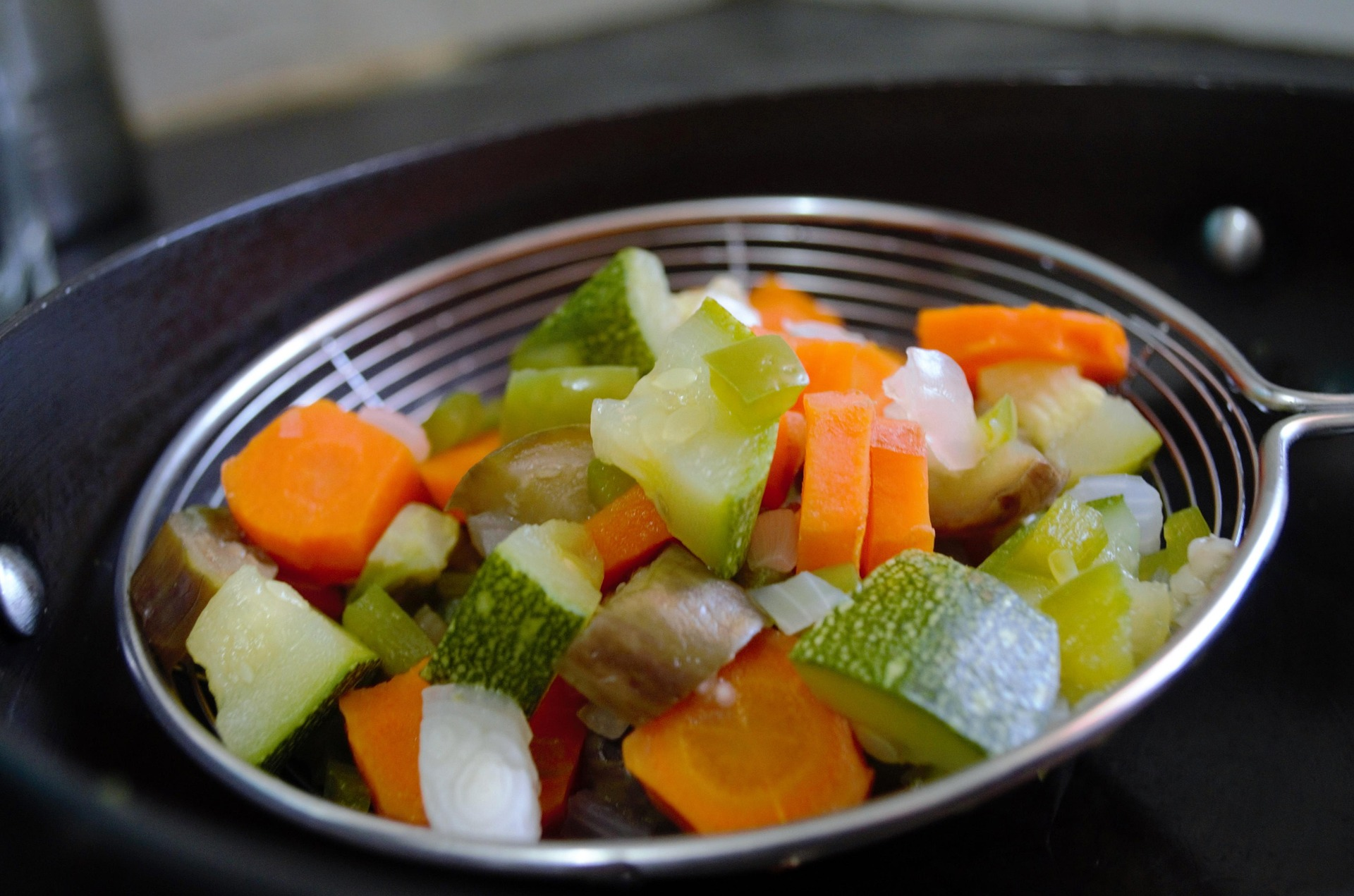
Under-blanching is worse than not blanching at all. NCHFP says so outright, and North Dakota State says it independently: a short blanch stimulates the enzymes instead of killing them. That makes the timer the whole job. And it means the common instinct, a quick dip because you are in a hurry and the pot is crowded, is the one mistake that actively costs you more than skipping the step.
What the blanch is actually for
Two enzymes. Peroxidase and lipoxygenase, named in NCHFP’s own laboratory work and nowhere else in this literature. In collard greens, peroxidase fell by 92 to 99 percent after blanching, while lipoxygenase fell by only 35 to 61 percent. Peroxidase does not come back: NCHFP measured it again at four months and six months in the freezer and it stayed down. Freezing by itself does not stop enzyme activity, it only slows it, which FSIS and Purdue both state.
Skip the blanch and the clock on quality is short. Alabama Extension puts flavor and color change at about four to six weeks of freezer storage, with an off odor on cooking. That is the only acceptable source out of eighteen checked that attaches a number to the timescale.
What blanching is not is a safety step, and the literature is sloppy about this. Minnesota says blanching improves food safety by killing bacteria on the vegetables. Minnesota’s own science-of-freezing page says freezing does not destroy or kill harmful bacteria. Illinois manages both positions on a single page, writing that blanching destroys microorganisms on the surface and also that blanching is not required for food safety. NCHFP uses the careful verb: blanching helps remove dirt and microorganisms. That is the defensible version. Nothing in home freezing is a kill step, so do not treat blanched vegetables as pasteurized or unblanched ones as dangerous.
The times, and one table you should not trust
NCHFP’s water-blanch figures are the reference set: green beans 3 minutes, broccoli florets 3, diced carrots 2, cut corn 4, collards 3, other greens 2, summer squash 3, green peas a minute and a half. Corn on the cob is sized by diameter rather than length, 7 minutes under an inch and a quarter, 9 up to an inch and a half, 11 above that.
Illinois publishes 5 minutes for diced carrots. Five other sources publish 2. This is not a disagreement worth weighing, it is a defect: the same Illinois table prints a stray digit in its Jerusalem artichoke row, which gives the conversion error away. Following it would over-blanch diced carrots by 150 percent.
Green peas are a real range rather than an error. NCHFP, NDSU and Utah State say a flat minute and a half; Oregon State, Minnesota, New Hampshire, Illinois and Clemson say a minute and a half to two and a half. Clemson alone gives the reason, which is pea size. The flat figure assumes young peas. If you are picking across a harvest window you will have over-mature peas in the colander, and given that under-blanching is the worse error, the range is the safer guidance.
Two more specifics. Timing starts when the water comes back to a boil, not when the vegetables go in, and if it takes more than a minute to get back there you have crowded the pot. Only Colorado State and Utah State address altitude, both adding a minute at 5,000 feet and above. The other ten institutions checked, NCHFP included, say nothing about it.
Cooling, where the rule was probably never tested
NCHFP, Oregon State and Illinois all say cool for the same length of time as the blanch, in water at 60 degrees or below, using about a pound of ice per pound of vegetables. New Hampshire and Minnesota carve out corn on the cob at twice the blanch time. Alabama says a flat 3 to 4 minutes for everything.
The corn exception gives away the mechanism. A cob is a dense solid with very little surface for its volume, so equal time under-cools it, and the symptom has a name in the literature: a cobby taste. Alabama’s flat 3 to 4 minutes cannot coexist with an 11-minute large-ear blanch. More telling, NCHFP’s own 2004 squash trial cooled for 5 minutes after a 3-minute blanch, which is 1.67 times, not equal time, on a thin slice that needed it least. The published consumer rule does not match the lab’s own practice. Treat equal time as a floor.
The microwave, and the recommendation nobody updated
This is the clearest case in the whole subject of guidance outliving its evidence. FSIS says plainly that you may blanch or partially cook vegetables in boiling water or in a microwave oven. NCHFP ran the trials. Collard greens in 2003 and yellow squash in 2004, at 1000, 1200 and 1300 watts. Microwave blanching came out as good as or better than boiling water and steam on enzyme inactivation.
NCHFP’s consumer page still says microwave blanching may not be effective because research shows some enzymes may not be inactivated, and refers to those who choose to run the risk of low-quality vegetables. Minnesota, Penn State, NDSU, Alabama and Clemson all repeat some version of it. Clemson’s phrasing is that the directions are not based on published research, which was true in 1999 and stopped being true in 2004. Every one of those pages is citing a position that predates the trials, and the trials belong to the institution whose page says not to.
How long it keeps, and what an outage costs you
Three answers are in print. Clemson and Purdue say 12 to 18 months. NCHFP, Oregon State, New Hampshire, Minnesota and Alabama say 8 to 12. NDSU says 3 to 6 for home-frozen vegetables. The 12-to-18 figure is the old USDA bulletin lineage surviving in the two oldest documents, and 8 to 12 is the current NCHFP number, so that part is just vintage. NDSU is not explained by vintage. It is the most recently reviewed document in the set, revisited in January 2024, and it is two to four times more conservative than everyone else without stating a basis.
None of those numbers is a safety limit. FSIS: frozen foods remain safe indefinitely, and the published times are quality figures. The safety line is the thermometer instead. A full freezer holds about 48 hours with the door shut and a half-full one about 24, which is the window a backup generator actually has to cover. Food still carrying ice crystals can be refrozen. Past that the federal charts split by food, and the split is wider than most people expect. Blanched or packaged vegetables and vegetable juices get discarded after 6 hours above 40 degrees. Meat, poultry and seafood get 2.
Sources
- NCHFP, Blanching Vegetables
- NCHFP, Blanching Times
- NCHFP, Freezing Corn
- NCHFP, How Long Can I Store Frozen Foods?
- NCHFP, Microwave Blanch Technology as an Alternative (IFT 2003, collard greens)
- NCHFP, IFT 2004 yellow squash (poster and abstract): nchfp.uga.edu and nchfp.uga.edu
- USDA FSIS, Freezing and Food Safety
- foodsafety.gov (USDA/FDA/HHS), Food Safety During a Power Outage
- NDSU Extension, Freezing Vegetables, FN403 (reviewed Jan 2024)
- Alabama Cooperative Extension System, Freezing Summer’s Bounty of Vegetables
- University of Minnesota Extension, Vegetable blanching directions and times
- University of Minnesota Extension, The science of freezing foods
- University of Illinois Extension, Vegetables (food preservation)
- PNW 214, Freezing Fruits and Vegetables (Oregon State, rev. 2018)
- UNH Cooperative Extension, Freezing Vegetables
- Penn State Extension, Understanding the Process of Freezing
- Ohio State University Extension, HYG-5333: ohioline.osu.edu
- Purdue Extension, CFS-134-W: extension.purdue.edu
- Clemson Cooperative Extension, HGIC 3063: dc.statelibrary.sc.gov
- Colorado State University Extension, High Elevation Food Preparation Guide
- Utah State University Extension, Vegetable Freezing Methods
- Iowa State University Extension AnswerLine, Blanching Vegetables
Leave a Reply