
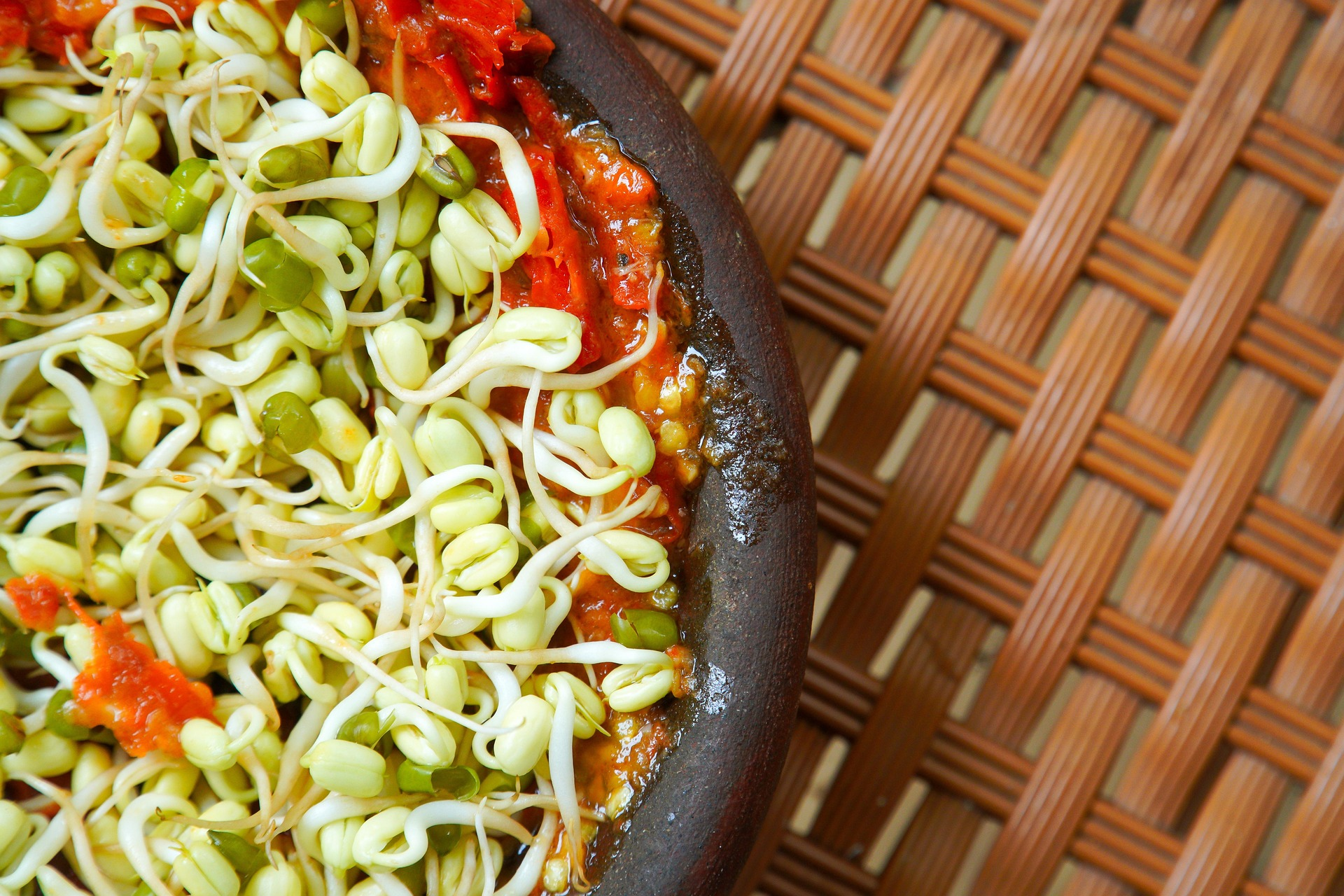
USDA’s Agricultural Research Service put barley trays on a scale before and after sprouting. Seven days turned 0.29 pounds of grain into 1.22 pounds of mat, a 327 percent gain in fresh weight. Dry matter yield fell 17 percent over the same week. Total energy per tray fell 21 percent. More feed to carry, less feed to digest. That gap is what the whole practice turns on.
The weight is water
Dry barley seed runs about 95 percent dry matter. A seven-day mat runs 18 percent by the same measurement. So the tray gains roughly four pounds of water for every pound of plant tissue it does not gain.
How wet depends on who measured. ARS got 18 percent in climate-controlled chambers. ARS and the University of Minnesota got 15.4 percent from a commercial unit on a working farm. Utah State got 12.6 percent from a six-day crop. A Western SARE project in Utah measured 10.7 percent at feeding. Nearly twofold. Every downstream figure rides on that spread.
The Western SARE report did the arithmetic that settles the argument. One ton of alfalfa hay carries 1,812 pounds of dry matter. One ton of barley sprout fodder carries 214. Matching a ton of alfalfa would take 16,935 pounds of fodder, about 8.5 tons of wet mat. Per pound fed, fodder delivered 0.11 pounds of dry matter against 0.91 for alfalfa.
Starch is what goes missing. In the ARS trays it fell from 58.1 percent of dry matter to 27.7. Fiber roughly doubled. Crude protein rose from 12.9 to 14.7 percent, which reads like a gain. Then multiply by the 17 percent smaller yield. Total protein per tray did not move. But the starch under it burned off.
Animals eat less, not more
This is the part that surprises people. Across four trials, adding fodder cut total dry matter intake.
ARS and Minnesota measured cows at 31.9 pounds of dry matter a day on fodder against 38.5 without. That is a 6.6-pound drop while the fodder supplied only three pounds. Milk went from 29.3 to 27.1 pounds. Milk urea nitrogen rose from 13.5 to 16.5 mg/dl, a sign of poorer protein use. Utah State’s lambs ate 1.43 to 1.50 kg a day against 1.63 for controls, and the authors put that down mainly to moisture. Utah State’s feedlot steers ate 25 percent less dry matter.
Goats refused it. In the Western SARE trial they ate 86 percent, then 78, then 70 of what was offered as the rate climbed. At the top rate, five pounds as fed to a 110-pound doe, fodder still supplied about 5 percent of total dry matter intake. Mixed-hay intake fell from 2.46 to 2.09 pounds a day. The fodder displaced hay rather than adding to the ration, which is the opposite of stretching winter feed, and it bites hardest in a species already tight on winter rumen capacity.
The report’s own conclusion is the sentence to remember. A ewe needing five pounds of dry matter a day would have to eat about 46 pounds of fresh fodder, which it calls infeasible. Fodder cannot be the sole forage because of the moisture.
What it costs per pound of dry matter
The Western SARE project priced everything on one basis. Grass hay 8 cents a pound of dry matter, alfalfa 11 cents, barley grain 13, corn 14, beet pulp 17, soybean meal 31. Barley sprout fodder came in at 28.
Read that against the grain it was made from. Fodder cost 2.2 times the barley going into the tray and 2.5 times alfalfa hay. UVM Extension, citing Iowa State’s Larry Tranel, reports 40 cents a pound of dry matter for fodder against 11 cents for good hay. Both sit well above the hay you would otherwise buy. Daily feed cost rose in both species tested, goats from 82 to 88 cents and sheep from 73 to 75.
Labour is a bigger line than power. The Western SARE small system drew 1.32 dollars of electricity a day and 3.75 dollars of labour, at 15 minutes and 15 dollars an hour. UVM puts daily labour at one to four hours. Utah State’s model shows the per-pound cost does not fall with scale either. It runs 10.5 cents a kilogram small, 11.8 medium, 10.5 large, on capital of 30,000 to 800,000 dollars.
Utah State’s two sentences
The steer paper says sprouted barley at 20 percent of the diet had no negative effect on performance. Gain was the same and feed conversion was better. The same paper reports net return over feed of minus 116.56 dollars a head against minus 23.40 for controls. It says sprouted barley is expected to have a negative impact on economic performance.
Both statements hold, because they answer different questions. The animal does fine. The ledger does not. A reader who takes only the first sentence has the finding backwards, and the first sentence is the one that gets quoted.
The same group found that less fodder paid better than more. Net return per head ran 15.72 dollars for controls, 27.92 at 10 percent inclusion, 15.42 at 20 percent and 11.82 at 30. More fodder was worse. The authors flag that the gain-to-feed difference was not significant, and that the economics used modelled rather than observed costs from one season in one place.
The water claim reverses when somebody meters it
UVM reports, citing Al-Karaki and Al-Momani, that fodder uses 2 to 3 percent of the water field crops need. That is the figure these systems are sold on. Western SARE metered its own unit at 4.28 gallons per pound of dry matter, against roughly one gallon for alfalfa. On the basis that matters, fodder drank about four times what hay does.
Mold, and the gap between a chamber and a barn
Mold scores in the ARS and Minnesota work were near zero for oats and barley, 0.03 and 0.04 on a six-point scale. Wheat scored 1.1, rye 2.8 and triticale 4.8. So choose the grain accordingly.
On working farms the picture changed. The Northeast SARE final report calls on-farm mold chronic. Two of the three organic dairies monitored for a year quit feeding fodder, citing labour, cost, barley supply and mold, and neither of those two saw any milk response. Penn State gives the mechanism without reference to livestock at all. Germination supplies nutrients, high moisture and heat, which help bacteria grow. Bacteria already on the seed keep multiplying. Home sprouting is not inherently safer, because contaminated seed produces high bacterial counts even under sanitary conditions. NDSU’s instruction if visible mold appears is to send a sample for mycotoxin analysis before feeding, especially to pregnant or lactating animals.
Poultry, rabbits, and the article that got pulled
A North Central SARE grantee in Indiana tried both. Egg production dropped every time bagged feed was cut and fodder added, then recovered when the bagged feed came back. The fodder group also started cannibalising immediately. Broilers managed 20 percent less bagged feed and no more. Barley alone was unpalatable to them, so field peas had to make up half the mix and bagged feed had to be sprinkled on top to get birds eating. Kentucky’s poultry pages give an independent reason. Barley is low in starch and high in fibre, and its non-starch polysaccharides gel in the gut.
For rabbits there is nothing at all. No acceptable source publishes a fodder intake figure for them. Oregon State Extension’s own fodder article is now archived behind a 403, noting it may be out of date or inaccurate.
Where it might still pencil
Northeast SARE’s verdict: economics generally favoured producing or buying good forage over sprouted grain in temperate regions. It names the exceptions: small operations, high land values, drought-prone ground, or surplus labour. The one dairy of three that gained ran a homemade system on family labour with marginal forage. That is a specific set of conditions, not a general case.
If you try it anyway, run oats or barley rather than rye or triticale. Keep inclusion near 10 percent of dry matter. Feed it the day it comes out, since moisture rules out storage. Then price the capital in. ARS puts it plainly: each farm must put pencil to paper to decide whether fodder is economical. The figure to write on that paper is cost per pound of dry matter, not pounds of mat per pound of seed.
Sources
- USDA Agricultural Research Service, Sprouted Barley for Dairy Cows
- USDA Agricultural Research Service, Case Study: Sprouted Barley Fodder in Organic Dairy Diets (2017)
- USDA Agricultural Research Service, Feeding Sprouted Barley Fodder on Organic Dairy Farms
- USDA Agricultural Research Service and University of Minnesota, Sprouted Barley Fodder On-Farm Study
- Northeast SARE, Sprouted Barley Fodder for Organic Dairy Cows, ONE14-224
- Western SARE, Hydroponic Barley Fodder for Dairy Goats and Sheep, FW19-343
- North Central SARE, Hydroponic Fodder for Pastured Poultry, FNC13-902
- University of Vermont Extension, Fodder Systems (2016)
- Iowa State University, Hydroponic Fodder Systems for Dairy Cattle, ASL R2791 (2013)
- Utah State University, Sprouted Barley in Lamb Finishing Diets (2025)
- Utah State University, Sprouted Barley in Feedlot Steer Diets (2026)
- NDSU Extension, Feeding Value of Sprouted Grains, AS647 (2023)
- Ohio State University Extension, Feeding Sprouted or Otherwise Damaged Wheat to Beef Cattle (2015)
- Penn State Extension, What You Should Know About Sprouts
- Penn State Extension, From Feed to Milk: Understanding Rumen Function
- University of Kentucky, Cereals in Poultry Diets
- Oregon State University Extension, Living on the Land: Raising Rabbits for Meat, EC 1655 (2018)
- Cooperative Extension, Ask Extension: Hydroponic Fodder Systems
Leave a Reply