
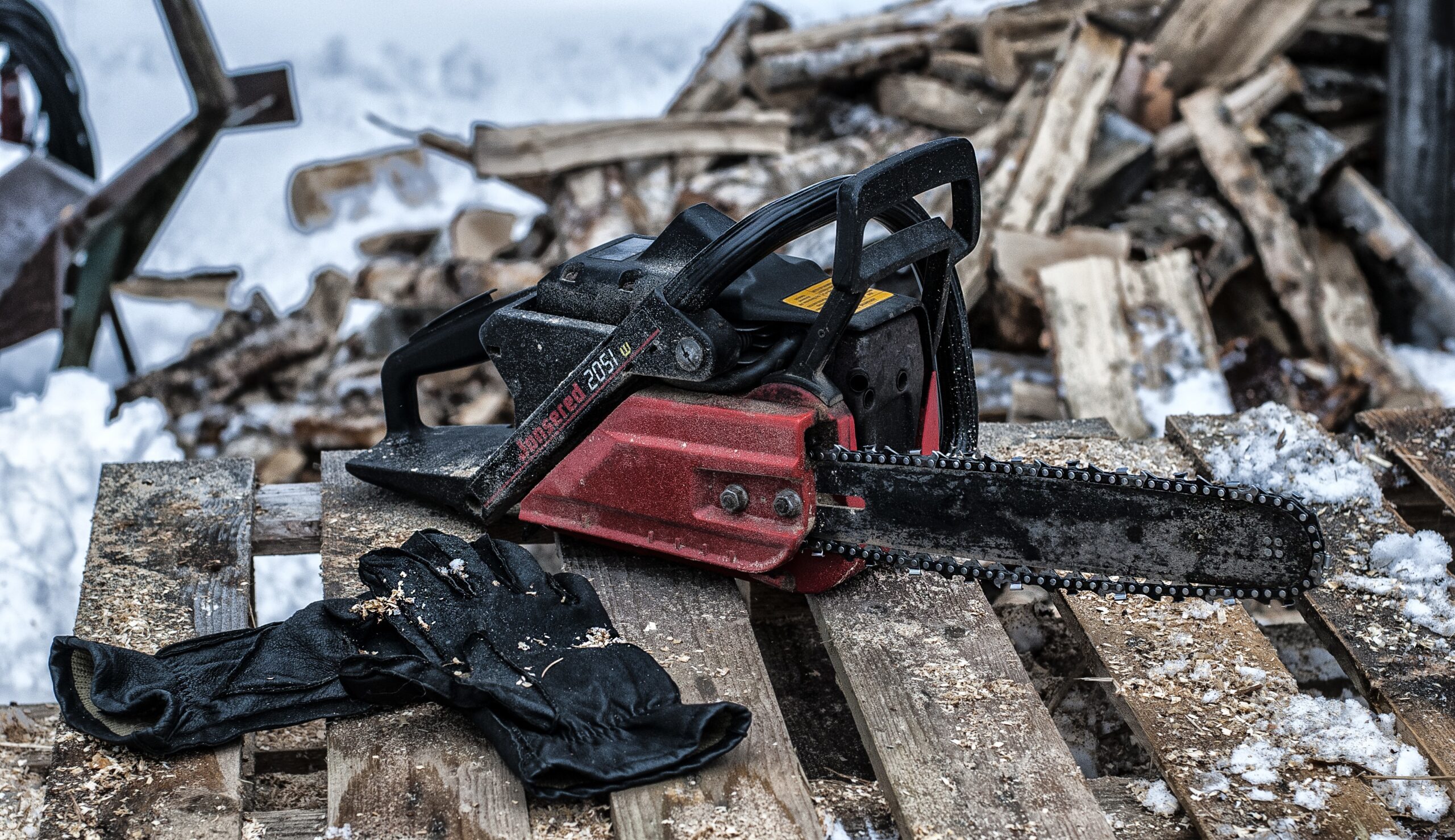
Penn State Extension puts chainsaw injuries at nearly 128,000 emergency department visits in the United States between 2018 and 2022, which works out to about 70 people a day. More than 80 percent of those were to arms and legs, and open wounds made up 76 percent of the non-occupational cases. Alabama Extension circulates a different figure, more than 36,000 a year, with no year range attached to it. Use the Penn State number. It has a stated window.
Most of that traces to kickback, and kickback is a geometry problem rather than a strength problem. The chain in the upper quadrant of the bar nose catches wood or gets pinched, and the bar swings up and back along the arc of your shoulders. Oregon State calls the motion unpredictable and extremely fast. It also happens without any tip strike at all, when the chain passes from soft live wood into hard dead wood.
The maintenance that changes kickback risk
This is the part that surprises people who assume a sharp chain is a safe chain. The Forest Service names depth gauges filed too deep as a condition that raises kickback risk. A freshly filed chain with over-lowered rakers is more prone to kick than a duller one, not less.
Depth gauges are the small ramps ahead of each cutter, and they set how much wood the cutter can take in one pass. Wisconsin Extension gives 0.025 inch as the height difference between cutter and gauge. Do not eyeball that. Use a depth-gauge tool with the setting built into it and file until the gauge sits flush with the tool. How often is contested. Missouri Extension repeats the manufacturer guidance of lowering them every third filing, while the Forest Service treats checking them as part of the filing routine. Checking every time costs nothing.
For the cutters themselves, Wisconsin gives a top plate angle of 25 or 30 degrees, with the file held at 90 degrees to the cutter and pressure applied only on the push stroke. The Forest Service adds that the file should ride at least one-fifth of its diameter above the top plate. Two other sources declined to give a degree figure at all and referred back to the chain manufacturer, which is the right instinct if your chain came with a spec card.
You can tell a dull chain without measuring anything. Missouri lists four signs: the saw cuts crooked, the cut throws fine sawdust instead of chips, you have to push down to keep it cutting, and you smell burnt wood. The Forest Service adds a consequence nobody thinks about, which is that the fine dust a dull chain makes gets pulled straight into the air filter.
Chaps, ears, and what they actually do
Chaps are worth understanding rather than just wearing. The layers do not blunt the chain. The fibers pull out and jam the drive sprocket, which is why chaps packed with sawdust or soaked through with bar oil stop working, and why the Forest Service retires a pair once first-layer cuts run past an inch. OSHA requires cut-resistant leg protection under 29 CFR 1910.266, meeting ASTM F1897-98. Jeans do not count.
Hearing protection needs a noise reduction rating of 25 or better against a saw that runs somewhere between 90 and 110 decibels depending on which source you read. Doubling up plugs and muffs adds about 5 dB to the higher of the two ratings rather than summing them, which is worth knowing before you assume you have 58 dB of protection.
Tension, bar, oil
Run it snug. Missouri specifies 1/32 inch of gap at the center of the bar on a cold chain and 1/8 inch when warm, Alabama says a dime’s width, and the Forest Service gives it qualitatively as snug but pulling freely, never hanging off the bar. All three rule out the loose chain some people run to keep it from binding. CDC’s warning on that one is short. A loose chain comes off the bar.
Set tension cold. The Forest Service line is worth memorizing, that a chain tensioned hot will be too tight once it cools.
Flip the bar and clean it. The Forest Service says rotate it every time you file the chain, or at least once a day, while Alabama says every chain change, which is a materially slacker interval. Clean the groove working from the tip toward the base so debris moves away from the roller nose, clear the oil holes, and take burrs off the rails with a flat file. Blue discoloration on the bar is not a badge of hard work. It means the chain ran dry, ran too tight, or was dull or badly filed.
Use bar oil and nothing else. Missouri Extension says do not use crankcase or reclaimed oil, because waste oil has reduced lubricating properties and can corrode the oil pump, and Wisconsin rules out generic substitutes. A tank of oil should last as long as a tank of fuel or longer, so if your gas runs out well ahead of your oil, the oiler is not delivering.
Fuel and filter
Alabama gives 50:1, which is 2.6 fluid ounces of two-stroke oil per gallon, at 89 octane or better, ethanol-free or under 10 percent. Wisconsin says mixed fuel expires in one to two months, so run the saw empty before it sits for the winter. Penn State’s account of ethanol explains the hurry. Ethanol absorbs water where gasoline does not, and on older equipment it makes seals and hoses shrink, swell or deteriorate into leaks.
The air filter has one rule people break constantly. The Forest Service says never blow it out with an air hose. Tap it against something instead, and do not rub or scrape it. Check the spark plug weekly in heavy use, looking for a dry beige tip rather than a black one.
Bucking is where the bar gets trapped
A log under load has a compression side where the fibers are squeezed together and a tension side where they are pulled apart. Cut the compression side first and the tension side second, and make the two cuts bypass each other so every fiber gets severed. Get it backwards and the kerf closes on your bar.
Purdue gives the two common cases plainly. Log supported at one end: cut a third of the diameter from underneath, then finish the remaining two thirds from the top. Log supported at both ends: a third from the top, then two thirds from underneath. On level ground, cut from the top so you do not drive the chain into dirt.
Get the wood up off the ground. Missouri’s sawbuck spec is cross pieces 16 to 20 inches apart with clearance underneath for the bar, and the final cut placed between the cross pieces rather than outside them where the offcut can pinch. Standard firewood length is 16 inches, give or take two, which is also the length that stacks and seasons without a fight.
Springpoles deserve their own paragraph because they hurt people who are otherwise careful. A sapling bent under a fallen tree is a loaded spring. OSHA’s method is to shave the underside gradually so the fibers on top release slowly, rather than cutting through and letting it whip.
Two limits show up in every source without qualification, and neither is negotiable. Do not cut above shoulder height. Do not run a saw from a ladder. CDC puts the working line at waist level or below, and Oregon State and Missouri both say plainly not to work alone. There is a number that makes the case for all of it: in the time it takes to react to anything, more than 30 feet of chain has already gone past a single point on the bar.
Sources
- The Dangers of Using Chainsaws, Penn State Extension
- Chainsaw Safety Tips, Penn State Extension
- Fuel Ethanol: Hero or Villain, Penn State Extension
- Chain Saw and Crosscut Saw Training Course: Saw Maintenance, USDA Forest Service MTDC
- Chain Saw and Crosscut Saw Training Course: Reactive Forces, USDA Forest Service MTDC
- Chain Saw Chaps Tech Tip, USDA Forest Service
- G1954 Chain Saw Operation and Maintenance, University of Missouri Extension
- G1959 Chain Saw Safety, University of Missouri Extension
- G5451 Cutting Firewood, University of Missouri Extension
- EC 1124 Chain Saw Safety, Oregon State University Extension
- Buying and Maintaining a Chainsaw, University of Wisconsin Extension Forestry
- FOR-2084 Chainsaw Safety: Maintenance, Alabama Cooperative Extension System
- Chainsaw Safety: Personal Protective Equipment, Alabama Cooperative Extension System
- Chainsaw Safety: Safety Features and Maintenance, Alabama Cooperative Extension System
- S-78 Chain Saw Safety, Purdue Extension
- Chain Saw Safety, Centers for Disease Control and Prevention
- Logging eTool: Limbing and Bucking, OSHA
- Logging eTool: Leg Protection, OSHA
- Chain Saw Kickback Significantly Reduced, U.S. Consumer Product Safety Commission
- Chainsaw Safety, eXtension Ag Safety and Health
- Bulletin #2353 Chainsaw Safety, University of Maine Cooperative Extension
- Chain Saw Safety, Virginia Tech Environmental Health and Safety
- Reducing the Risk of Chainsaw Kickback, Cornell Small Farms Program