
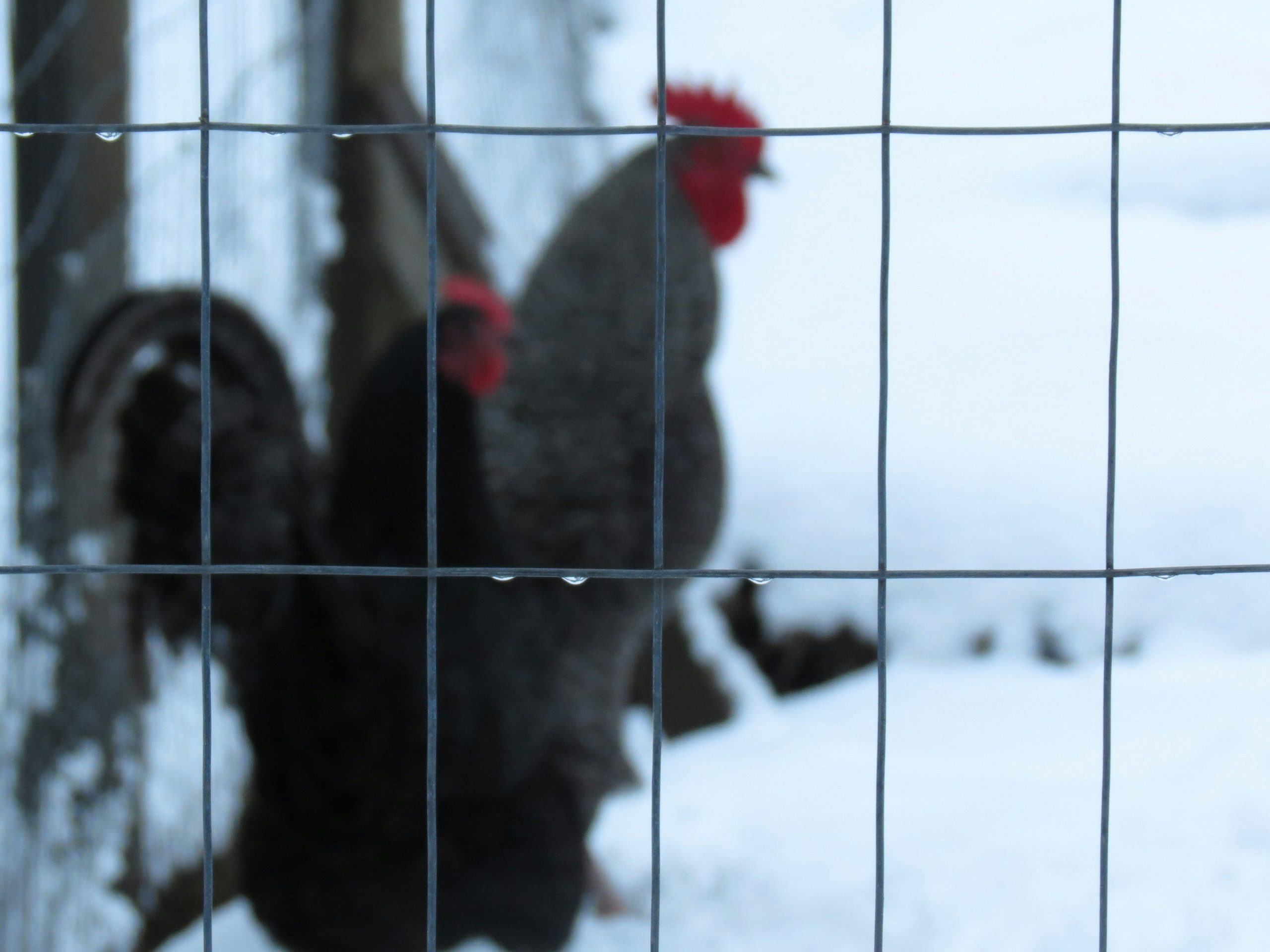
An egg leaves the hen at about 109°F and freezes at 31°F. Penn State Extension publishes both figures. The gap between them is most of the winter egg problem, because the egg starts hot and the nest box does not.
So the first question is how often you walk out. Penn State says collect at least twice daily in extreme weather, and notes that most flocks have laid by 10 a.m. University of Wisconsin Extension says twice before noon, with a third trip in the late afternoon worth considering in hot or cold weather. UGA Extension says collect more often when temperatures run very hot or very cold. None of them gives you a clock.
The number nobody publishes
There is no sourced figure for how long an egg can sit in a cold nest before it freezes. Not at 20°F, not at 0°F, not at any temperature. Penn State has a page devoted to how freezing affects egg quality and it does not give one. The times that circulate, twenty minutes or an hour, trace to backyard poultry forum threads and hobby-farm sites rather than to research.
That absence changes what you can plan. Without a figure you cannot schedule against the risk, so the rule extension actually gives is the usable one: add a collection, do not try to time one. A third trip at dusk catches everything laid after the morning round.
The egg that froze anyway
Penn State draws a hard line at cracks. Contents expand as they freeze, the shell can split, and an egg that cracked while frozen gets thrown out. An intact one is a different case. USDA FSIS says keep it frozen, thaw it in the refrigerator, and use it immediately after thawing.
Expect the texture to be wrong. Penn State, citing Cotterill, reports that raw yolk gels and thickens when frozen, especially below 21°F, and stays gel-like after it thaws. The white comes through better. Scrambled, that egg is fine. In a custard it will not behave.
One sentence no acceptable source will write: that a thawed, previously frozen, uncracked egg is safe. FSIS implies it by telling you to use it right away. USDA’s Egg Grading Manual classifies any frozen egg as a loss egg, which bars it from sale, but that is a grading rule and not a kitchen ruling. The guidance stops one sentence short.
Whether to wash at all
FSIS says consumers should not wash eggs. Penn State, UNH, UGA and Alabama Extension all publish washing procedures. Those two positions look like a fight and are not, because they address different people. FSIS is talking to someone holding a store carton, where the eggs were washed and sanitized at a plant, and re-washing those only risks driving something through the shell. Extension is talking to someone holding a dirty egg out of a nest.
Penn State is explicit about the home flock: you are not required to wash eggs you produce for your own table. The bloom, the cuticle sealing the pores, comes off with brushing and washing. A clean egg should be left alone.
For a dirty one, USDA’s Egg Grading Manual sets the commercial rule. Wash water at a minimum of 90°F, and at least 20°F warmer than the egg’s internal temperature. Penn State gives the mechanism plainly: cool water makes the shell contract and pull surface dirt and bacteria down through the pores. Alabama Extension adds the part people skip. Eggs are never left submerged, because the same thing happens once water and egg equalize.
Penn State also prints 10°F as the differential in one consumer article, against its own poultry pages and against USDA. Use 20.
The arithmetic that only breaks in winter
University of Kentucky Extension publishes the full set of bounds: wash water 20°F warmer than the egg, a suggested range of 110°F to 120°F, never more than 50°F above the egg’s temperature, and never above 128°F, where the egg begins to cook.
Now run a 35°F egg from a January nest through that. Water at 110°F clears the 20-degree minimum with room to spare. It also sits 75 degrees above the egg, which blows through the 50-degree ceiling. Both rules come from the same publication, and a cold egg cannot satisfy both.
Alabama Extension resolves it. Eggs should be at least 60°F before washing, and cold eggs are tempered at room temperature for a couple of hours first. Sixty plus fifty is 110, which is the bottom of Kentucky’s suggested range. The two publications are describing one rule, and the winter version of it has a waiting step bolted to the front.
If waiting is not in the plan, clean dry. UMN Extension, UW Extension and Alabama all endorse fine sandpaper, a brush, or an emery cloth, and UMN is blunt about the reason: keep eggs dry, because bacteria pass through a wet shell. Badly soiled eggs get discarded rather than washed. Alabama and Kentucky both say so.
Where it goes next
A refrigerator at 40°F or below, per FSIS, in the body of the unit rather than the door. Alabama puts the band at 33°F to 40°F. That lower bound sits two degrees off the freezing point, which matters if the eggs are headed for an unheated porch or a garage refrigerator that drifts with the weather outside.
Skip the counter. The claim that unwashed eggs keep for weeks at room temperature because of the bloom has no US extension support. Penn State states that USDA recommends refrigerating all eggs, washed or unwashed, and rejects pantry and basement storage specifically because neither holds at or below 40°F. The counter habit is British practice, described accurately in a University of Kentucky article on European rules and then quoted back as American guidance.
Shelf life looks like a mess and resolves cleanly. FSIS says three to five weeks. UMN says four to five. UW Extension says six to eight, and Penn State says at least six weeks holding Grade A quality at 45°F. The federal figures count from the pack date of a commercial egg that already spent time in a distribution chain, while the extension figures count from the day the hen laid it.
Store them pointed end down. Penn State gives that instruction twice, and the published reason is air cell stability. Nothing in the literature says orientation makes an egg keep longer.
One test that works and one that does not
The float test measures age, not spoilage. FSIS says a floating egg “is of poor quality, but it may be perfectly safe to use.” Illinois Extension and Iowa State’s AnswerLine say the same thing in their own words. A floater has a large air cell. Crack it into a bowl and use your nose.
Candling answers a real question, and USDA publishes the scale. An air cell 1/8 inch deep or less is Grade AA. Up to 3/16 inch is A. Deeper than that is B.
The nest, and why the basket got light
Crowding breaks eggs, which makes nest count matter most in the season birds spend indoors. UW Extension says one nest per three to four hens. UNH and Alabama say one per four. Mississippi State says one per four to six, and no measurement separates the three. Take the low end for winter.
Bedding is contested. UNH specifies 6 to 8 inches of fresh wood shavings or sawdust and says hay and straw are not recommended, because they are hard to clean once soiled. UW and Alabama list straw as fine. That is a cleanability argument against a cost argument, not a conflict about facts. Worth noticing what is absent: no extension source gives a bedding depth for slowing an egg’s freeze, though depth is obviously the mechanism.
And the production drop is not the cold. PNW 565, the extension publication written specifically on why hens stop laying, puts it on day length and never lists cold among the causes. Below roughly 12 hours of light, birds quit; 14 to 16 hours is the working figure for keeping them going, which is the same mechanism behind the fall molt and the egg drop that comes with it. Cold does raise feed intake by as much as 25 percent, per UMN, and that can push a bird already short on feed. The short days are what stopped the laying.
Sources
- Penn State Extension, How Freezing Affects Egg Quality — https://extension.psu.edu/how-freezing-affects-egg-quality
- Penn State Extension, Proper Handling of Eggs: From Hen to Consumption — https://extension.psu.edu/proper-handling-of-eggs-from-hen-to-consumption
- Penn State Extension, How to Safely Handle and Store Eggs from Your Home Flock — https://extension.psu.edu/how-to-safely-handle-and-store-eggs-from-your-home-flock
- Penn State Extension, What Do I Do with All These Eggs? — https://extension.psu.edu/what-do-i-do-with-all-these-eggs
- USDA FSIS, Shell Eggs from Farm to Table — https://www.fsis.usda.gov/food-safety/safe-food-handling-and-preparation/eggs/shell-eggs-farm-table
- USDA AMS, Egg Grading Manual — https://www.ams.usda.gov/sites/default/files/EggGradingManual.pdf
- Alabama Cooperative Extension System, ANR-3142, Tips for Enhancing Egg Quality and Safety from Washing to Cooking — https://www.aces.edu/wp-content/uploads/2025/04/ANR-3142_TipsforEnhancingEggQualityandSafetyfromWashingtoCooking_040925aL-G.pdf
- Alabama Cooperative Extension System, Enhancing Egg Quality and Safety in Small Flocks — https://www.aces.edu/blog/topics/poultry/enhancing-egg-quality-safety-in-small-flocks/
- University of Kentucky Cooperative Extension, ASC-229 — https://afs.o2.boa.ca.uky.edu/sites/afs.ca.uky.edu/files/ASC229.pdf
- University of Wisconsin Extension, Egg Safety and the Backyard Flock — https://sheboygan.extension.wisc.edu/files/2011/01/Egg-Safety-and-the-Backyard-Flock.pdf
- University of Minnesota Extension, Safety tips for handling farm fresh eggs — https://extension.umn.edu/small-farms/safety-tips-handling-farm-fresh-eggs
- University of Minnesota Extension, Caring for chickens in cold weather — https://extension.umn.edu/agriculture/animals-and-livestock/poultry/caring-for-chickens-in-cold-weather
- UNH Extension, Producing Your Own Eggs — https://extension.unh.edu/resource/producing-your-own-eggs
- UGA Extension Circular 1230, Maintaining Good Egg Quality — https://fieldreport.caes.uga.edu/publications/C1230/maintaining-good-egg-quality-a-guide-for-small-producers/
- University of Illinois Extension, Safely storing store-bought eggs — https://extension.illinois.edu/blogs/live-well-eat-well/2025-01-29-safely-storing-store-bought-eggs
- Iowa State University Extension and Outreach, AnswerLine, Egg Safety — https://blogs.extension.iastate.edu/answerline/2026/03/31/egg-safety-2/
- Oregon State, Washington State and University of Idaho Extension, PNW 565, Why did my chickens stop laying? — https://extension.oregonstate.edu/sites/extd8/files/catalog/auto/PNW565.pdf
- Mississippi State University Extension, P3624, Poultry Beginnings — https://extension.msstate.edu/sites/default/files/document/2025-09/P3624_web_1.pdf
- Jacquie Jacob, University of Kentucky, Safe Handling of Eggs from Small and Backyard Flocks — https://poultry.extension.org/articles/food-safety-with-poultry-meat-and-eggs/safe-handling-of-eggs-from-small-and-backyard-flocks/
Leave a Reply