
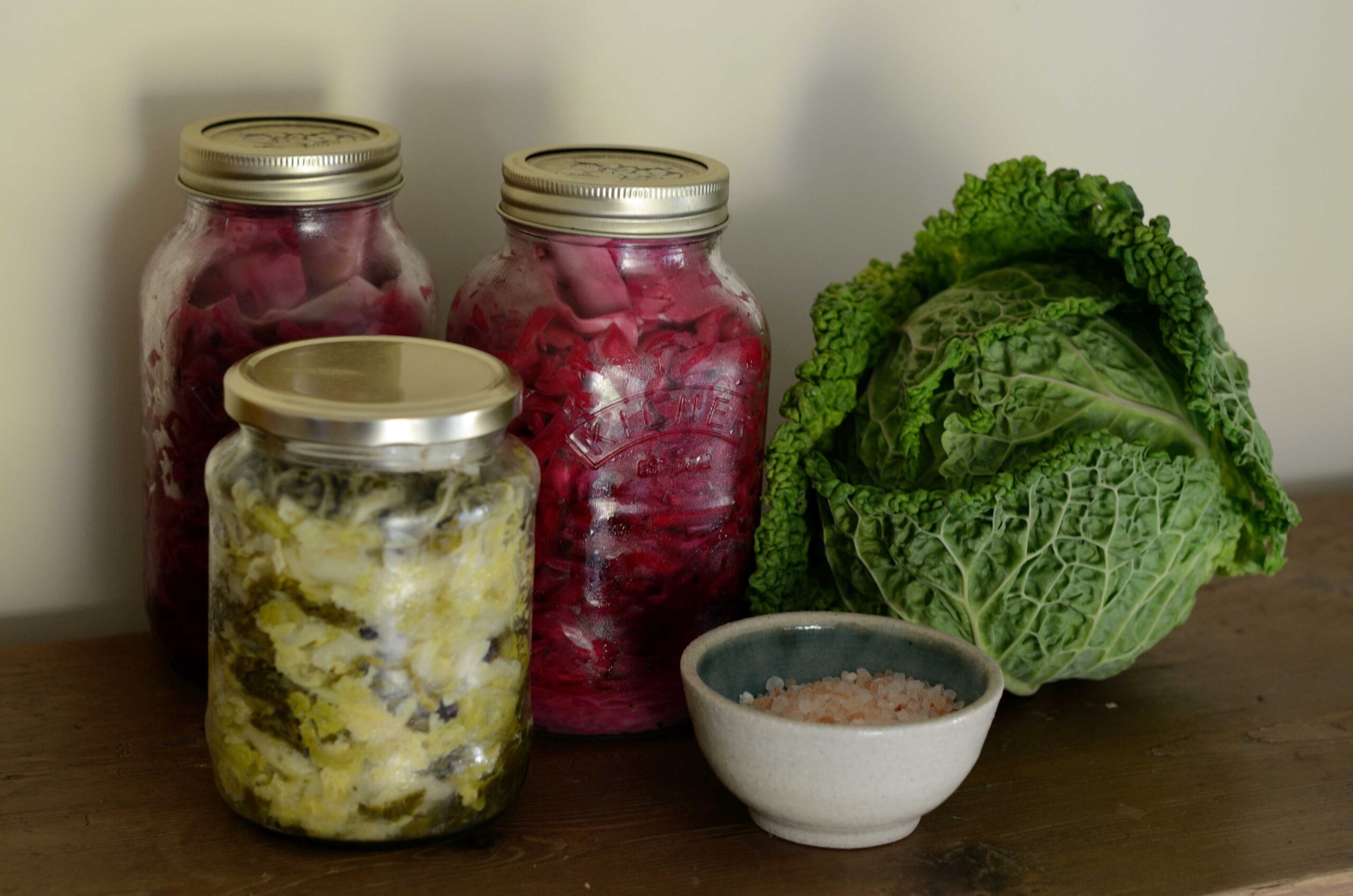
Three things hold a ferment on the safe side of the line. Salt ratio, temperature, and time. None of the three is adjustable to taste, and the salt one is where people get into trouble because it is the one that seems like a preference.
It is not. Penn State and the National Center for Home Food Preservation both say the same thing in the same words: do not attempt to make sauerkraut or fermented pickles by cutting back on the salt. Oregon State adds that reduced-sodium salt substitutes are not recommended in fermented pickle recipes either. Salt is what favors the bacteria you want over the ones you do not.
Sauerkraut, by weight
University of Wisconsin Extension gives 2.25 to 2.5 percent salt by weight of cabbage. NC State gives a final concentration of 2.0 to 2.5 percent. Colorado State gives the same band with the kitchen version, roughly 3 tablespoons of salt per 5 pounds of shredded cabbage, which is also the NCHFP working ratio.
Weigh it. A kitchen scale removes the entire question, and the volumetric conversion is only approximate because shredded cabbage packs differently every time.
Get it wrong low and Wisconsin says the tissue softens and the flavor goes flat. Get it wrong high and fermentation stalls, the color darkens, and pink pigment-producing yeasts can take hold. Minnesota puts the high-salt failure in the terms that matter: too much salt and the pH never drops.
The universal “2% salt for everything” rule you see repeated is at or below the low end for cabbage, and it is badly wrong for cucumbers. Illinois Extension puts whole vegetables like cucumbers and carrots at around 5% and shredded vegetables like cabbage at 3%. Whole cucumbers have skin in the way and much less surface area, so they need a stronger brine to do the same work.
For fermented dills, use the NCHFP recipe rather than a percentage: half a cup of canning salt, a quarter cup of 5% vinegar, and 8 cups of water per gallon of crock, over 4 pounds of pickling cucumbers.
Temperature and time
NCHFP and USDA both put the optimum at 70 to 75°F. Below 60, kraut may not ferment at all. Above 75 it goes soft, and cucumbers hold out only until about 80 before they do the same.
Sauerkraut takes three to four weeks at 70 to 75°F. Five to six if your room sits at 60 to 65. Fermented dills run the same schedule.
Three to four weeks. Not five days. The “kraut is done in a week” advice that circulates is contradicted by every safety-authoritative source except Colorado State, which is the outlier at 7 to 14 days. You will know it is finished when the bubbling stops.
Under the brine, and stay there
NCHFP says cabbage and cucumbers must be kept 1 to 2 inches under the brine for the whole ferment. The reason is oxygen, which is what mold and film yeast need to grow. NC State says submersion is what prevents spoilage in cucumbers, not what helps prevent it.
If the cabbage does not make enough of its own liquid, NCHFP says add boiled and cooled brine at 1.5 tablespoons of salt per quart of water. Do not add plain water, which dilutes the salt you just measured.
Check the crock two or three times a week and skim any surface film. This is not optional tidiness. NCHFP explains that the wild yeasts in that film feed on the acid, which lowers the acidity that is keeping the batch safe. Skim with a clean non-metal spoon. Nobody credible says to stir it back in.
Film, mold, and when to quit
Illinois Extension draws the line most usefully: a white film that is not fuzzy and not in round patches is kahm yeast, and it is safe. Fuzzy growth or round colored patches are mold, and mold is a different conversation.
UC’s Master Food Preserver program sets the threshold on quantity. A small amount of mold can be skimmed. A large amount affects the safety of the kraut and it should be discarded.
Beyond that, both Illinois and NCHFP give the same simple rule. Slimy, or smelling spoiled or rotten, means throw it out. A crock of cabbage costs a few dollars.
Worth knowing that NCHFP does not use the term kahm yeast anywhere. It refers only to scum. The kahm-is-harmless framing rests on Illinois Extension, which is a real source, but it is one source rather than a consensus.
Two things people say that are not in the manuals
Iodized salt is the first. You will hear that iodine kills lactobacillus and ruins the batch. NCHFP does not say that. Its stated objection is that anti-caking agents in other salts make the brine cloudy. Penn State’s objection is also cosmetic, that iodized salt may darken or spot the product. Wisconsin does make the hard claim that iodine prevents fermentation, but I could not find a study cited behind it.
Use canning or pickling salt anyway, because every source agrees on that and it costs a dollar. Just know the reason is probably appearance rather than microbiology.
The second is starter culture. No NCHFP or extension recipe for kraut or fermented pickles calls for whey, a purchased culture, or juice from a previous batch. Salt, vegetables, and time. Nor does any of them require an airlock lid. The published method is a cover, a weight, and skimming a couple of times a week.
Afterward
USDA gives two acceptable endings and no third: refrigerate, or can it properly. Fermented kraut keeps several months refrigerated, fermented pickles about four to six.
To can sauerkraut, boiling-water canner with half-inch headspace. NCHFP hot pack at sea level is 10 minutes for pints, 15 for quarts, and raw pack is 20 and 25, with longer times as altitude climbs. Fermented dills run 10 to 20 minutes for pints depending on altitude, or the low-temperature pasteurization option of holding jars at 180 to 185°F for 30 minutes. Look the table up rather than trusting a number in a blog post, including this one.
Canning kills the lactobacillus, as Minnesota points out. If the live culture is the reason you are doing this, the refrigerator is the only ending that keeps it, and 25 pounds of cabbage makes about 9 quarts, which is a lot of refrigerator.
Sources
- National Center for Home Food Preservation, Sauerkraut
- NCHFP, Fermented Dill Pickles
- NCHFP, Problems with Fermented Pickles
- USDA NIFA, Safely Fermenting Food at Home
- University of Wisconsin Extension, B2087 Make Your Own Sauerkraut
- Illinois Extension, Fermenting FAQ
- University of Minnesota Extension, Fermentation
- Penn State Extension, Ingredients Used in Home Food Preservation
- NC State Extension, Lactic Acid Fermentation