
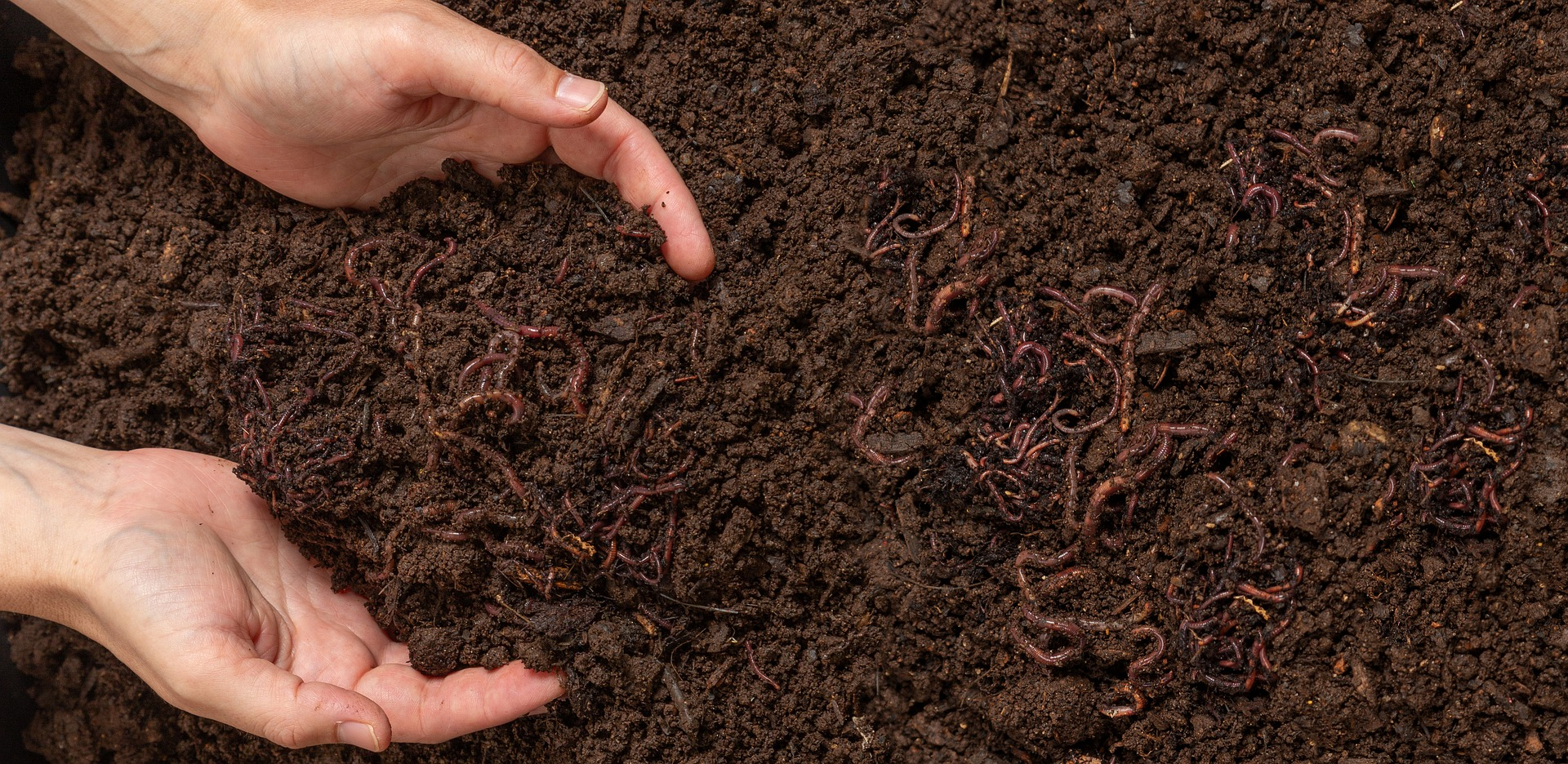
Red wigglers die near freezing, and not one extension service in the country will tell you how thick to make the insulation. That gap settles the question. If nobody can put a number on what keeps an outdoor bin above the lethal line, the honest move in October is to bring it inside.
Oregon State University Extension puts the active range at 55 to 77 degrees, with tolerance from 40 to 90, and says worms feed less and move less below 50. NC State Extension publishes a wider survival window of 32 to 95 degrees, but attaches a condition most people drop when they repeat it: that range holds only with at least four inches of bedding and insulation around the bin. The EPA prints the same numbers and the same condition, word for word from NC State, so the two are not independent confirmation of each other.
Two extension services say outright that this does not work outdoors
Penn State Extension states that red wigglers “generally do not survive Pennsylvania winters.” The Natural Resources Research Institute at the University of Minnesota Duluth goes further and treats the cold intolerance as a feature, not a problem. Its guidance calls red wigglers a good choice for northern climates because they do not survive cold winters, which means an escaped population cannot establish itself in the woods. That is an invasive-species document arguing the opposite case from a how-to guide. Both are right about the same fact.
The sources that do permit outdoor overwintering hedge it hard. University of Georgia Extension allows worms below 55 degrees only “as long as the center of the vermicompost bin or pile remains above freezing.” Oregon State gives two outdoor methods: worms in the middle of a mature compost pile with food buried in the center, at roughly half the normal feeding rate, or the bottom half of the bin sunk in the ground with straw banked around and over it and the air holes left clear. Then it warns that a buried bin can die off “in an uncommonly cold or wet winter.” That is the quiet admission that the method has no margin.
The insulation number does not exist
Twelve publications name insulation materials. Blankets, burlap, straw, hay bales, blue board, foam board, magazines, leaves, cardboard, dryer lint, old socks, fleece, carpet. Not one states a thickness, an R-value, or any other quantity. NC State, Illinois, WSU, UC Sacramento, Oregon State, the EPA, and the Ontario agriculture ministry are all silent on it. Shredded leaves sit on both the bedding list and the insulation list, so the leaf mulch and leaf mold piece is the companion read if that is what you are banking up this fall.
The silence runs deeper than thickness. No source gives a temperature or a date at which to move a bin indoors. None gives a duration a bin can sit below the stated minimum before the worms are gone. Every published figure is an instantaneous threshold with no exposure-time dimension, which is no help at all on a cold Tuesday in a Zone 5 garage. So if the ground freezes hard, the bin comes inside. Any insulation spec circulating locally did not come from extension, the USDA, or the EPA.
Feeding rates disagree by a factor of 28
This is the largest spread in the vermicomposting literature. Oregon State says start at a quarter to a half pound of scraps per pound of worms per week. Penn State says a half to one pound per week. University of Georgia Extension says three pounds per week. University of Illinois Extension says a pound per pound of worms per day, seven times the UGA figure and twenty-eight times the Oregon State starting rate.
Two different quantities are being printed as one. The low figures are explicitly starting rates for a new bin, worded as “start with” and “increase gradually.” The high figures describe what a mature population at good temperature can biologically process. Nobody reconciles the two in print, and UGA publishes both the weekly and the daily version inside the same document.
Oregon State is the only source that gives a criterion you can act on instead of a ratio: if untouched food is still sitting there after two or three weeks, stop feeding for up to two weeks. That rule holds at any temperature, which matters because Illinois notes feeding drops off sharply in the cold and an insulated outdoor bin needs less food in January than in August.
Deep bin or shallow bin, and the tradeoff nobody names
Oregon State caps bin depth at one foot, and UC Cooperative Extension in Sacramento County says the same. University of Maryland Extension builds at five to eight inches. WSU Whatcom County Extension specifies 12 to 24 inches, entirely above the Oregon State ceiling, and NC State’s Pender County office treats 12 inches as a floor rather than a limit.
Those are two camps managing two different failure modes. The shallow camp is fighting anaerobic conditions and odor, and University of Nebraska–Lincoln Extension names a too-deep bin as a cause of smell outright. The deep camp is managing thermal mass, which is exactly the winter problem: Illinois says larger bins hold heat better and give worms room to migrate away from a cold wall. Going into cold weather the two camps give opposite instructions and no publication acknowledges that it is a tradeoff at all. A bin in a heated basement can be shallow. A bin in a cold garage wants the depth and the mass.
The basement is also where the washing machine lives
University of Maryland Extension states that worms “will not crawl out of their bin unless the bin becomes too dry or too wet.” That is an absolute claim and two other extension services falsify it. Oregon State lists vibration from foot traffic or laundry machines as a cause of worms leaving. Penn State says flatly that a bin in the laundry room can drive worms out through machine vibration.
This collides with the winter advice. Illinois, Nebraska, and Maryland all point to the basement or the garage as a bin’s cold-weather home, and in most houses that is also the laundry room. Illinois adds that indoor winter air is drier, so check the bedding weekly and mist it.
The pH question is where the common advice is actually wrong
Six sources put the target at or near neutral. NC State says maintain 7.0. UGA says around 7, with anything below 5 harmful to worm activity and reproduction. UC Sacramento says 6.5 to 7, Texas A&M AgriLife says 7.0, and the Ontario ministry says 6.5 to 8. Oregon State is the lone outlier at roughly 5.5, inside the band UGA calls harmful. It separately gives its tolerable range as 4 to 9, so this is not an optimal-versus-tolerable distinction.
The acid end is where three publications locate real failures. NC State and UGA both read mold in a bin as bedding gone too acidic, and NC State’s commercial bulletin treats a pH below 6.8 as the mite threshold and calls for lime. Cornell says citrus-heavy bins turn acidic, and that the acidity is what draws fruit flies. Nebraska, meanwhile, calls mold and mildew “natural in the composting cycle,” a worry only if someone in the house has allergies. Three institutions, three causal theories, incompatible remedies, same visible symptom in your bin.
What happens to the bin when you are done with it
Most worm-bin material skips this part. The Minnesota Duluth guidance says to freeze finished vermicompost for at least a week before it goes outdoors, because freezing kills the worms and the egg cocoons, and not to dump a bin in woods or water. Penn State independently says one to four weeks in the freezer. The two disagree on duration and agree on the principle.
The reason is a single line in the Duluth document: earthworms do not drown. A bin emptied into a ditch is a bin released, and the same institution notes that Amynthas jumping worms are a common contaminant in worms sold as red wigglers. NC State says not to buy from bait shops at all. So the worms you bought in October may not be only what you ordered, and the castings you spread in April carry whatever came with them.
Sources
- Oregon State University Extension, EM 9034, Composting with Worms — https://extension.oregonstate.edu/sites/extd8/files/catalog/auto/EM9034.pdf
- Penn State Extension, Vermicomposting Puts Worms to Work — https://extension.psu.edu/vermicomposting-puts-worms-to-work
- NC State Extension, Earthworms and Worm Bins — https://composting.ces.ncsu.edu/vermicomposting-2/earthworms-and-worm-bins/
- NC State Extension, Worms Can Recycle Your Garbage — https://content.ces.ncsu.edu/worms-can-recycle-your-garbage
- NC State Extension, Raising Earthworms Successfully — https://content.ces.ncsu.edu/raising-earthworms-successfully
- NC State Extension, Pender County Center, How to Compost Indoors With Worms — https://pender.ces.ncsu.edu/news/how-to-compost-indoors-with-worms/
- US EPA, Approaches to Composting — https://www.epa.gov/sustainable-management-food/approaches-composting
- University of Minnesota Duluth, Natural Resources Research Institute, Great Lakes Worm Watch, Vermicomposting Best Management Practices — https://wormwatch.d.umn.edu/sites/wormwatch.d.umn.edu/files/2021-10/vermicompostingBMP.pdf
- University of Georgia Extension, B1596, Vermicomposting Basics for Gardens, Landscapes, Farms — https://fieldreport.caes.uga.edu/publications/B1596-01/vermicomposting-basics-for-gardens-landscapes-farms/
- University of Illinois Extension, Keep Worms Warm for Winter Vermicomposting — https://extension.illinois.edu/news-releases/keep-worms-warm-winter-vermicomposting
- University of Nebraska–Lincoln Extension, Lancaster County, Vermicomposting / Composting Worms — https://lancaster.unl.edu/vermicomposting-composting-worms/
- University of Maryland Extension, Indoor Worm Composting — https://extension.umd.edu/resource/indoor-worm-composting-or-vermicomposting
- UC Cooperative Extension, Sacramento County, Garden Notes GN 144 — https://ucanr.edu/sites/default/files/2015-12/153018.pdf
- WSU Whatcom County Extension, Worm Composting Basics — https://wpcdn.web.wsu.edu/wp-extension/uploads/sites/2093/2020/08/WormCompostingBasics-v2.pdf
- Cornell Waste Management Institute, Worm Composting Troubleshooting — https://compost.css.cornell.edu/worms/troubleshoot.html
- Texas A&M AgriLife Extension, Home Worm Production — https://aggie-hort.tamu.edu/archives/parsons/publications/worm/worm.html
- Ontario Ministry of Agriculture, Food and Rural Affairs, Vermicasting (non-US) — https://www.ontario.ca/page/vermicasting-or-vermicomposting
Leave a Reply