
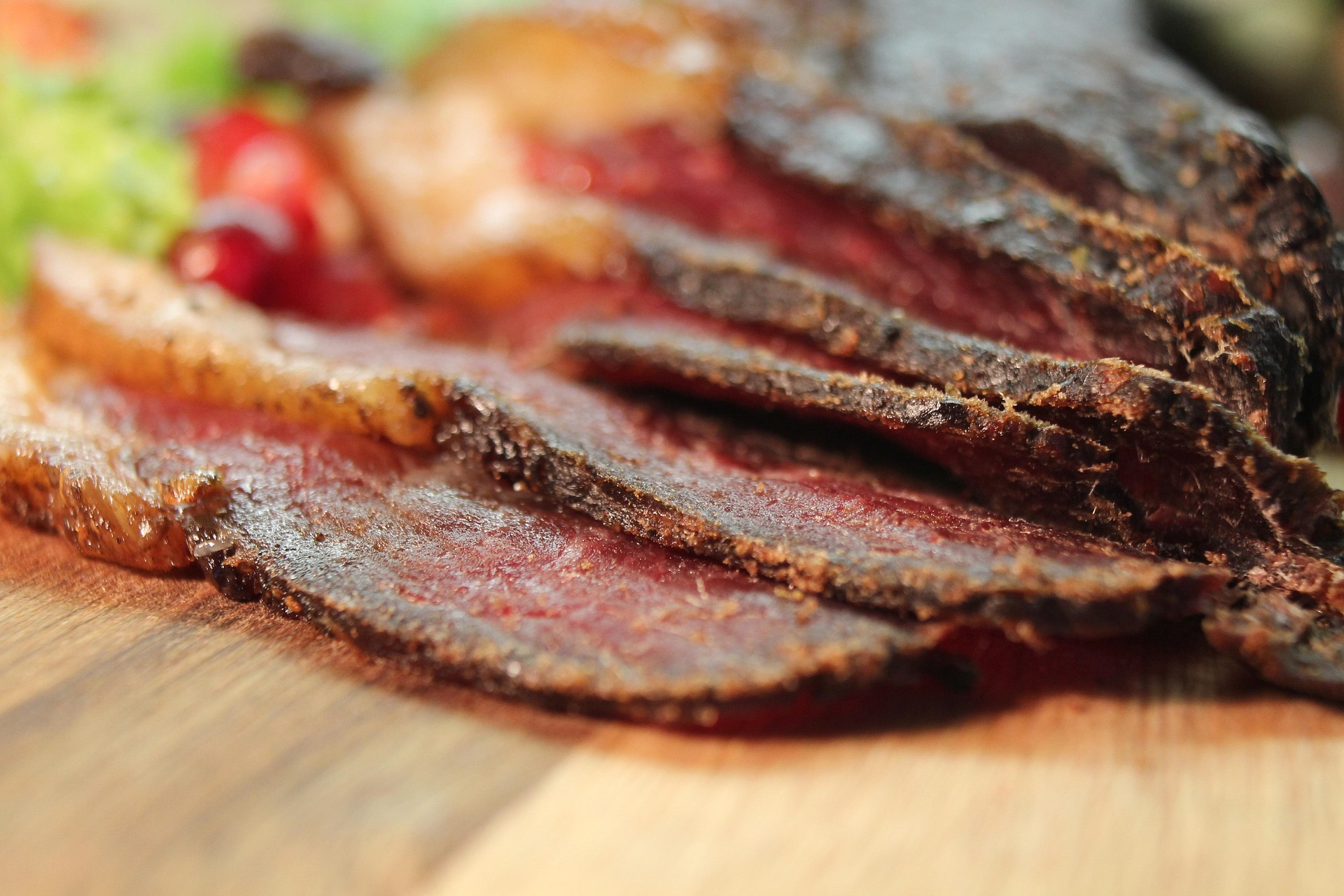
Drying is not a kill step. USDA FSIS gives three reasons, and all three work against a home dehydrator. Evaporating moisture soaks up most of the applied heat, so the meat stays cool while it loses water. Bacteria that have already dried out get harder to kill, not easier. Many home units never reach 160 degrees at all.
So every current extension publication puts a heat step somewhere in the sequence. Beef and venison go to 160 degrees inside. Poultry goes to 165. FSIS is blunt about which number counts: product internal temperature, not oven temperature, is the thing to control.
Where the heat step goes, and who disagrees
FSIS and the USDA Meat and Poultry Hotline lead with precooking, then drying. NCHFP, Kansas State and Ohio State call either order acceptable. Penn State and NDSU want the precook first, with post-drying heat as a fallback. Minnesota and Virginia Tech treat the post-drying oven step as extra margin on top of a process that already works.
That step is specific. Put the strips in a 275-degree oven for 10 minutes, a quarter inch thick or thinner, in a single layer and not touching. UGA’s own data backs it as a standalone kill. In Ruth Rose’s 2003 thesis, 10 minutes at 275 drove E. coli O157:H7 and Listeria below detection, and she concluded that dry heat does the post-drying job as well as moist heat.
Precooking costs you something. Jerky heated in marinade dries faster, and both its color and its texture come out different from traditional jerky. NCHFP and Ohio State both say so. If you want the chew you remember, the oven step after drying gets you closer.
Humidity is the part home methods skip
The Wisconsin work is the most useful thing published on this. Buege, Searls and Ingham heated whole-muscle beef and counted survivors. Constant dry heat at 140 or 160 degrees gave only 3.8 to 4.7 log of Salmonella, under the 5-log commercial target. Stepping up through 120, 130 and 140 gave about 3 log.
Then they added moisture. A wet-bulb spike first, say 54.4 degrees for an hour at 32 percent humidity, then drying at 76.7 dry-bulb, produced 6.4-log cuts in both Salmonella and E. coli O157:H7. Same meat, same dryer, roughly a thousandfold difference. Drying first and heating later gave the smallest margin of all, which is the authors’ own phrase.
At home that argues for boiling or simmering the strips in the marinade, rather than trusting dry air. NCHFP’s version is five minutes at a boil. Penn State brings 2 to 3 cups of marinade back to a full boil for one minute. PNW 632 says a minute and a half to two minutes, and adds a warning the others leave out. Do not soak the strips in marinade before precooking. NDSU repeats it, because the marinade itself can turn into the source.
The dial is not the temperature
Published dehydrator settings run from 130 degrees to 200. FSIS, Kansas State and Kentucky say hold 130 to 140. NCHFP, Penn State and Missouri say 140. NDSU says 140 to 150. Ohio State makes 145 a hard floor, and says a unit that cannot reach it should not be used for meat. Minnesota says 145 to 155 for six hours. Utah State dries at 150.
PNW 632 explains why the spread barely matters. Home dehydrator temperatures swing 30 to 40 degrees. Air temperature can differ from the dial by as much as 40 degrees. Warm-up takes anywhere from half an hour to four hours. A dial reading 155 proves nothing.
Test the empty unit instead. Ohio State gives the method. Use a bi-metallic stemmed thermometer inside a horizontal-airflow unit with the door shut, or between the top two trays of a three-tray stack in a vertical one. Run it at each setting, let it settle, write down what you get. PNW 632 sets the pass mark at 145 degrees in the empty machine.
UAF turns that reading into a decision. A unit holding 160 to 200 degrees works like an oven. One that reaches 160 and has a fan still needs the 275-degree oven step near the end of drying. A unit that cannot reach 160 and has no fan should stay away from meat.
What the marinade does not do
It does not make raw meat safe, and the numbers are small enough to be worth repeating. In the Wisconsin study, 22 to 24 hours of marinade at pH 5.3 cut Salmonella by 0.04 to 0.43 log, and E. coli O157:H7 by 0.04 to 0.34. FSIS quotes the UGA and Colorado State work the same way: marination alone did not significantly reduce the pathogen.
Marinade does help the drying that follows it. With a salt marinade, drying at 140 degrees cut E. coli by 5.8 log against 4.0 log for plain strips. That is an assist, not a control. Acid behaves the same way. PNW 632 allows a 5 percent vinegar soak, 2 cups per 2 pounds for 10 minutes, then withholds it from game meat. Virginia Tech calls the same dip a load reduction sitting on top of the 160-degree step.
Curing salt barely appears in the home literature. NCHFP’s jerky page never mentions nitrite, and neither Kansas State nor PNW 632 gives a rate. Utah State is the outlier, treating nitrite as one of two routes to safety and publishing the only jerky-specific rate: a tablespoon of commercial curing salt per pound, an hour in the refrigerator, then rinsed. Nitrite in bacon and country ham is a separate subject with its own federal limits.
Venison, bear, and the freezing question
Venison starts dirtier than beef. FSIS says it can carry heavy fecal contamination, depending on the shot and the dressing, and deer often hang at outdoor temperatures instead of chilling fast. FSIS also reports that pathogenic E. coli in venison survived drying for up to 10 hours at temperatures as high as 145 degrees. The Oregon outbreak of November 1995 came from home venison jerky dried at 125 to 135 degrees for 12 to 18 hours. Eleven people got sick.
Freezing is where the sources split. NCHFP, Penn State and Ohio State all say 0 degrees for at least 30 days, in pieces no thicker than 6 inches, for pork or game. UAF uses one month under an inch and two months over, then says plainly that freezing cannot be counted on against parasites. PNW 632 agrees, and goes further. Freezing and traditional drying do not kill all Trichinella, while post-drying heat or precooking do. CDC gives 5 degrees for 20 days for pork under 6 inches, then warns that some wild species carry freeze-resistant worms.
Idaho settled that argument in 1995. Ten people caught trichinellosis from cougar jerky that had been brined, then smoked in a smoker the maker said never got more than warm. Investigators recovered live larvae from meat that had been frozen. The strains were T. nativa and Trichinella T6, which tolerate freezing. UAF’s answer is to keep bear out of jerky altogether and cook it to 185 degrees instead.
How long it keeps, and how little you get
Shelf life is the loosest number in the literature. NCHFP says two weeks sealed at room temperature. FSIS, Kentucky and Kansas State say one to two months. Ohio State and PNW say two weeks out, or three to six months refrigerated. Penn State says one to three weeks. NDSU says both: two weeks in its text, two months in a photo caption on the same page.
Yield is tighter, but still split. Ohio State, PNW 632 and Kentucky all land on a pound of raw meat giving about 4 ounces, so four to one. NDSU says five pounds yields about two pounds, which is two and a half to one. The gap is probably where each one stops drying. The bend test is the only endpoint they share: a cooled strip should crack when bent, and not break in two.
NDSU is also the only source doing arithmetic on cost. Store jerky at a dollar per half ounce works out to roughly $32 a pound. A $5 rump roast turns into jerky at about $12.50 a pound. That is before counting the eight hours the dehydrator ran, which is the part nobody puts in the comparison.
Sources
- USDA Food Safety and Inspection Service, Jerky and Food Safety
- USDA Food Safety and Inspection Service, FSIS Compliance Guideline for Meat and Poultry Jerky (2014)
- National Center for Home Food Preservation, Jerky
- Penn State Extension, Drying Jerky (2024)
- Ohio State University Extension, Making Safe Jerky in a Home Dehydrator (HYG-5362)
- North Dakota State University Extension, Jerky Making: Producing a Traditional Food With Modern Processes (FN580) (2022)
- University of Idaho, Oregon State and Washington State, Drying Meat (PNW 632) (2012)
- Kansas State University Research and Extension, Dry Meat Safely at Home (MF3173) (2026)
- University of Minnesota Extension, How to Safely Make Homemade Jerky
- Utah State University Extension, Drying Meat
- University of Alaska Fairbanks Cooperative Extension, Jerky (FNH-00262)
- University of Kentucky Cooperative Extension, Jerky (FCS3-594) (2017)
- University of Missouri Extension, Making Jerky From Venison
- Virginia Cooperative Extension, Jerky Processing (458-501) (2005)
- Buege, Searls and Ingham, University of Wisconsin-Madison, Lethality of Commercial Whole-Muscle Beef Jerky Manufacturing Processes (2006)
- Rose, University of Georgia, Effects of Preparation Methods on the Microbiological Safety of Home-Dried Meat Jerky (2003)
- CDC, Outbreak of Trichinellosis Associated With Eating Cougar Jerky, Idaho, 1995 (1996)
- CDC, Outbreak of Salmonellosis Associated With Beef Jerky, New Mexico, 1995 (1995)
- CDC, How to Prevent Trichinellosis (2024)
Leave a Reply