
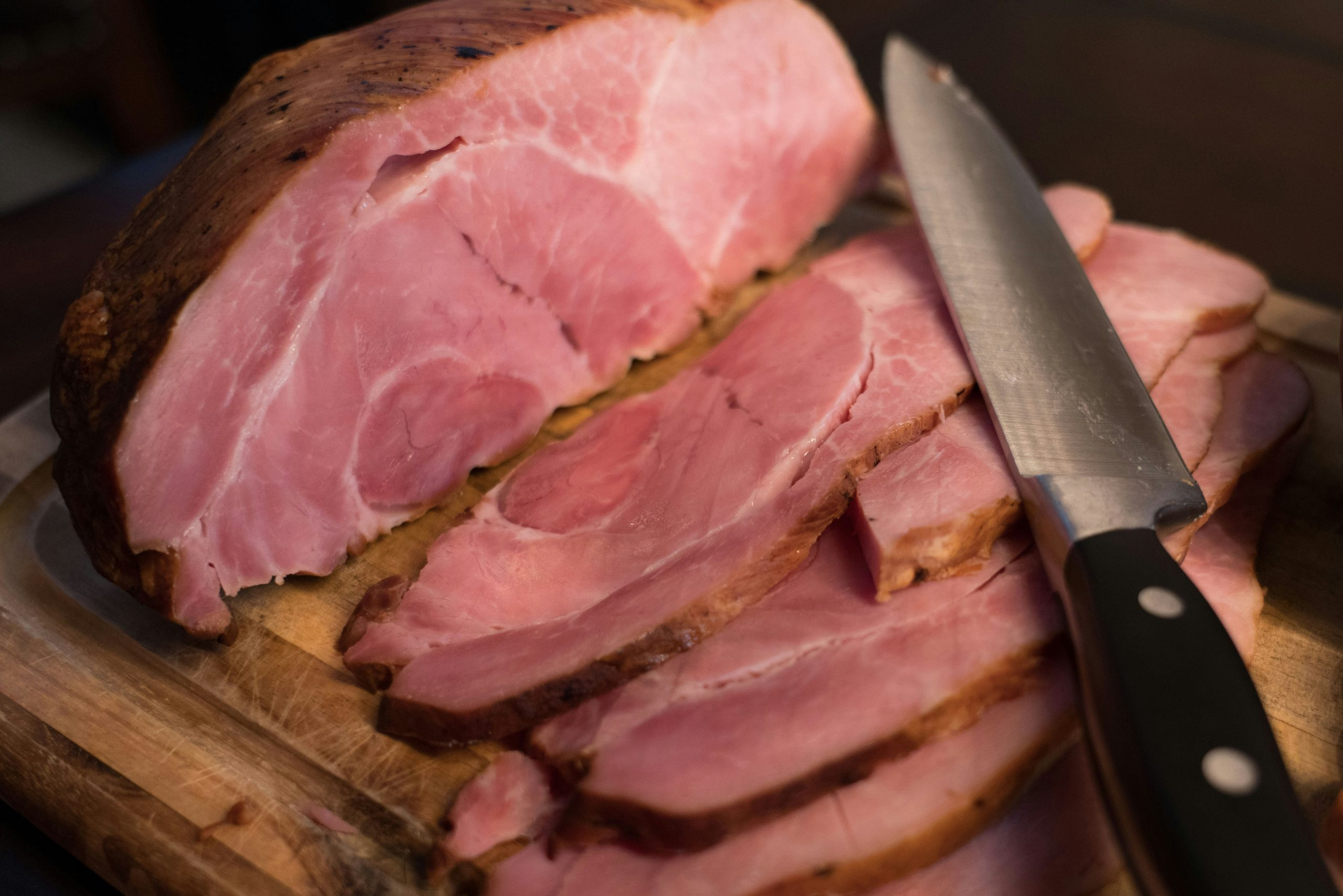
The rule that you must freeze pork for 20 days at 5°F before curing it does not exist. 9 CFR 318.10, the trichinae regulation that table lived in, was eliminated effective July 30, 2018 and now reads [Reserved]. FSIS moved the tables into a guidance document as non-binding safe harbors for inspected plants running a hazard analysis, and they never governed a home kitchen. It is probably the most repeated error in writing about home curing.
The tables are still published and worth having if you want the margin. Twenty days at 5°F, or 10 days at minus 10°F, for product up to six inches thick. Treat that as an option, not a legal step.
What the pink salt is
Cure #1, sold as Prague Powder #1, is 6.25 percent sodium nitrite and 93.75 percent salt. That comes from Oregon State Extension’s PNW 784, published August 2025 and the most current guidance on home bacon. Its home rate is one teaspoon per 5 pounds of pork belly, checked against the manufacturer’s directions. OSU states the outcome as a ceiling rather than a number: its recipes produce bacon under 200 parts per million of nitrite. No acceptable source converts a home teaspoon dose into an exact ppm.
Nitrite does three published things. It inhibits Clostridium botulinum, which is why it is not optional. It makes nitrosomyoglobin, which is the pink. And it slows rancidity. Oklahoma State adds that the color sets when the meat is heated to 130 to 140°F. The toxicity is real enough to state: Mississippi State says flatly that too much nitrate and nitrite can be toxic, and UW-Madison Extension puts a lethal dose of pure nitrite at 3 to 5 grams, or 6,000 to 10,000 servings of cured meat.
The limit depends on the method
FSIS sets ingoing nitrite by curing method and the figures are not interchangeable. Pumped or massaged bacon is capped at 120 ppm, with 550 ppm of sodium ascorbate or erythorbate required alongside it. Immersion-cured bacon, also 120. Dry-cured bacon, 200. Anything that is not bacon runs 200 ppm immersion or pumped, 156 comminuted, and 625 dry cured.
Flatten that into one number and you generate three errors. The widely repeated claim that 156 ppm is the legal limit is the comminuted figure, right for sausage and wrong for whole muscle. Oklahoma State’s own fact sheet applies 156 to hams, which is likely where some of it starts. UGA’s country ham bulletin gives 200 ppm as a maximum “in finished whole meat products,” which reads as a residual cap when FSIS publishes that same number as an ingoing one. The 625 ppm dry-cure figure belongs to country ham and not to bacon, which has its own stricter 200.
Mississippi State contradicts itself in a single publication. Its home dry cure is 8 pounds salt, 3 pounds sugar, 2 ounces sodium nitrate and half an ounce of sodium nitrite, with half the nitrate and nitrite for bacon. The same bulletin states that USDA does not permit sodium nitrate in bacon. FSIS confirms it. Nitrate is no longer permitted in any bacon by any method, on nitrosamine grounds. Use that formula on a ham and never on a belly.
A side of bacon, start to finish
OSU’s 2025 procedure is short. Five tablespoons of salt and one teaspoon of Cure #1 per 5 pounds of belly. Five to seven days in the refrigerator at 40°F, flipping the bag every day. Rinse. That takes off surface salt and, as OSU is careful to say, does not pull cure out of the interior, so it is no fix for an overdose. Cook or hot smoke at 225 to 250°F to an internal temperature of 160°F, about three hours. Sliced, it keeps 7 days refrigerated and four months frozen before quality goes.
Missouri Extension supplies the front-end timing: cure within 48 hours of slaughter, chill bellies to about 42°F first, stack them no more than four layers deep. That belly comes off the same carcass as the leaf fat worth rendering, which runs its own five-to-seven-day clock.
Cure #2 is out for bacon. It carries up to 4 percent sodium nitrate on top of the nitrite, the nitrate acting as a slow reservoir for products never cooked before eating, and OSU says it makes more nitrosamines in a belly.
Ham, and the two ways to count days
Mississippi State and Oklahoma State both give 7 days per inch of thickness, so a 5-inch ham is 35 days. Virginia Tech gives 7 days per inch of cushion depth and calls that a day and a half per pound. Kentucky, NDSU, and the USDA minimum UGA cites all say 2 days per pound.
Thickness and weight are two bases for one process, and 7 days per inch is the same rate as Kentucky’s inch-per-week box cure. The live disagreement is 1.5 against 2 days per pound, and on a 20-pound ham that is a ten-day difference in margin. Take 2.
Temperature looks worse and resolves cleanly. UMN says 30 to 40°F. Mississippi State and Oklahoma State say 32 to 40, Virginia Tech and UGA 36 to 40, NDSU a flat 38, OSU a flat 40. Oklahoma State gives the warm-end reason: warm meat spoils before salt reaches the center. NDSU gives the cold end: curing stops once the interior drops below 34°F. A nitrate country ham wants the warm end, because nitrate-reducing bacteria have to do the conversion. A nitrite dry cure tolerates the cold one.
Apply the cure in thirds on days 1, 7 and 14, which NDSU and Kentucky both specify, or in halves on days 1 and 7, per Virginia Tech. Then equalize at 50 to 60°F for about 14 days. USDA’s country ham standard, as both Kentucky and UGA report it, is at least 18 percent loss of green weight and at least 4 percent salt. Hit both and the ham is shelf stable without refrigeration.
The smoke, and the finished temperature
Four acceptable sources give four cold-smoking ceilings. Virginia Tech says below 90°F, Mississippi State below 100 with 70 to 80 ideal, Kentucky and UGA below 110. Their reasons differ as much as their numbers. Kentucky’s 110 is about preserving flavor enzymes; Mississippi State’s is the 80 to 110°F band where spoilage bacteria move fast. FSIS publishes nothing on cold smoking at all, defines smoking as indirect cooking, and tells you to hold smoker air between 225 and 300°F.
Finished temperatures are a three-way split with one explanation. Mississippi State and Oklahoma State smoke ham to 142°F internal and call 148 fully cooked. FSIS tells consumers 145°F plus a three-minute rest. The glossary on that same FSIS page says 160, and UMN says 160 for fresh raw ham. The 142 and 148 are commercial processing endpoints, 145 plus rest is the consumer standard FSIS adopted in 2011, and 160 is the figure it replaced, still sitting inside FSIS’s own page.
What nobody publishes
No acceptable source gives a home procedure for a Cure #2 product. No salami, no coppa, no pancetta, no prosciutto. The only nitrate-containing home procedures in the literature are country hams, and those specify saltpeter or sodium nitrate by weight rather than Cure #2. Mississippi State goes further and does not promote aging dry-cured meats at home at all, because southeastern weather may make them unsafe.
Equilibrium curing, weighing Cure #1 at a fixed 0.25 percent of meat weight, appears in no acceptable source. Neither does any water activity target for home country ham. Kentucky discusses water activity and gives no number. UGA gives salt and shrink and no figure. The only quantities are FSIS commercial ones: 0.92 water activity or below to stop C. botulinum, and 6 percent brine inside two of the trichinae curing methods.
Uncured is cured
Celery powder is nitrite. UW-Madison Extension says there is no difference between purified and plant-based nitrate or nitrite, because they are the same molecules. FSIS does not approve natural nitrite sources as curing agents under 9 CFR 424.21(c), only as antimicrobials and flavorings, which is why those products carry the word “uncured” along with a qualified no-nitrates-added statement. FSIS granted a petition in December 2020 saying it intends to prohibit both phrases and set new definitions for cured and uncured. That rulemaking has not been finalized, so the labels are still on the shelf, still describing cured meat.
Sources
- Oregon State University Extension, PNW 784, Making Cured Bacon at Home — https://extension.oregonstate.edu/catalog/pnw-784-making-cured-bacon-home
- USDA FSIS, Cured Meat and Poultry Product Operations, FPLIC 5a — https://www.fsis.usda.gov/sites/default/files/media_file/2021-03/fplic-5a-cured-meat-and-poultry-operations.pdf
- USDA FSIS, Sausage Operations Equations Quick Reference — https://www.fsis.usda.gov/sites/default/files/media_file/2021-11/FPLIC-Sausage-Operations-Equations-Quick-Reference.pdf
- 9 CFR 424.22, GPO — https://govinfo.gov/content/pkg/CFR-2020-title9-vol2/pdf/CFR-2020-title9-vol2-sec424-22.pdf
- eCFR, 9 CFR 318.10 (Reserved) — https://www.ecfr.gov/current/title-9/chapter-III/subchapter-A/part-318/subpart-A/section-318.10
- USDA FSIS, Elimination of Trichinae Control Regulations, 83 FR 25306 — https://www.federalregister.gov/documents/2018/05/31/2018-11300/elimination-of-trichinae-control-regulations-and-consolidation-of-thermally-processed-commercially
- USDA FSIS, Trichinella Compliance Guide — https://www.fsis.usda.gov/sites/default/files/import/Trichinella-Compliance-Guide-03162016.pdf
- USDA FSIS, Hams and Food Safety — https://www.fsis.usda.gov/food-safety/safe-food-handling-and-preparation/meat-catfish/hams-and-food-safety
- USDA FSIS, Smoking Meat and Poultry — https://www.fsis.usda.gov/food-safety/safe-food-handling-and-preparation/food-safety-basics/smoking-meat-and-poultry
- USDA FSIS, Ready-to-Eat Fermented, Salt-Cured, and Dried Products Guideline — https://fsistraining.fsis.usda.gov/pluginfile.php/34201/mod_resource/content/1/FSIS%20Ready-to-Eat%20Fermented,%20Salt-Cured,%20and%20Dried%20Products%20Guideline%20.pdf
- USDA FSIS, Sausage Operations FPLIC 4b — https://www.fsis.usda.gov/sites/default/files/media_file/2021-03/FPLIC_4b_Sausage_Operations.pdf
- USDA FSIS, response to Petition 19-03 — https://www.fsis.usda.gov/sites/default/files/media_file/2021-04/19-03-fsis-final-response.pdf
- Mississippi State University Extension, P2648, Curing Pork Products at Home — https://extension.msstate.edu/sites/default/files/publications/P2648_web.pdf
- Oklahoma State University Extension, ANSI-3994, Meat Curing — https://pods.okstate.edu/fact-sheets/ANSI-3994pod.pdf
- Virginia Cooperative Extension, 458-223, Dry Curing Virginia-Style Ham at Home — https://pubs.ext.vt.edu/458/458-223/458-223.html
- University of Kentucky Cooperative Extension, ASC-213, How to Make a Country Ham — https://publications.mgcafe.uky.edu/files/ASC213.pdf
- University of Georgia Cooperative Extension, Bulletin 1526, Country Cured Ham — https://secure.caes.uga.edu/extension/publications/files/pdf/B%201526_1.PDF
- NDSU Extension, FN155, Preservation of Game Meats and Fish — https://www.ndsu.edu/agriculture/sites/default/files/2022-10/fn155.pdf
- University of Missouri Extension, G2528 — https://extension.missouri.edu/publications/g2528
- University of Minnesota Extension, Meat, fish and poultry preservation — https://extension.umn.edu/food/preparing/cooking-at-home/food-preservation/meat-fish-and-poultry
- University of Wisconsin-Madison Division of Extension, nitrates and nitrites in meat products — https://livestock.extension.wisc.edu/articles/whats-the-deal-with-nitrates-and-nitrates-used-in-meat-products
Leave a Reply