
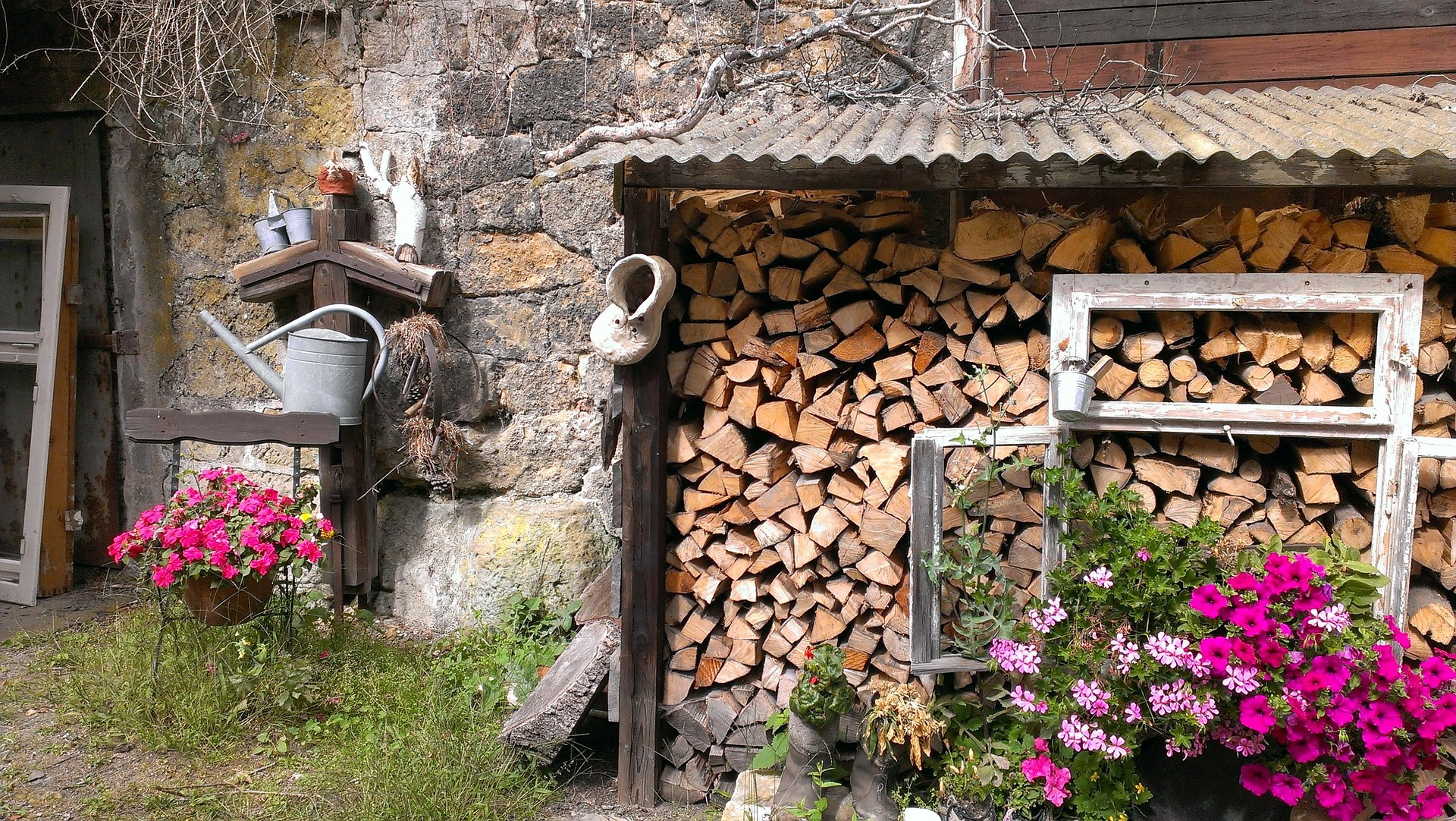
The EPA’s instruction is one sentence: “Be sure to store wood outdoors, off the ground, with only the top covered — covering the sides traps in moisture.” Oregon State says the same thing from the other direction, describing blocked-off shed walls as a way to deliberately slow drying. The Forest Products Laboratory describes fully enclosed structures only as pre-dryers, running at 80 to 100 degrees with forced air.
So three institutions agree that closing a shed up is wrong. Not one of them publishes a number for how open it has to be. No free-area ratio in print, no slat gap, no air-change figure. EPA’s own one-cord shed plan has slatted rear and side walls and gives no spacing for the slats.
The shed cannot beat the outdoor air
Wood stops drying when it reaches the equilibrium moisture content of the air around it, and FPL publishes that figure month by month for US cities. In Madison it runs 12.6 to 15.4 percent across the year, New York bottoms out at 11.0 in April, and Portland, Oregon spans 11.2 in July to 17.2 in December.
FPL’s recommended moisture content for exterior wood is 12 percent in most of the country, 9 percent in the dry southwest. That is the floor. A shed that keeps rain off lets wood reach it; no carpentry gets below it, because the only lever left is temperature. FPL notes that pulling an outdoor EMC of 14 percent down to 7 takes a rise of just 20 degrees, which is the whole idea behind Utah State’s solar firewood kiln. That design is clear plastic over pallets, and it is vented on purpose: a gap at the top, pallet sides left exposed.
Nobody will tell you which basis the 20 percent is on
EPA, Penn State, Missouri and Utah State all say to burn wood at 20 percent moisture or less. None of them says whether that is a dry-basis or wet-basis figure, and the difference is not small. FPL defines wood moisture content on a dry basis, water weight divided by oven-dry wood weight, which is why green wood can read over 100 percent. Natural Resources Canada says about 25 percent is ideal and is the only source in the set that states its basis, wet. Twenty-five percent wet basis is 33 percent dry basis.
Then UNH Extension says air-dried firewood is “generally around 30 percent” and calls 20 to 30 percent the best stove fuel. As printed that contradicts everyone else. Probably another basis mismatch, since 30 percent dry basis is about 23 percent wet, but UNH does not say so, and at face value the figure sits at the fiber saturation point.
Which matters, because 20 to 30 percent is where wood rots
Morris and Winandy, writing for Forintek Canada and the Forest Products Laboratory, put it plainly: wood decays above 30 percent moisture content and does not decay below 20, and “the 20% to 30% region represents a grey area for decay.” FPL brown-rot trials showed rapid decay at 32 percent, slower initiation at 29 percent, and no decay after four weeks at 26 percent. Mold growth stops around 16 percent.
The same paper adds the line that should decide how you stack: “decay is more difficult to stop than it is to prevent from starting.” Wood that sat on wet ground for a year carries fungus into the shed with it, and drying it later does not undo the damage. Penn State makes the same point about collecting rotting logs.
The water leaves through the ends
This is the part the common advice gets backwards. Longitudinal diffusion in wood is 10 to 15 times faster than radial or tangential, so a stick of firewood loses most of its water out the two cut faces, not through the sides. That is why checks appear on the ends first. Splitting helps by shortening the path across the grain and adding surface, but the main route is end grain, which argues for exposing the ends to moving air rather than packing the rows tight.
Oregon State corrects the other half of the folklore: “Wind is not needed to force air through the stack.” Natural convection does it, and the published rule is to let prevailing wind pass under the foundation. Nobody publishes a measured drying rate for split firewood at all; every curve in the literature is for sawn lumber.
Six months, twelve months, or a year, depending which EPA page you read
EPA’s Best Practices page says to season wood at least six months. EPA’s own storage pages say six months for softwood and twelve for hardwood. Missouri says most dense hardwoods need at least a year. These are rules of thumb with no species, climate or stacking date attached, and FPL’s measured lumber data shows why that fails: one species in one city reached 20 percent in 62 days stacked in June and 184 days stacked in October. Same wood, same place, three times the wait.
Wood stacked in October is not next winter’s wood. It is the winter after that, and the seasoning and stacking piece covers the species side.
What is actually published about the structure
EPA’s one-cord shed is the only published US design with real dimensions on it. Six 12-inch concrete deck blocks for footings, an eight-foot floor frame, three six-foot front posts and three five-and-a-half-foot rear posts, slatted rear and side walls, and a six-by-ten metal roof chosen to create overhang, run a foot past the shed on all sides.
Oregon State’s two-to-three-inch overhang figure does not transfer. That roof sits directly on a four-foot lumber stack, weighted with cinder blocks; EPA’s sits on posts six feet up over an open-sided building where wind-driven snow reaches much further in. Take the foot.
Two cautions on those plans. The EPA materials list calls for 13 slats and three 12-foot posts while the instructions use 17 slats and six posts cut from those three, so anyone buying from the list as printed comes up short. And EPA states that the Burn Wise program ran from 2009 to 2025 and stopped being updated on October 30, 2025. They are still the best published specifications in the country, and now archival.
The ground, the weight, and the distance
Oregon State alone publishes a measured ranking of what you build on: concrete or asphalt dries wood faster than bare or vegetated ground, and crushed rock slows it. Nobody gives a height. EPA, Penn State, Missouri, Nebraska and UNH all say to keep wood off the ground without putting an inch figure on it.
Size the base for real weight: a cord of seasoned oak runs about 3,600 pounds, white oak 5,573 green. Utah State notes that the 128 cubic feet of a cord is wood plus air, and Missouri puts the solid wood at 65 to 90 cubic feet. Missouri’s buying guide then works an example implying 127 cubic feet of solid wood per cord, which is impossible and contradicts its own sister publication.
Distance from the house is unsettled. Illinois says at least three feet from structures; UMN says as far from buildings as possible, which is a different kind of instruction entirely. EPA, Nebraska, Missouri and Oregon State say “away from buildings” with no figure, and Oregon State’s reason is the wind shadow rather than pests. Penn State’s 18 inches gets quoted here, but it is a wood-to-soil termite clearance.
Seasoned wood is not safe from insects either. The Wisconsin insect diagnostic lab lists seasoned firewood among the materials powderpost beetles most often attack, and Illinois notes borer eggs are usually in the tree when it is cut. Indoors it matters less than people think: beetles and carpenter ants emerging from a load cannot establish in dry framing lumber. Bring in a day or two worth at a time, and do not spray the woodpile. Illinois says that one outright.
There is an upper limit on how long the shed is worth using. Missouri says borers make holding wood outside more than a year or two inadvisable, and termites make eighteen months a losing proposition. Penn State puts the shelf life of well-seasoned wood at a few years and says to keep each year separate, burning the oldest first. A third winter in the shed buys no dryness, because the wood hit the local EMC in the first one.
Sources
- USDA Forest Service, Forest Products Laboratory, Wood Handbook GTR-282, Ch. 4 — https://www.fpl.fs.usda.gov/documnts/fplgtr/fplgtr282/chapter_04_fpl_gtr282.pdf
- USDA Forest Service, Forest Products Laboratory, Wood Handbook GTR-282, Ch. 13 (EMC Table 13-1, recommended MC Table 13-2) — https://www.fpl.fs.usda.gov/documnts/fplgtr/fplgtr282/chapter_13_fpl_gtr282.pdf
- W. T. Simpson, USDA FS FPL Research Note FPL-RN-0268, Equilibrium Moisture Content of Wood in Outdoor Locations — https://www.fpl.fs.usda.gov/documnts/fplrn/fplrn268.pdf
- Morris & Winandy (Forintek Canada and USDA FS FPL), Limiting Conditions for Decay in Wood Systems, IRG/WP 02-10421 — https://www.fpl.fs.usda.gov/documnts/pdf2002/morri02a.pdf
- USDA FS FPL, GTR-121, air-drying data — https://www.fpl.fs.usda.gov/documnts/fplgtr/fplgtr121.pdf
- US EPA Burn Wise, Best Wood-Burning Practices — https://www.epa.gov/burnwise/best-wood-burning-practices
- US EPA Burn Wise, Firewood Storage — https://www.epa.gov/burnwise/storage
- US EPA Burn Wise, How to Build a Wood Shed (plan PDF) — https://www.epa.gov/system/files/documents/2025-01/buildwoodshed2024508.pdf
- Oregon State University Extension, EM 8612, Air-Drying Lumber — https://extension.oregonstate.edu/sites/extd8/files/documents/em8612.pdf
- Oregon State University Extension, EM 8600, Drying Wood — https://extension.oregonstate.edu/sites/extd8/files/catalog/auto/EM8600.pdf
- Penn State Extension, Heating With Wood: An Introduction — https://extension.psu.edu/heating-with-wood-an-introduction
- Penn State Extension, Why Does Lumber Need to be Dried? — https://extension.psu.edu/why-does-lumber-need-to-be-dried
- Penn State Extension, Eastern Subterranean Termites — https://extension.psu.edu/eastern-subterranean-termites
- University of Missouri Extension, G5450 — https://extension.missouri.edu/publications/g5450
- University of Missouri Extension, G5452 — https://extension.missouri.edu/publications/g5452
- University of Nebraska–Lincoln, G1554, Producing, Harvesting and Processing Firewood — https://extension.illinois.edu/sites/default/files/nebraska_producing_harvesting_and_processing_firewood.pdf
- Utah State University Extension, Wood Heating — https://extension.usu.edu/forestry/resources/forest-products/wood-heating
- Utah State University Extension, Solar Kiln — https://extension.usu.edu/forestry/publications/utah-forest-newsletter/solar-kiln
- University of New Hampshire Extension, Drying Firewood — https://extension.unh.edu/blog/2018/02/drying-firewood
- University of Illinois Extension, Why Are There Bugs in My Firewood? — https://extension.illinois.edu/blogs/good-growing/2022-11-18-why-are-there-bugs-my-firewood-identifying-and-managing-firewood
- University of Wisconsin–Madison, Insect Diagnostic Lab, XHT1053, Powder Post Beetles — https://hort.extension.wisc.edu/articles/powder-post-beetles/
- University of Minnesota Extension, Carpenter Ants — https://extension.umn.edu/garden-and-home/home-maintenance/household-insects/carpenter-ants
- Natural Resources Canada, Residential Wood Heating (non-US) — https://natural-resources.canada.ca/sites/nrcan/files/NRCAN_BB_no7_e_indd.pdf
Leave a Reply