
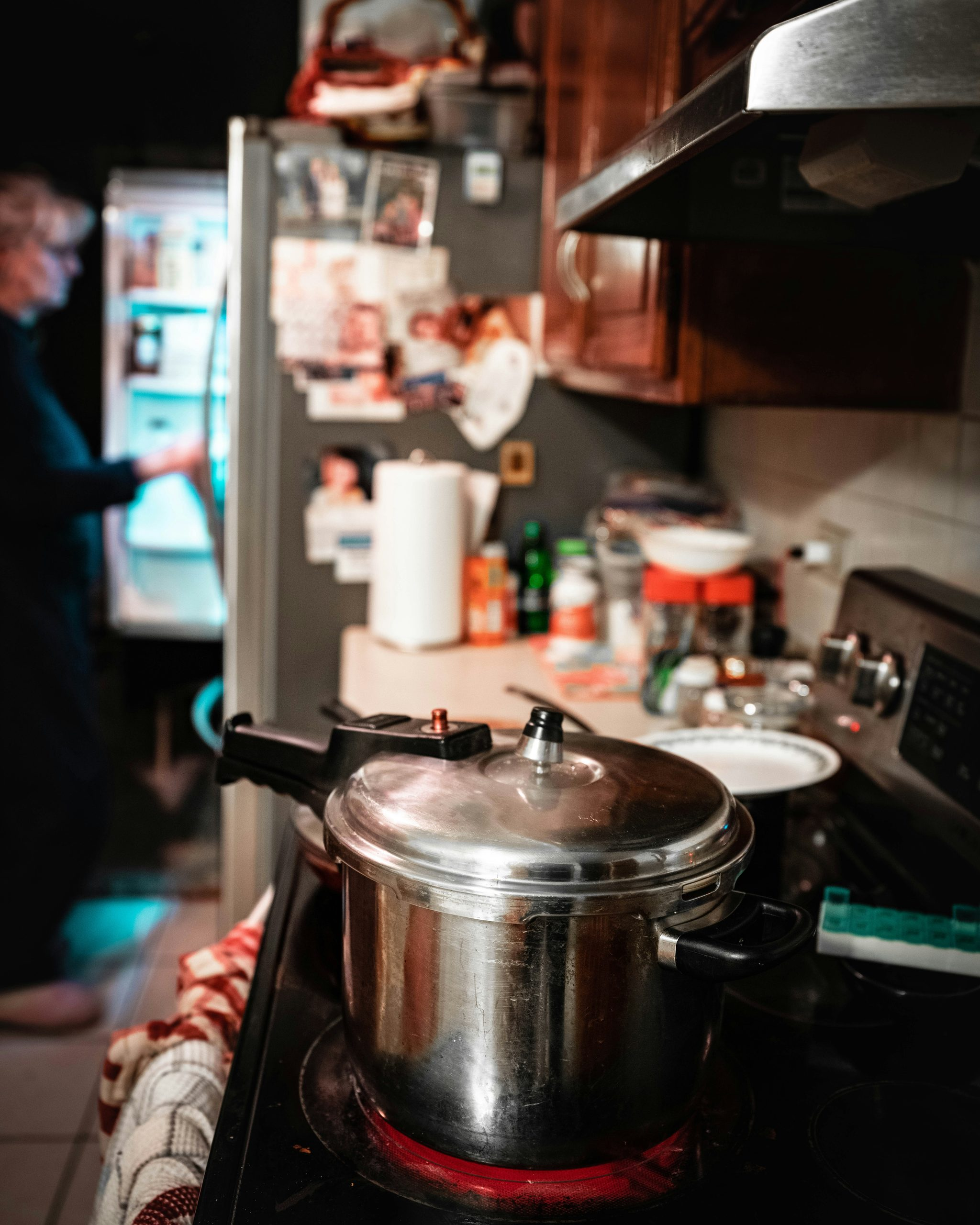
Red meat cut into strips, cubes or chunks takes 75 minutes in pints and 90 in quarts. Boneless chicken takes the same. Bone-in chicken takes less: 65 and 75. That surprises people, because bone sounds like something heat has to fight through. USDA’s table in Guide 5 gives one time per jar size. Hot pack and raw pack share a single merged row, so the pack you choose does not move the clock.
What the pack changes is whether the jar still holds liquid at the end. USDA prefers the hot pack for liquid cover and storage quality. Today’s lean cuts rarely give off enough fat and juice to cover meat packed raw. That is a storage argument, not a safety one. Fresh food carries 10 to more than 30 percent air. Raw packing seals that air in, and it can discolor the top of the jar within two or three months.
The instruction that reads like a mistake
Raw-pack meat gets no added liquid. USDA prints the words Do not add liquid in the raw-pack paragraph for red meat, then again for chicken. The current NCHFP pages carry it too. Elsewhere the same NCHFP site warns against dry canning, because food canned without the covering liquid used in process research can end up under-processed. Read fast, those two look like a contradiction. That is why people top up raw jars with broth.
The operative words are used in process research. The work behind raw-pack meat used no added liquid. Following that instruction matches the research rather than departing from it. Dry canning means pulling out a liquid the tested process assumed. Adding broth to a raw jar of beef is the actual deviation, because it changes how heat moves through the jar.
Where the published numbers fight each other
Three disagreements are worth knowing. All three sit in documents that look current.
NDSU’s FN188, reviewed in April 2024, says to wait two minutes after pulling the weight before unfastening the lid. USDA, NCHFP and Penn State all say ten. Every neighboring sentence in NDSU’s step is word-for-word USDA text. One of them even keeps the warning to lift the lid away from your face. So two minutes reads like an old number that survived the review, not a North Dakota position. The ten-minute wait guards against siphoning and seal failure. The short version costs liquid, not safety. Use ten.
South Dakota State’s poultry table pairs boneless poultry with raw pack only, and bone-in with hot pack only. USDA applies both packs to both. SDSU’s own red-meat table says Raw or Hot, and its times match USDA exactly. That marks it as a formatting loss rather than a real recommendation. The same page gives poultry about 1 inch of headspace. Poultry’s figure is 1-1/4 inch. USDA headspace numbers are not approximate.
The salt one is stranger, because NCHFP contradicts itself. Its page for ground or chopped meat calls for 2 teaspoons of salt per quart. The USDA guide that page cites calls for 1 teaspoon. So do Penn State, Utah State, UAF, and NCHFP’s own page for strips and chunks. The error has probably survived because salt in canned meat only seasons it. NCHFP answers that question flatly. Salt is for flavor and is not needed for safe processing.
The edition stamp is not a quality signal
Check the footers, but do not trust them. NCHFP’s ground-meat page cites the 2015 guide and carries the wrong salt figure. The strips-and-chunks page says 2009 and gets it right. The poultry page says 2009, slightly revised April 2020. That one is the newest. The April revision widened the species list past the PDF’s narrow chicken-or-rabbit title, out to duck, goose, turkey and game birds.
Venting, and why the gauge can lie
Vent every canner ten minutes, every load. Guide 1 gives the reason in one sentence. Air trapped in a canner lowers the temperature you get at 5, 10 or 15 pounds of pressure, and the result is under-processing. So a canner with air in it can sit at the right pressure and the wrong temperature. The gauge will not tell you. Dial-gauge canners are the worst case, because they never vent air during processing. Weighted gauges lose a little every time they rock.
Start the ten minutes when steam leaves in a steady funnel, not when the burner goes on. Then hold off on the process clock. Wait until the gauge reads pressure, or the weight begins to jiggle. If pressure drops below the figure for your altitude, bring it back up and restart timing from zero. Use the whole original time. There is no partial credit.
Dial gauges drift. USDA allows adjustment for a gauge up to 2 pounds high or low, and says to replace anything further off. A gauge reading high is the dangerous direction, because it under-processes. Weighted gauges need no testing. That is also why they jump from 10 pounds straight to 15 above 1,000 feet. They cannot correct precisely for altitude. Dial canners step 11, 12, 13 and 14 across four bands to 8,000 feet. The time never changes, only the pressure.
What has no tested process
Meat in your own sauce has none, and NCHFP says nobody can work one out. An untested low-acid mixture’s process cannot be estimated or made up. Tested meat mixtures do exist. USDA publishes chili con carne for pints only, at 75 minutes, and tells you not to thicken it. UAF bars noodles, rice, flour, cream and milk from canned soups by name. Half-gallon jars are out for everything but apple and grape juice. Larger-jar times stretch to no formula.
A pressure saucepan or a multicooker is not a substitute. USDA’s floor is a canner holding four quart jars upright on the rack. Smaller pressure saucepans do not qualify. Butter and fat are not canning at all. NCHFP calls the circulating butter directions open-kettle canning, which is no canning. Oven canning fails on three counts: regulator accuracy, slow dry-heat penetration, and jars that break.
Chill the meat first. Dressed chicken wants 6 to 12 hours of chilling before it sees a jar. NDSU puts red meat at 40 degrees or below soon after slaughter, and frozen at 0 degrees if it waits more than a few days. Canning does not rescue meat somebody already handled badly. SDSU says it plainly: contaminated food will not be safe to eat after canning.
Two boiling times that get mixed up
A suspect jar that is still sealed goes into a heavy garbage bag, not a pot. The 30-minute boil people remember is for detoxifying containers before disposal. Jars go on their sides in an 8-quart pot, with water an inch over the top. The other number is 10 minutes, plus a minute per 1,000 feet above 1,000. That one applies to destroying toxin in food you mean to eat, and NCHFP disclaims it as a rescue for anything known to be under-processed. CDC’s position, as NCHFP reports it on the same page, is to throw out any home-canned food that might hold the toxin. Spoiled low-acid food often shows almost nothing. That is why the rule treats every suspect jar as though it already made the poison.
Sources
- USDA, Complete Guide to Home Canning, Guide 1: Principles of Home Canning (2015)
- USDA, Complete Guide to Home Canning, Guide 5: Preparing and Canning Poultry, Red Meats, and Seafoods (2015)
- National Center for Home Food Preservation, Meat, Strips, Cubes or Chunks
- National Center for Home Food Preservation, Meat, Ground or Chopped
- National Center for Home Food Preservation, Poultry or Rabbit
- National Center for Home Food Preservation, Using Pressure Canners (2014)
- National Center for Home Food Preservation, Ensuring Safe Canned Foods
- National Center for Home Food Preservation, Equipment and Methods Not Recommended
- National Center for Home Food Preservation, For Safety’s Sake
- National Center for Home Food Preservation, FAQs: General Canning
- National Center for Home Food Preservation, FAQs: Meats
- National Center for Home Food Preservation, FAQs: Miscellaneous Questions
- Penn State Extension, Let’s Preserve: Meat and Poultry (2025)
- North Dakota State University Extension, Home Canning Meat: Poultry, Red Meats, Game and Seafood (FN188) (2024)
- University of Alaska Fairbanks Cooperative Extension, Canning Low-Acid Foods: Meat and Poultry in Jars (FNH-00721)
- South Dakota State University Extension, Canning Meats and Poultry
- Utah State University Extension, Preparing and Canning Poultry, Red Meats and Seafoods
- NC State Extension, Safely Canning Meat, Poultry, and Game (2022)
Leave a Reply