
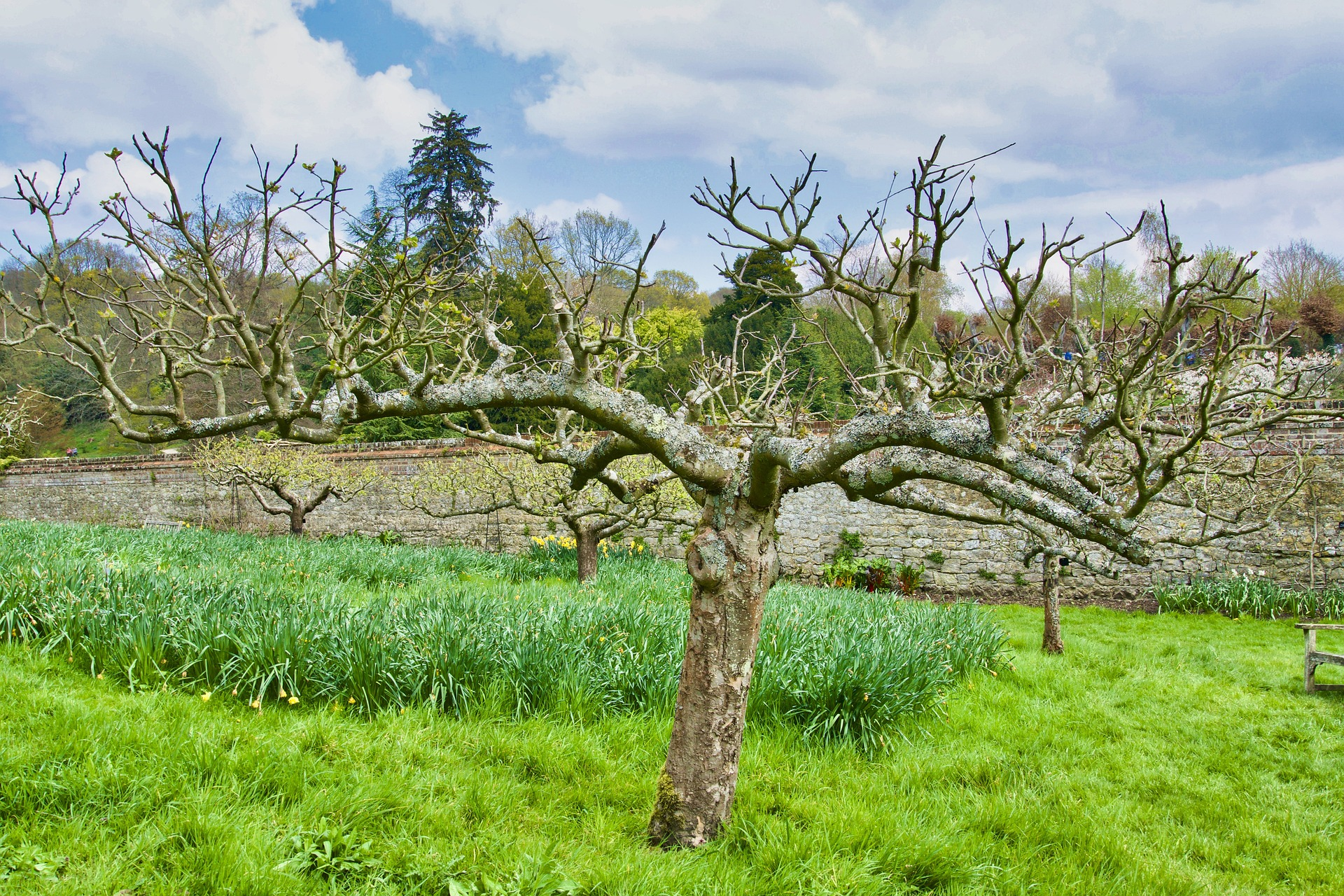
Iowa State Extension publishes the one number that tells you whether last winter’s pruning was right: about 10 to 15 inches of new shoot growth on a mature apple. Less than that and the tree wants more pruning or more fertility. Much more and you cut too hard. Or fed too much nitrogen. Nothing else in this literature gives you a number to check your work against.
Late winter, and the one source willing to give a temperature
The window is broadly agreed. February through April in New Hampshire and South Dakota, March in Kansas with southern counties starting around Valentine’s Day, February to early March in northern New Mexico. The reason is cold hardiness. Utah State states the mechanism plainly: a fresh cut temporarily lowers the cold hardiness of the wood near it. A tree pruned in November carries that handicap through every cold snap still to come.
South Dakota State is the only source, out of about thirty checked, that attaches numbers to the rule. Stop pruning 3 to 4 days before a forecast below 0°F. Resume 2 to 3 days after the temperature climbs back above 10°F. It gives no citation for either figure. Every other source warning about cold injury does so with no temperature at all, and none says how much hardiness a cut costs or for how long. That unquantified claim is the whole basis for pruning late rather than early.
Ohio State disagrees outright. Its plant pathology sheet says March through June, when growth and callus formation are highest. That is a different objective, not an error: it protects wound closure, where everyone else protects cold hardiness. Same tree, two things being defended.
How much to take: three numbers measuring three different things
Published ceilings for one season run from 20 percent to a third. The USDA Forest Service says a quarter of the living crown. Kansas State says 30 percent of the tree with dead wood excluded, Colorado State 20 percent of live wood on a neglected apple, and Missouri, Oklahoma State and New Hampshire a third.
Those are not the same measurement. Living crown, leaf area, live wood volume and branch count are four different denominators, and nobody publishes a conversion. The split runs along a professional line too. Every low figure comes from arboriculture and forestry publications, every high one from home-orchard and pomology publications. An arborist is protecting the tree’s life, while an orchardist trades regrowth for light and a crop.
None of these came out of a trial. South Dakota State writes its figure as “30% (1/3),” as though those are the same number, and no source cites research for any percentage. Work to the Forest Service quarter if you want the most defensible figure: it is federal, revised in 2012, and says what it is measuring. Following an orchard source to a third is a different goal, not a mistake.
“Flush” means two opposite things, and both are in print
This is the one most likely to wreck a beginner’s tree. In arboriculture, a flush cut is the name of a defect: a cut made inside the branch bark ridge or collar, injuring stem tissue and opening the way to decay. The Forest Service says do not make them. Cornell’s sheet says DO NOT MAKE A FLUSH CUT, in capitals. Kansas State writes “make thinning cuts at the collar, not flush with the branch.”
In the orchard literature the same word means close, with no stub left. NC State tells you to cut flush with the adjacent branch. Alabama’s September 2025 revision says to remove low feathers using a flush cut.
Read both in one afternoon and you will think the sources contradict each other on technique. They do not. They agree on where the blade goes, but they are using one word for two things. Cut just outside the swollen collar at the branch base, leave no stub, and stay out of the collar. No publication gives a stub tolerance in inches, so there is no number to aim at, only a landmark.
Dipping the pruners between every cut
Utah State’s apple fact sheet tells you to dip tools in a 10 percent bleach solution between each cut. Utah State’s own fire blight page says dormant-season pruning does not require sterilizing pruners between cuts. A third Utah State publication, from its forestry program, says researchers have shown that most quick sterilization techniques are not effective. One institution, three documents, three positions.
The Forest Service settles it. Dormant pruning reduces the need for sanitation, and where you do disinfect, the spec is 70 percent denatured alcohol or bleach at 1 part to 9 water, immersed one to two minutes, with wood particles wiped off first. A two-second dip is not that. So disinfecting between every cut turns out to be a summer protocol for active fire blight, one that drifted into dormant-pruning advice.
One piece of arithmetic nobody fixes: 1 part household bleach to 9 parts water is not a 10 percent bleach solution. It is 10 percent of the product, and the product is mostly water to begin with. Mix instead to a literal 10 percent sodium hypochlorite and you are far past anything any of these sources intended, on steel that bleach corrodes. No publication in the set draws the distinction.
Water sprouts are a response, not a theft
The vertical shoots that erupt after a hard cutback are not stealing energy from the fruit. Utah State gives the mechanism. Dormant pruning leaves root reserves in excess of what the smaller canopy needs, and that surplus drives the regrowth. Washington State gives the hormonal half: a terminal bud suppresses the buds below it, so cutting it off releases them. The harms the sources name are shading, poor fruit color, delayed maturity and weak attachment. Nutrient theft is not among them.
That changes the handling. Washington State warns that trying to remove all of them triggers more, and its Mount Vernon fruit unit puts a number on the alternative: thin out about 80 percent, space the rest like a row of corn, and do not head them, because shortening a sprout stimulates further growth. Its chapter on woody plants says shortening some is fine. Neither document cites the other. Both agree on taking them off by hand in early summer while they are soft, and Utah State adds that sprouts pulled in midsummer seldom regrow, and that nitrogen should come down in a heavy-pruning year.
Leave the cut alone
Wound dressing is settled in its recommendation and unsettled in its reasoning. Do not paint the cut. The Forest Service calls dressings unnecessary and possibly detrimental outside of oaks and elms wounded in disease season, and Cornell, Ohio State, New Hampshire, NC State and Washington State all land in the same place. Then they split on why. Utah State and New Hampshire say paint traps moisture against the wound. Ohio State says it blocks the oxygen the wound needs. Repeat both and you are claiming the dressing keeps a wound too wet while starving it of air. Meanwhile a 1994 Utah State orchard publication is still live on a land-grant server, still advising that wounds over two inches across benefit from a dressing, which is the advice the rest of this literature spent thirty years retiring.
Sources
- Iowa State University Extension and Outreach, Pruning Apple Trees
- Utah State University Extension, Training and Pruning Apple Trees (2017)
- Utah State University Extension, Utah Pests IPM, Fire Blight
- Utah State University Extension Forestry, Utah Forest Facts 004: Pruning Landscape Trees (1998)
- Utah State University Extension, Pruning the Orchard, HG 363 (rev. 1994)
- USDA Forest Service, How to Prune Trees, NA-FR-01-95 (rev. 2012)
- SDSU Extension, Pruning Fruit Trees (2018)
- Kansas State University, Pruning Apple and Pear Trees, MF3450 (2019)
- Colorado State University Extension, CMG GardenNotes #771: extension.colostate.edu
- UNH Cooperative Extension, Care of Mature Backyard Apple Trees (2010)
- UNH Cooperative Extension, Science of Pruning Q&A (2021)
- NC State Extension, Training and Pruning Fruit Trees, AG-29
- Alabama Cooperative Extension System, Training and Pruning Fruit Trees, ANR-0053-K (rev. Sept 2025)
- Cornell Cooperative Extension of Monroe County, How to Correctly Prune a Tree, FS 2319
- Ohio State University Extension, Pruning and Care of Tree Wounds, PLPATH-TREE-06
- Washington State University Extension, The Pacific Northwest Gardener’s Handbook, Ch. 23
- WSU Mount Vernon Research and Extension Unit, Pruning Tree Fruit: The Basics
- University of Missouri Extension, Fruit Production, MG6
- Oklahoma State University Extension, Growing Apples in the Home Garden
- New Mexico State University Extension, Pruning the Home Orchard, Guide H-327 (rev. 2017)
Leave a Reply