
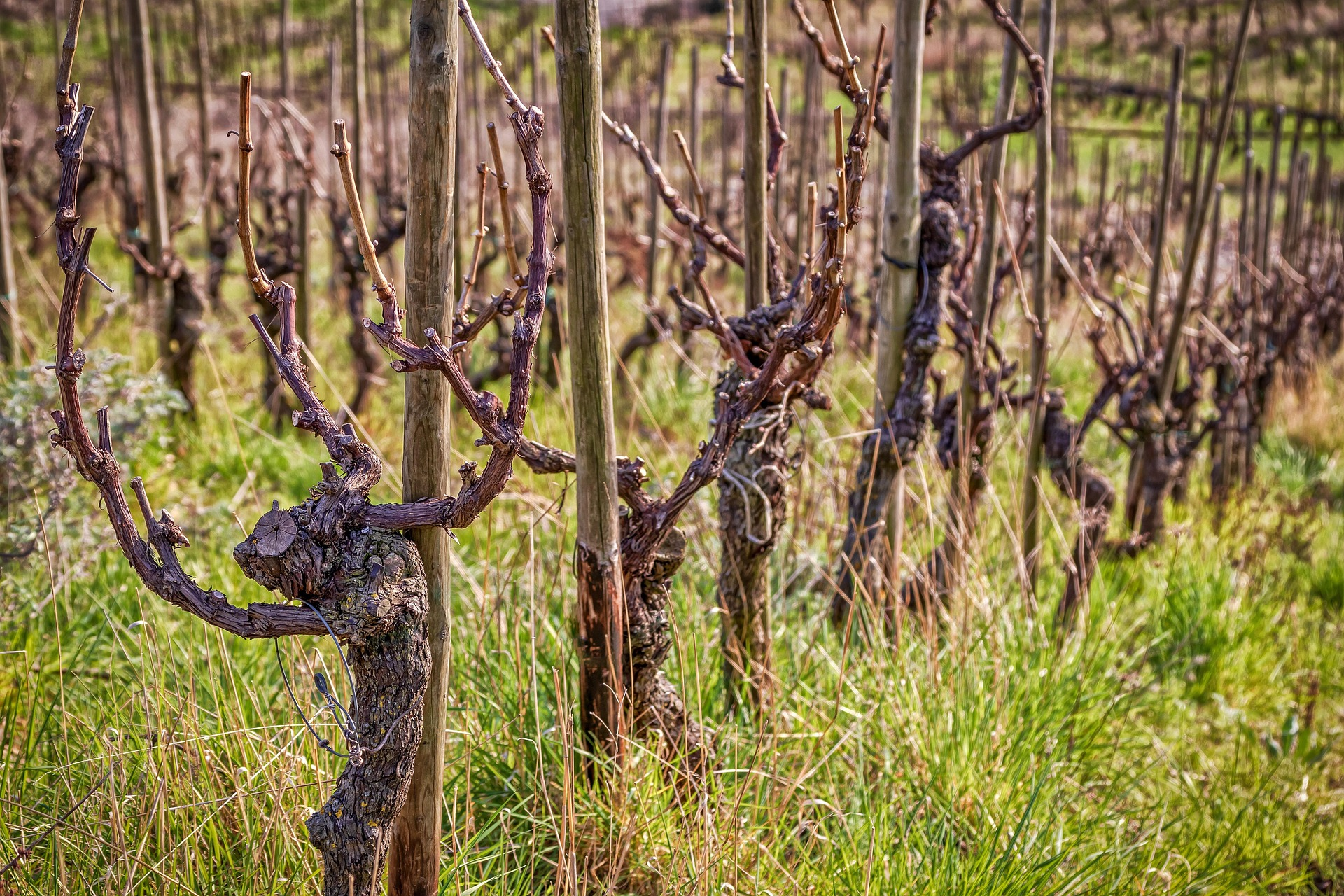
Prune grapes late in the dormant season, not early, and take off about 90 percent of last year’s growth. Prune brambles late too, but the real decision there is which kind you planted, because that sets how many times a year you cut. Both rules come from the same reason: waiting lets you see winter damage before you decide what to keep.
When to prune
The published grape window runs from late November to early April. Georgia says late November through late March. Penn State says December to March for a backyard vine. Iowa State says January, and an older Iowa State page says late February. Missouri says early March. Minnesota says March.
The spread follows winter, not the calendar. Oregon State’s blackberry guide shows it inside one state. In the Willamette Valley and southwestern Oregon it says to prune December through February. In central and eastern Oregon it says as late as possible, such as early March, to reduce cold injury.
Penn State gives the main reason to wait. Pruning later “enables the pruner to assess cold injury and adjust bud number accordingly.” Iowa State adds that fall pruning is not recommended and that pruned vines often suffer more winter injury than unpruned ones. Minnesota alone explains both ends. Cut too early and buds near the cuts can dry out. Cut after the sap flows and the risk of trunk disease goes up.
Kentucky gives the only weather rule. Do not prune while the wood is frozen, because frozen canes are brittle. No source publishes a temperature cutoff.
The common fear that late pruning “bleeds” a vine has no support. Georgia, Kentucky, Clemson, Virginia Tech and Iowa State all say the sap flow from a late cut does no harm. Not one source says otherwise.
How much comes off a grape
About 90 percent of last year’s growth. Penn State, Iowa State and Washington State agree. Minnesota’s home garden page says 80 to 90 percent of new growth. Minnesota’s enology handout says nearly 90 percent of the vine’s “biomass,” a larger claim, since biomass includes the trunk.
The better guide is balanced pruning. Ohio State’s Midwest grape guide states the rule. Weigh last year’s prunings, leave 30 buds for the first pound, then 10 for each pound after that. Three pounds of prunings means 50 buds. Count only one-year-old wood. Georgia adds that a vine with less than three-quarters of a pound of prunings should not carry a crop.
The 30-plus-10 rule is for American grapes like Concord. Kentucky uses 20 plus 10 for most French-American hybrids. Ohio State’s table goes cultivar by cultivar, and the two disagree on some: Kentucky gives Foch 20 plus 10, Ohio State 30 plus 10. Use your cultivar’s row if it has one.
Iowa State shows why a formula beats a rule of thumb. Its two live grape pages disagree. One says 40 to 50 buds per vine and three-node canes. Its older page says up to 60 buds and canes of 8 to 13 buds. The reason is likely training system, cordon against Kniffin, but neither page says so.
Iowa State’s newer page also has an arithmetic slip. It says 4 to 6 shoots per foot on an 8-foot cordon “roughly correlates” to 40 to 50 buds. That is 32 to 48. It then says 16 three-node canes reach a 50-node target. That is 48. Small errors, but they show what happens when nobody weighs the wood.
Check for cold injury first
Ohio State gives the method. Cut about 100 buds per cultivar, such as ten 10-bud canes, and bring them inside for a day or two. Slice across each bud with a razor until the main bud shows. Green is alive. Brown or black is dead.
If more than 20 percent are dead, leave more buds. Iowa State and Cornell both publish an adjustment table from the same 2007 study, and they do not match. At 15 to 34 percent dead, Iowa State says leave 35 percent more buds. Cornell says 30 percent more. Both agree on doubling the bud count at 35 to 50 percent dead, and on barely pruning above 50. The middle row is a judgment call either way. Leave the extra third.
Brambles: know which kind you have
Floricane raspberries and blackberries fruit on second-year canes, which then die. Primocane, or fall-bearing, types fruit on first-year canes. NC State sums up the difference. Floricane types need pruning several times a year. Primocane types get mowed once a year in winter.
Many growers try to get two crops from a primocane raspberry by leaving the canes up. Penn State is the only source that measured the cost. Pruned that way, the spring crop on Heritage is “only about 10 percent of the total crop.” Minnesota says you are unlikely to see an overall yield gain. So mow fall-bearers to an inch or two. If you want a summer crop, plant a summer variety.
For floricane types, the dead canes come out, and here Ohio State contradicts itself. Its anthracnose fact sheet says to remove fruited canes after harvest. Then the very next sentence says “it is best” to remove old canes in the dormant season. NC State’s caneberry guide offers a third view. In colder southern areas, old canes may store carbohydrates that help with winter cold, so they can stay until winter. Five other sources say remove them right after harvest to cut disease. If you missed that, take them out now, at ground level. Kentucky advises against composting diseased canes. Virginia Tech says to destroy them to guard against anthracnose.
How many canes to leave
This is the widest spread in the bramble literature. For erect blackberries, Penn State works out to about 1.2 canes per foot of row and Illinois about 1.5. NC State says 6 to 8 per yard. Arkansas says about six canes per foot. That is a fivefold gap, and all four assume roughly the same row width.
Raspberries are tighter. Most sources land between 1.5 and 4 canes per foot of row, and Minnesota’s rule of one fruiting cane every 6 inches sits in the middle. Watch the unit, though. NC State’s commercial guide says 3 to 4 per square foot, while its home garden leaflet says 3 to 4 per foot of row. The numbers match and mean different things. Virginia Tech gives two cane counts per hill in one section, four or five and then seven or eight, with no reason for the difference.
Pick the spacing, not the count. Most sources publish inches between canes. For red raspberries that is about 6 to 8 inches. Then tip the canes. Oregon State reports that tipping erect blackberries raises yield four- to fivefold, the biggest effect in the bramble literature. NC State warns that tipping can spread cane blight, especially before rain, and recommends a fungicide after.
One more thing nobody publishes: a cut angle. Only Minnesota gives one, cutting about half an inch above the bud and on a slant so water runs off. The familiar 45 degrees and a quarter inch appear in no acceptable source, for either crop.
Do not carry grape habits to the orchard. Minnesota notes that cutting 90 percent off an apple tree would push it into heavy regrowth. The apple rules are in pruning apple trees in the dormant season.
Sources
- Ohio State University Extension, Midwest Grape Production Guide (2005)
- Penn State Extension, Dormant Cane and Spur Pruning in Bunch Grape Vineyards (2021)
- Penn State Extension, Backyard Grape Growing (2005)
- Penn State Extension, Pruning Brambles in Home Fruit Plantings (2024)
- University of Georgia Cooperative Extension, Home Garden Bunch Grapes (2017)
- University of Kentucky Cooperative Extension Service, Growing Grapes in Kentucky (1997)
- University of Kentucky Cooperative Extension Service, Cane Diseases of Brambles (2017)
- Iowa State University Extension and Outreach, How to Prune Grapevines in the Home Garden (2024)
- Iowa State University Extension and Outreach, Yard and Garden: How to Prune Grapevines (2019)
- Iowa State University Extension and Outreach, Winter Injury to Grapevines and Methods of Prevention (2014)
- Cornell Cooperative Extension Finger Lakes Grape Program, Update on Potential Cold Injury to Grapevine Buds (2022)
- University of Minnesota Extension, Cold Climate Grape Management: Dormant Pruning (2023)
- University of Minnesota Extension, Growing Grapes in the Home Garden (2024)
- University of Minnesota Extension, Pruning and Training Raspberries (2026)
- Washington State University, Pruning Grapes in Home Gardens: Some Basic Guidelines (undated)
- University of Missouri Extension, Home Fruit Production: Grape Culture (2017)
- Clemson Cooperative Extension, Bunch Grapes (1999)
- Virginia Cooperative Extension, Small Fruit in the Home Garden (2022)
- Oregon State University Extension Service, Growing Blackberries in Your Home Garden (2020)
- Ohio State University Extension, Anthracnose of Raspberry and Blackberry (2016)
- Ohio State University Extension, Pruning Erect Blackberries in the Home Garden (2017)
- NC State Extension, Southeast Regional Caneberry Production Guide: Pruning and Training (2023)
- NC State Extension, Raspberries in the Home Garden (2019)
- University of Illinois Extension, Early Spring Pruning Guide for Growing Healthy Raspberries and Blackberries (2025)
- University of Arkansas Cooperative Extension Service, Blackberry Production in the Home Garden (undated)
Leave a Reply