
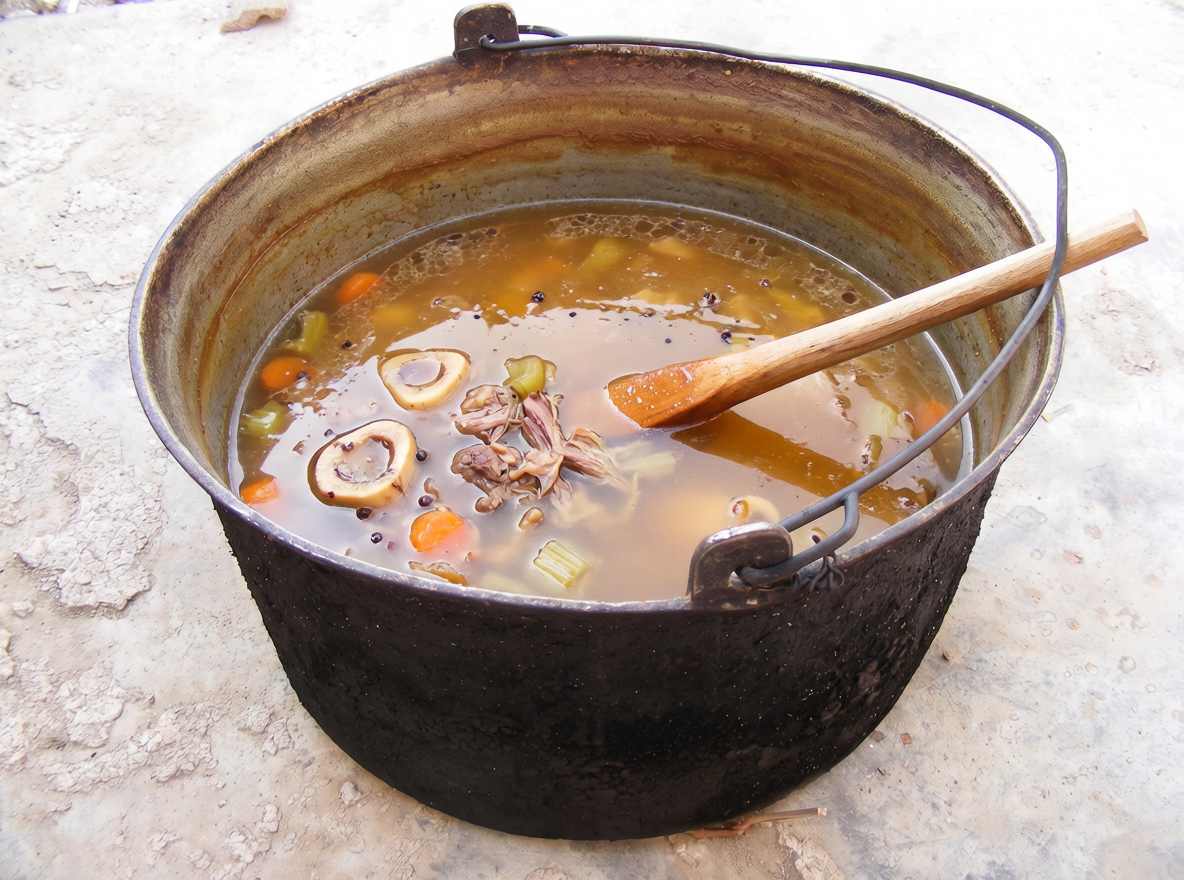
Stock is 20 minutes for pints and 25 for quarts. Soup is 60 and 75. Both numbers come out of the same USDA home canning guide, they are not interchangeable, and people swap them in both directions.
The tested process is titled Meat Stock (Broth), and it treats the two words as one product. Beef bones get cracked or sawed, covered with water and simmered 3 to 4 hours. Poultry carcass bones get simmered 30 to 45 minutes, until the meat still clinging to them falls off easily. Then remove the bones, cool the broth, skim off the excess fat, reheat to boiling and fill jars to 1-inch headspace. Pints and quarts only. Hot pack only.
A dial-gauge canner holds 11 pounds from 0 to 2,000 feet, 12 from 2,001 to 4,000, 13 from 4,001 to 6,000 and 14 from 6,001 to 8,000. A weighted gauge holds 10 pounds to 1,000 feet and 15 above it. The time does not change with altitude, only the pressure does, and no published table in this literature goes past 8,000 feet. Higher than that, the number you need is not in print. If your dial gauge has not been checked this year, start with testing and using a pressure canner.
Why there is no water-bath option
Stock is a low-acid food, above pH 4.6, and NCHFP puts the consequence in one sentence: the time needed to safely process low-acid foods in a boiling-water canner ranges from 7 to 11 hours. Botulinum spores are very hard to destroy at boiling-water temperatures. Low-acid foods need 240 to 250°F, which a pressure canner reaches at 10 to 15 psi.
The same reasoning rules out an electric multi-cooker with a canning button on it. NCHFP’s position, published in 2019 and restated by Penn State in August 2025, is that no USDA thermal process work has been done with jars inside an electric pressure cooker of any kind. Keep NCHFP’s own line for this: what matters is temperature, not pressure. Hitting a stated pressure does not prove the jars got as hot as they did in the canner the process was built on.
Vegetable broth has no tested process
This is the gap that catches people, because vegetable broth looks like the least dangerous thing in the kitchen. Oregon State University Extension states it outright, in a sheet revised June 2025: we do not have recommended processing times for vegetable, fish or other seafood-based broth or stock, and these products freeze well. There is no vegetable stock page anywhere in NCHFP’s canning index.
Oregon State is right about vegetables and behind on fish. NCHFP published a tested Fish Stock process out of 2023 research: quarts, 1-inch headspace, 25 minutes, the same altitude-indexed pressures as meat stock. On fish the state sheet and the national center disagree, and the national center is the newer one.
The tempting workaround is to borrow the soup process. It does not transfer, and the reason sits in the pack rather than the ingredients. USDA’s soup directions say to fill hot jars only halfway with the mixture of solids, then cover with the remaining liquid to 1-inch headspace, and Kansas State gives the why: space is needed for the hot liquid to circulate between the food particles. An all-liquid broth is not that pack. Nor does the meat stock process stretch past meat and poultry.
Bone broth, and the one source that says no
Kansas State Research and Extension states that reconstituted bouillon cubes, powders, pastes and bone broths are not suitable for home canning, because they often contain ingredients such as starches or gelatin, and that broth and stock are not interchangeable in home canning. Set against USDA, that reads like a flat contradiction.
It is not one. Kansas State is writing about using a broth as the covering liquid inside somebody else’s tested recipe, where an unknown viscosity changes heat penetration. USDA is writing about canning plain strained stock as the product itself. A long-simmered broth of bones and water, strained, nothing added, is what the USDA process already covers under a different name. A broth carrying gelatin, starch or a reconstituted concentrate has no tested process at all.
Fat, and the claim only one institution makes
Skim it, and no acceptable source will tell you how much is too much. There is no percentage, no gram figure, no depth. NCHFP gives one reason only and it is about the seal: any fat that reaches the rim can prevent an airtight seal, and excess fat in the jar makes it easier for fat to climb the sides and foul the seal.
Penn State goes further. Fats and oils interfere with proper heat penetration, it says, and fat molecules surround bacterial spores and protect them from destruction. That is a safety argument rather than a seal argument, and NCHFP and USDA do not make it. Attribute it to Penn State.
Straining is the other asymmetry. The USDA meat and poultry process has no straining step at all, while NCHFP’s newer fish stock process holds the liquid at 190 to 200°F through a 30-minute simmer and then strains twice, colander first and then cheesecloth or a fine-mesh sieve. No acceptable source publishes a chill time either. Cool broth is the whole instruction, and the refrigerate-overnight-and-lift-the-fat-cap routine comes from Iowa State’s fresh-use recipe, which is not a canning process and does not claim to be.
The jar that lost half its liquid
Do not top it up and do not throw it out. NCHFP classifies loss of liquid as not a sign of spoilage, says that liquid loss does not cause spoilage, and answers the question head on: liquid lost during processing should not be replaced. Food above the liquid line may darken. If at least half the liquid is gone, refrigerate that jar and use it within two or three days.
The first published cause of siphoning is the shortcut taken to save twenty minutes: lowering the pressure suddenly after the processing period. NCHFP says not to force pressure down by putting the canner in a draft, opening the vent too soon or running cold water over it, and warns that forced cooling may result in unsafe food or food spoilage. Let it fall to zero on its own. Heavy-walled canners take about 30 minutes with pints and 45 with quarts, then 10 minutes before the weight comes off and another 10 before the lid does.
Then leave them alone. Retightening hot lids may cut through the gasket and cause seal failures. Cool at room temperature for 12 to 24 hours, take the screw bands off, and test three ways: press the lid’s middle for spring-back, tap it with a teaspoon and listen for a high ringing tone, then sight across it for a slight downward curve. Turning jars upside down to help them seal is published as a cause of imperfect seals.
Store them without the ring bands, between 50 and 70°F, never above 95°F or near hot pipes, a range or direct sun. Can no more than you will use within a year.
What else goes in the jar
Nothing thick. USDA is blunt about it: do not add noodles or other pasta, rice, flour, cream, milk or other thickening agents to home canned soups, and caution, do not thicken. NCHFP’s reason is that these ingredients affect the heat penetration of the jars during processing. Penn State rules out dairy on separate grounds, because dairy foods are low acid and support Clostridium botulinum at room temperature.
One last pair of numbers. The two boiling times on NCHFP’s site do different jobs. Ten minutes below 1,000 feet, plus a minute for every additional 1,000, destroys toxin in low-acid food you intend to eat. Thirty minutes detoxifies a suspect jar and its lid before they go in the trash. NCHFP adds that spoiled low-acid foods may show very little evidence at all, and that CDC’s recommendation as of July 2013 is to discard home-canned food that might contain botulism toxin. That last clause is why none of this is worth improvising.
Sources
- USDA, Complete Guide to Home Canning, Guide 5 (poultry, red meats and seafoods): nchfp.uga.edu/papers/guide/GUIDE05_HomeCan_rev0715.pdf
- USDA, Complete Guide to Home Canning, Guide 4 (vegetables and vegetable products, including Soups): nchfp.uga.edu/papers/guide/GUIDE04_HomeCan_rev0715.pdf
- National Center for Home Food Preservation, Meat Stock: nchfp.uga.edu/how/can/preparing-and-canning-poultry-red-meats-and-seafoods/meat-stock/
- National Center for Home Food Preservation, Chicken or Turkey Stock: nchfp.uga.edu/how/can/preparing-and-canning-poultry-red-meats-and-seafoods/chicken-or-turkey-stock/
- National Center for Home Food Preservation, Fish Stock: nchfp.uga.edu/how/can/preparing-and-canning-poultry-red-meats-and-seafoods/fish-stock/
- National Center for Home Food Preservation, Soups: nchfp.uga.edu/how/can/canning-vegetables-and-vegetable-products/soups/
- National Center for Home Food Preservation, Ensuring Safe Canned Foods: nchfp.uga.edu/how/can/general-information/ensuring-safe-canned-foods/
- National Center for Home Food Preservation, For Safety’s Sake: nchfp.uga.edu/how/can/general-information/for-safetys-sake/
- National Center for Home Food Preservation, Recommended Canners (venting, depressurizing, force cooling): nchfp.uga.edu/how/can/general-information/recommended-canners/
- National Center for Home Food Preservation, Cooling Jars and Testing Jar Seals: nchfp.uga.edu/how/can/general-information/cooling-jars-and-testing-jar-seals/
- National Center for Home Food Preservation, Causes and Possible Solutions for Problems with Canned Food: nchfp.uga.edu/how/can/general-information/causes-and-possible-solutions-for-problems-with-canned-food/
- National Center for Home Food Preservation, Storing Home Canned Foods: nchfp.uga.edu/how/can/general-information/storing-home-canned-foods/
- National Center for Home Food Preservation, Identifying and Handling Spoiled Canned Food: nchfp.uga.edu/how/can/general-information/identifying-and-handling-spoiled-canned-food/
- National Center for Home Food Preservation, general canning FAQs (headspace, liquid loss, storage life): nchfp.uga.edu/faqs/general-canning/category/faq-canning
- National Center for Home Food Preservation, meats FAQs (fat and seals): nchfp.uga.edu/faqs/meats/category/faq-canning
- National Center for Home Food Preservation, Canning in Electric Multi-Cookers: nchfp.uga.edu/newsflash/canning-in-electric-multi-cookers
- Penn State Extension, Caution: Canning with Fats and Oils: extension.psu.edu/caution-canning-with-fats-and-oils
- Penn State Extension, Foods That Are Not Safe to Can: extension.psu.edu/foods-that-are-not-safe-to-can
- Penn State Extension, Canning in Electric Multi-Cookers: extension.psu.edu/canning-in-electric-multi-cookers
- Oregon State University Extension, SP 50-931, Canning Soup: extension.oregonstate.edu/food/preservation/canning-soup-sp-50-931
- Kansas State University Research and Extension, Using Broth When Canning: k-state.edu/news/you-asked-it/articles/2025/06/using-broth-when-canning.html
- Kansas State University Research and Extension, Home Canning Soup: k-state.edu/news/you-asked-it/articles/2016/12/home-canning-soup.html
- Iowa State University Extension and Outreach, Chicken Broth and Cooked Chicken (a fresh-use recipe, not a canning process): spendsmart.extension.iastate.edu/recipe/chicken-broth/
Leave a Reply