
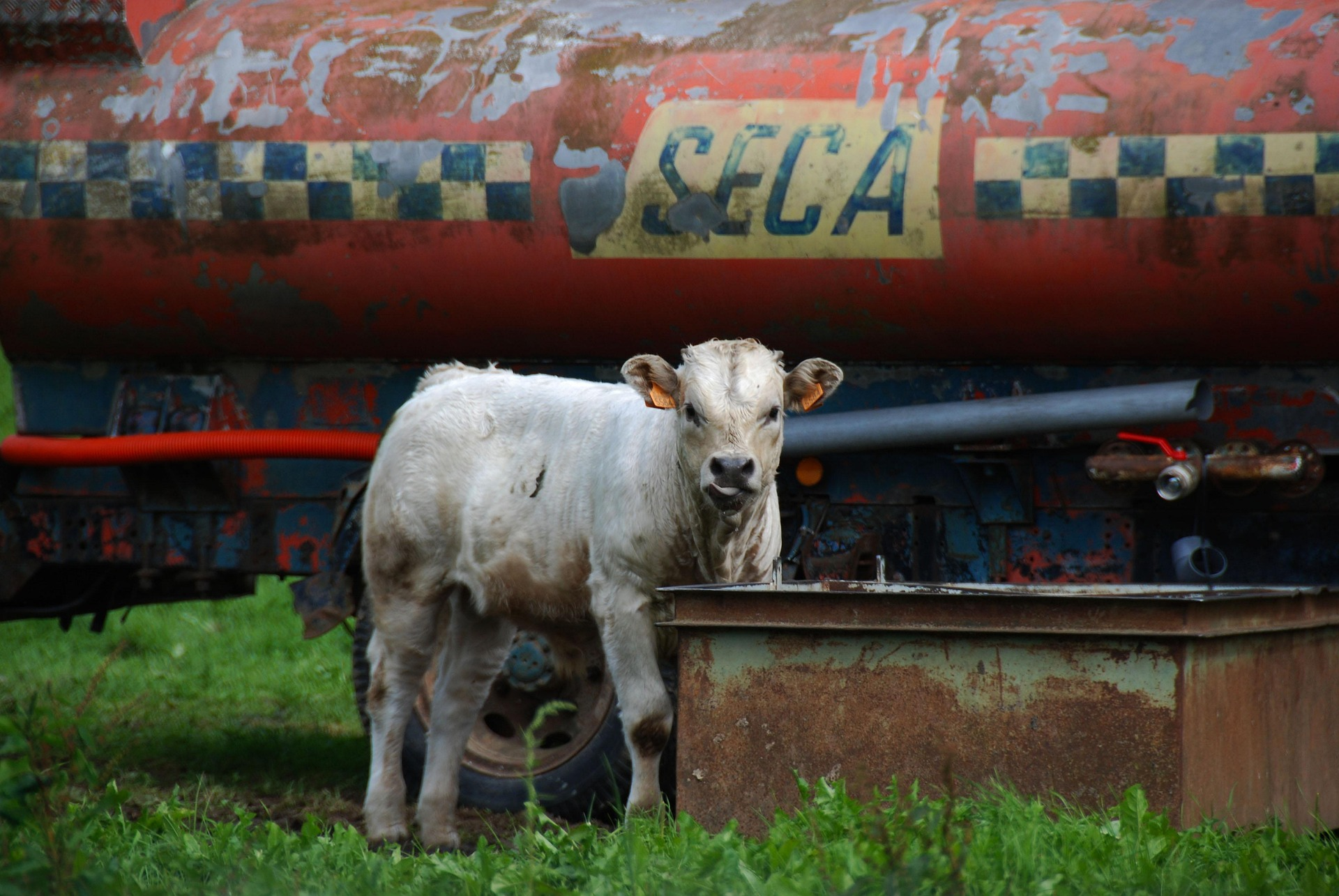
Animals need water they can reach every day below freezing, and the failure that stops them drinking is often not ice. It is a few volts of stray current in a heated tank, or a heater that quietly came unplugged. Check the tank once a day, by hand, with a thermometer if you have one.
University of Minnesota Extension tells the story of a farmer who found a waterer element disconnected, likely by heifers playing with it, and a bad float too. South Dakota State says to check for electrical shorts because current shocks cattle as they drink and lowers intake. NDSU says to check fountains daily in severe cold.
How much they drink in winter
For beef cows, the published winter numbers run from about 6 to 10 gallons a day for a 1,000-pound animal. NDSU and Georgia both reprint the 2016 National Research Council table: a 900-pound pregnant cow drinks about 6.7 gallons at 40°F. Missouri says about 10 gallons at 40°F. Nebraska and South Dakota State use a rule of thumb of 1 gallon per 100 pounds in cold weather.
West Virginia University manages to print both in one fact sheet. Its prose says 1 gallon per 100 pounds in winter, which is 10 gallons for a 1,000-pound cow. Its own table gives 6. The table is measured intake from the NRC. The prose is a design rule with no source behind it. For sizing a tank or a hauling schedule, use the larger figure.
Horses run the other way. NDSU’s table puts a mature idle horse at 11.1 gallons a day at -4°F and 8.2 at 68°F. Minnesota gives the reason. Summer pasture is 60 to 80 percent water, and dry hay is under 15 percent, so a horse on hay has to drink more. “They need less water in winter” is wrong for a horse on dry feed.
Does warm water matter?
It raises intake. USDA’s Agricultural Research Service ran a three-winter study at Miles City, Montana, giving pregnant cows water at about 47°F or 88°F. Cows on warm water drank more. The same USDA page reports the gain as 32 percent in one summary and 30 percent in the abstract below it. Either way, it is a real effect.
But warm water had no effect on cow weight, body condition or calf birth weight. The authors concluded that heat from digestion is enough to warm snow, cold water and forage to body temperature. So tempering water helps cows drink more. It does not, on this evidence, put condition on them.
For horses the case is stronger. Minnesota says research on ponies found daily intake rose about 40 percent when winter water was above freezing. UConn puts it at 41 percent and credits a different study. Two land-grant sources disagree on the number and the paper, but they agree on the direction.
The “ideal” temperature is less settled than it sounds. West Virginia, Minnesota and Auburn say animals prefer 40 to 65°F. Minnesota’s horse page says 45 to 65°F. Georgia says 40 to 77°F, and Oregon State says at least 37°F. Missouri tells you to set a heater thermostat at 32 to 34°F, just above ice. None of them cites a measurement for its range. Agriculture and Agri-Food Canada says temperature has “only a slight effect” on drinking. Keeping water open is the job. Warming it is a bonus, mostly for horses.
Stray voltage is the hidden problem
Wisconsin’s agriculture department collected the research on dairy cattle. At 3 volts on a water bowl, heifers drank 20 percent less. Six volts cut it by 68 percent. At 4 volts, one heifer and one cow refused water for 36 hours, and at 5 to 6 volts some cows did not drink at all.
The regulatory level of concern is lower, at 1 volt across a 500-ohm resistor. That is a trigger for testing, not a damage level. Wisconsin says under 3 percent of cows are expected to sense 1 volt. And a water meter will not find it: the same document says a meter is not useful for detecting low contact current.
What to do is simple. Iowa State says to run submersible heaters off a grounded three-wire supply and add a GFCI, including for heated buckets. Ohio State says a GFCI cuts power in about 1/40th of a second. If an animal hesitates at the tank, test before you blame the cold. Every threshold above comes from cattle, and no acceptable source found one for goats, sheep or horses.
Heaters, cords and fire
South Dakota State gives the most practical rules. Plastic tanks need a wire guard around the element. A floating heater belongs in a tank that refills on its own. And a dry tank with a heater in it is a fire risk, so check the level daily. The same fact sheet says extension cords should not be used inside a barn, citing the NFPA barn safety checklist.
If a cord has to run outside the barn, the Consumer Product Safety Commission says to use one marked for outdoor use and at least 16 gauge. CPSC’s 1990 release put extension cords behind about 4,600 home fires a year. No agency publishes a fire count for tank heaters.
Cost is real but not huge. University of Wyoming Extension figures a 1,500-watt tank heater running nonstop at about $4 a day, or $120 a month, at Wyoming home rates. Missouri’s energy program looked at waterer upgrades on 57 farms. Installed cost averaged $1,677, savings averaged $278 a year, and payback averaged six years.
Energy-free waterers use ground heat and insulation. Iowa State says they work in most Iowa conditions “but not in the worst ones.” NRCS adds a rule many people miss: an energy-free fountain must be the primary water source for the pasture, because steady drinking is what keeps it from freezing. Turnover does the same for an open tank. Missouri says big tire tanks stay nearly freeze-proof when animals drink from them often. No acceptable source publishes a rule that a bigger tank freezes slower, or that a floating ball keeps a hole open.
Can they live on snow?
Sometimes, for some animals. Saskatchewan reports that Alberta studies found beef cows eating snow showed no loss of production. Utah State reports snow-only cows eating 30 to 40 pounds a day, with no difference in weight, body fat or calf weight. USDA’s Montana work found metabolism covers the cost of warming snow.
Oregon State Extension says the opposite. Its page states animals cannot meet their needs from snow and that eating it lowers body temperature. It gives no source. NDSU calls snow an emergency option only, and South Dakota State says it cannot be relied on.
The research has limits, and they settle most of the fight. Utah State says cows at body condition 3 or below should not rely on snow alone, and some take four or five days to learn to eat it. Four inches of snow gives about half an inch of water. Saskatchewan limits it to cattle and sheep before lactation, and says a horse may need 6 to 10 times as much snow as water. So snow can carry a dry cow in good flesh through a short outage. A nursing cow, a thin one or a horse needs open water every day.
If the water line feeding the tank is the weak point, the fixes are in keeping water lines from freezing. For goats, water intake by class is covered in what goats need before winter.
Sources
- USDA Agricultural Research Service, Water Temperature Impacts Water Consumption by Range Cattle in Winter (2016)
- North Dakota State University, Livestock Water Requirements (2026)
- NDSU Extension, Winter Management of the Beef Cow Herd (2022)
- University of Georgia Cooperative Extension, Maintaining a Clean Water Trough for Cattle (2022)
- West Virginia University Extension, Winter Watering for Livestock (undated)
- University of Missouri Extension, Pumps and Watering Systems for Managed Beef Grazing (undated)
- University of Missouri Extension, E3A: Energy Management for Farm and Ranch: Energy Efficiency and Farm Water Systems (2014)
- University of Nebraska–Lincoln, Water Requirements for Beef Cattle (2020)
- South Dakota State University Extension, Icebreakers: Winter Water Supply (2024)
- South Dakota State University Extension, Electrical Safety in the Barn (2024)
- University of Minnesota Extension, Are Your Livestock Ready for Winter? (undated)
- University of Minnesota Extension, Caring for Your Horse in the Winter (2022)
- University of Connecticut Extension, Enjoying the Winter with Your Horse (2022)
- Auburn University, Alabama Cooperative Extension System, Drinking Water for Livestock (2022)
- Oregon State University Extension Service, Winter Livestock Management (undated)
- Agriculture and Agri-Food Canada, Livestock Water Quality: A Field Guide for Cattle, Horses, Poultry and Swine (2009)
- Wisconsin Department of Agriculture, Trade and Consumer Protection, Stray Voltage and Water for Dairy Cattle: A Veterinarian’s Perspective (undated)
- Iowa State University Extension and Outreach, Protecting Water From Freezing (undated)
- Ohio State University Extension, Grounding and GFCI Protection (2015)
- U.S. Consumer Product Safety Commission, Limit Extension Cords to Reduce Risk of Fire (1990)
- U.S. Consumer Product Safety Commission, Household Extension Cords Can Cause Fires (undated)
- University of Wyoming Extension, DIY Solar Thermal Stock Tank Prototype (2016)
- USDA Natural Resources Conservation Service, Conservation Practice Standard: Watering Facility (Code 614) (2021)
- Utah State University Extension, Can Cows Eat Snow To Meet Water Requirements (undated)
- Government of Saskatchewan, Snow as a Water Source (undated)
Leave a Reply