
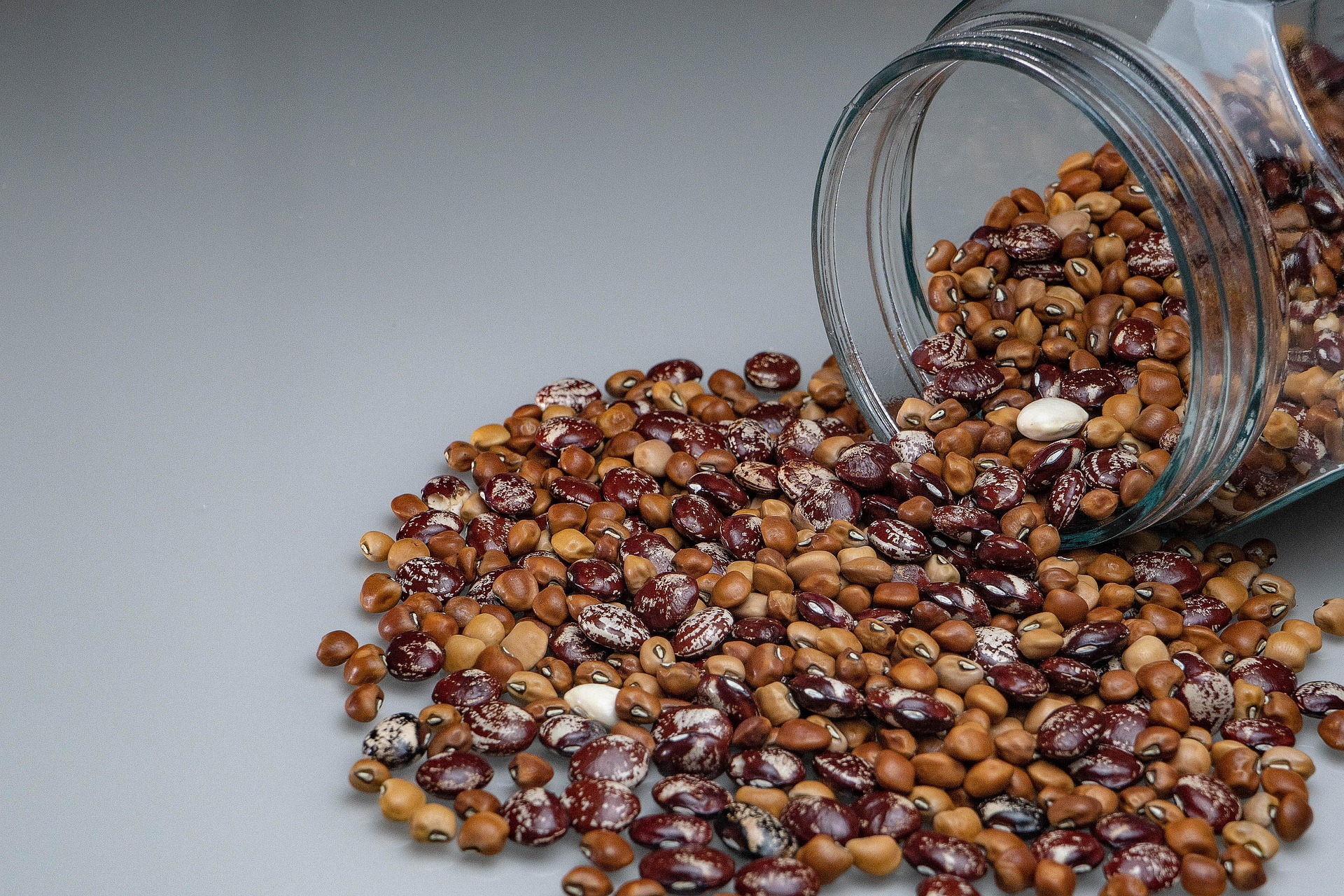
Dried beans get 75 minutes in a pressure canner for pints and 90 for quarts. That is 11 pounds on a dial gauge below 2,000 feet. The figure comes from USDA Agriculture Information Bulletin 539, which the National Center for Home Food Preservation reprints. Hot pack only. Almost everything that goes wrong with home-canned beans goes wrong before the jars reach the canner, so the rest of this covers the steps nobody times.
Dry beans in a jar have no process time
The shortcut going around is to tip dry beans into a jar, add water, and let the canner cook them. No tested process covers that. NCHFP says it has found no research establishing a process time for dry-packed beans. It calls the practice a big risk on food spoilage and possibly botulism food poisoning. The people who have done it, in NCHFP’s words, have been lucky.
The reason is heat movement. Dry beans sitting in water do not heat at the same rate as beans that were boiled first. So the sterilizing value reached at minute 75 is not the same value. Penn State does not hedge. Do not can dry beans without adding liquid, and no research shows that dry beans plus water in the canner is safe. NCHFP also lists food packed without covering liquid as a cause of under-processing.
Soak 12 to 18 hours, and watch where your figure came from
USDA gives two soaks. Cover the sorted beans with water and soak 12 to 18 hours. Or cover them with boiling water, boil two minutes, then stand one hour. Both routes end at the same 75 and 90 minutes, so the long soak buys no process time.
Here is the trap. NDSU’s bean publication gives a traditional soak of eight hours or overnight, and a hot soak standing four to 24 hours. Those are cookery numbers. They aim at tenderness, gas and folate retention rather than at canning. A bean that has not fully rehydrated takes up liquid inside the jar during processing, which NCHFP names as a cause of liquid loss. It also heats differently from the bean the process was timed on. Carrying NDSU’s eight hours into a canning recipe turns good cooking advice into a short process. Use 12 to 18 hours.
Where to put the pot has quietly changed too. USDA, NCHFP and Clemson all say a cool place, wording written when a cellar was the assumed venue. Oregon State’s 2024 bulletin and Penn State’s 2025 page both say the refrigerator instead. Neither one contradicts the older text. They are tightening a vague instruction, because a 12-hour soak in a warm kitchen can ferment. NDSU independently names fermentation as a soak risk.
The 30-minute boil is not optional
After either soak, drain, cover with fresh water, and boil 30 minutes before filling jars. Clemson is blunt about the soak itself: do not can dried beans without soaking. The boil matters for a second reason that has nothing to do with heat penetration. FDA names phytohaemagglutinin, a lectin concentrated in red kidney beans. Soaking at least five hours and then boiling in fresh water for at least 30 minutes removes and destroys it. That is why Penn State rules out slow cookers for rehydrating canning beans. They never get hot enough to break the lectin down.
How full is too full, and the only published number
USDA’s instruction for plain beans is one step. Fill hot jars with beans and cooking water, leaving one inch of headspace. No percentage. Starchy legumes expand rather than shrink during processing, and NCHFP lists overpacked jars among the causes of siphoning. But it gives no figure anywhere for how full is too full. Not one. Its own blog post on this exact question gives none either.
Oregon State is the only source that puts a number on it. EM 9435 has you fill with bean solids and hot liquid to two inches of headspace first, then top with liquid to one inch. It applies the same logic to the sauce version. There it equates USDA’s three-quarters full with two inches of headspace, a translation USDA never makes. That is not an authoritative figure. It is the only actionable one, and it errs in the conservative direction.
Check the altitude table you are reading
USDA publishes four dial-gauge bands. They run 11 pounds to 2,000 feet, 12 pounds to 4,000, 13 pounds to 6,000 and 14 pounds to 8,000. Weighted gauges take 10 pounds to 1,000 feet and 15 above.
Clemson’s legume page publishes only the first two bands. The strings for 4,001 feet, 13 pounds and 14 pounds do not appear on it anywhere. Geography probably explains it. South Carolina’s highest point is about 3,560 feet, and the page cites a 2006 source rather than the 2015 USDA revision. For a reader at 5,000 or 7,000 feet that omission is a live hazard, because the obvious default is to keep using 12 pounds. Work from the USDA table.
One publication, two waiting times
Once the canner has returned to zero, remove the weight, wait 10 minutes, then unfasten the lid. NCHFP publishes that figure. Oregon State’s EM 9435 repeats it three times in its own instructions.
The same document then prints a bean soup recipe saying to remove the lid after five minutes. The footnote repeats five. Oregon State licensed that recipe from a commercial canning book and credits it in the bulletin, but never harmonised it with the procedure on the pages above. Use 10 minutes. The wider lesson is worth more than the five minutes. A reprinted recipe inside an extension document is not necessarily carrying extension’s own process.
That soup recipe differs in a way that matters more. It calls for 75 and 90 minutes at one inch of headspace. USDA’s generic soup process calls for 60 and 75 minutes, with jars filled only halfway with solids. Both are tested, for different packs. Mixing the numbers is the error, and running 60 minutes on a jar packed like a dense bean soup under-processes it. To check your gauge before any of this, see testing and using a pressure canner.
Where the tested processes stop
No tested process covers refried, mashed or pureed beans. Clemson’s reasoning is heat again. A dense puree blocks heat from reaching the whole jar and leaves a cold spot in the centre where Clostridium botulinum may survive. Can cubes and mash at the table, or freeze.
Chili con carne is published for pints only, at 75 minutes. No quart process exists. USDA’s mixed vegetable recipe permits substitutions except for dried beans among others, so beans are excluded from it outright. Nothing gets thickened. No noodles, rice, flour, cream or milk go in before processing, for the same heat-transfer reason that drives the stock and broth rules. Half-gallon jars are out too, because Penn State says they are too large to allow adequate heat transfer to the centre.
Salt is flavouring here and nothing else. Half a teaspoon per pint, a teaspoon per quart, if you want it. Leaving it out changes no process time, and nothing in any tested process gives salt a preservative job.
Sources
- NCHFP, Beans or Peas, Shelled, Dried, All Varieties
- USDA, Complete Guide to Home Canning, Guide 4 (2015)
- NCHFP, Canning Dry Beans: It Matters How They Go in the Jar (2020)
- Penn State Extension, Dried Beans Versus Fresh Shelled Beans (2025)
- Clemson Cooperative Extension, Dry or Can Those Legumes (2018)
- Oregon State University Extension, Preserving Dry Beans, EM 9435
- NCHFP, Using Pressure Canners
- NCHFP, Ensuring Safe Canned Foods
- NCHFP, Causes and Possible Solutions for Problems With Canned Food
- NCHFP, Soups
- NCHFP, Chili con Carne
- NCHFP, Equipment and Methods Not Recommended
- NDSU Extension, All About Beans, FN1643 (2024)
- Clemson Extension Savannah Valley District, Canning Mashed or Pureed Vegetables (2025)
- Penn State Extension, Canning Jars and Lids: An Update (2025)
- Colorado State University Extension, Cooking With Dry Beans and Other Pulses
- FDA, Natural Toxins in Food
Leave a Reply